Due to his prodigious size (6-foot-7, 239 pounds) and enormous power potential, and maybe even some of the slow-boil nature of his development path, White Sox prospect George Wolkow has often received comparisons to Aaron Judge.
They're probably not the most helpful given that he's 20 years old and still in High-A with a .236/.329/.438 batting line and a 32.7 percent strikeout rate on the year. But the seal has already been broken, so what about putting another wild name beside Wolkow?
"I was thinking I'd come in, you know, on a Tuesday, get my work in, and then go out to the game like regular," Wolkow said. "And [hitting coordinator] Sherman [Johnson] is like, 'Hey, dude, how about you take a couple swings like [Shohei] Ohtani?"
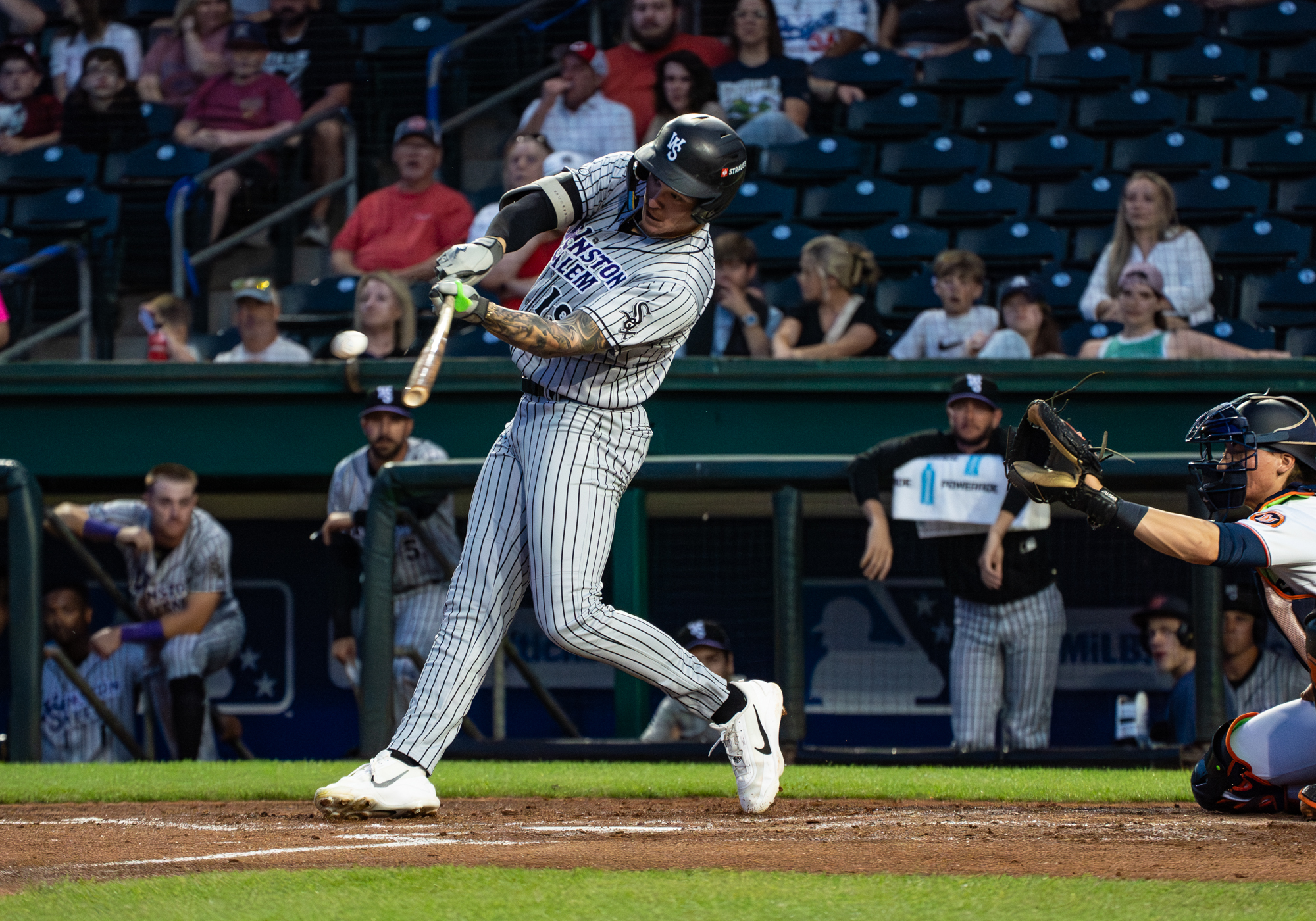
Of course, this is less a projection, but more an exploration of whether the setup of a similarly large-framed left-handed slugger who has dealt his own swing-and-miss issues might help Wolkow better access his top-of-the-scale raw pop. It's also coincided with him hitting .333/.403/.652 with a 26.9 percent strikeout rate in 19 games since May 12, with Tuesday night's go-ahead two-run blast serving as his fourth home run in this stretch.
Check out the lower half just as much as the hands.
"I'm shortening up my swing a little bit, getting myself in just a more consistent, repeatable pattern, and by widening up my feet a lot and covering more ground in the box, it might look like a big change, but to me it feels just way simpler and way easier," Wolkow said. "My misses or errors would always be the front foot landing a little bit late, and the front shoulder opening up a little bit too early. So being able to widen out, eliminate some of the stride, get my hands in a position where they're closer to launch, and have less of a negative movement backwards, work a little more positive, it got me in a place where I feel like I'm on time for all fastballs, and I have length and direction through to adjusting some of the breaking balls."
Shortening the swing path is almost always a target for Wolkow because of his size, contact issues and that power is never something he's lacking. He finds himself using the team's weighted bat training more as a means of building contact skill by challenging himself to stay consistent with his skill across different environments, because in terms of bat speed, "I'm already an outlier on the charts."
But the comment about giving himself more length to adjust to breaking balls is reminiscent of a recent tweak by a different Japanese slugger than Ohtani. Earlier this season, when Munetaka Murakami was struggling to do damage on breaking balls, the White Sox worked on lengthening out his leg kick, both to sync it up more evenly with his longer hand path his swing has, and to give him space to keep his weight back and adjust when he recognized offspeed.
Wolkow is using more of a toe tap, but both he and Sox hitting development see similarly in how each slugger is trying to give themselves more space to keep their weight back.
"Honestly I think some of the errors I was making were a lot like Mune," Wolkow said. "I pick up breaking balls well out the hand; I see them fine. With the little leg kick I was doing, I was landing too soon and I didn't have the adjustability to slow myself down enough to hit those breaking balls. If you were to break down the video and look at it super slow, my path is right on the ball. It looks like I'm about to just hammer it, but I'm releasing my barrel a couple frames too early.
"That was a byproduct of the leg lift landing just a little bit too early and the front shoulder opening a little bit too early, and by the time I'm trying to hit the changeup, my bat's pointed a little bit toward second base, first base than the shortstop and I'm out in front on it. If I widen out a little bit and allowing my path to enter a little bit deeper and extend through the ball a little bit longer, with a little bit better direction, I've been able to be ready for the fastball. It's the quickest [pitch] shape and I'm always going to have to hit those, but it's making a little bit easier on some of these breaking ball counts... I've been able to stay in my legs a little bit longer and use the ground to give me enough time."
A HOME RUN by @gwolkow19 to put El Humo in the lead! @AtriumHealthWFB pic.twitter.com/HW3v7hNB7f
— Winston-Salem Dash (@WSDashBaseball) June 3, 2026
If you can believe it after that walkthrough, Wolkow says his favorite part about his recent stretch is how much he's been able to "dumb it down" and focus on swing decisions, rather than his mechanics. His favorite part of the new hitting development infrastructure is how much time is spent facing difficult pitch shapes, since even at his young age, he's grown weary of gawking over big bat speed or exit velocities. Wolkow wants to have good at-bats, and everything else fades into the background in time.
"I'd catch myself a lot of times being in a two-strike count and landing and swinging the bat at 80 miles an hour, and it's like, that's sick bat speed, but if you don't run into the ball, you're just wasting it," Wolkow said. "This is the first spring training where we had multiple machines set up in cages with multiple different pitch shapes. We had cage with five or six coaches set up with different shapes that we'd see. There's guys swinging and missing, and guys fouling it off. If you guys were to go stand outside the cages and watch the guys work, you'd be like, "Dang, these hitters suck.' It's not pretty for sure. But with that type of work, when you step in the game, that's when it makes it feel easier."
At this point in his third full professional season, Wolkow has built up a level of acceptance with thing not looking pretty, with ugly stretches full of strikeouts being part of his journey. He has a complicated relationship with the Judge comparisons, where he knows they are unreasonable at this time, but ultimately aren't overselling his own personal ambitions.
In the scope of his place among White Sox prospects at large, he's a low-probability, high-ceiling long shot. But on his own terms, there's a massive ceiling here that it's his career mission to unlock. The new setup in his swing feels like an important step, but still one of many.
"I've always been one to want to compare myself to others, just trying to be the best at everything, and I think in pro ball that sometimes could be a little bit of a trap," Wolkow said. "I do have those ambitions, and it is fueling and motivating, but it's not always going to be pretty. There's the 0-for-19 weeks, and then going and hitting .600 for a week and getting Player the Week, the game has crazy ups and downs. So, if I could just focus on, one day at a time, one pitch at a time, the rest of it's going to take care of itself."