New White Sox hitting coordinator Sherman Johnson played pro baseball for a decade, but his major league career consisted of a single 2018 September call-up with the Angels, which was more than enough time to provide lessons that would inform his coaching career.
On a getaway day in Houston, veteran starter Charlie Morton left after a single inning and gave way to rookie left-hander Framber Valdez, for whom Johnson was entirely unprepared.
"He was throwing me backdoor sinkers at 96 mph, and James, I'm not going to lie to you, it's the only at-bat I've ever had in my life where I did not know where the sinker needed to start for me to swing," Johnson recalled in a recent phone interview. "You can go look up my at-bats against Framber Valdez in a big leagues. You will see him throw me a backdoor sinker and see him punch me out and I just kind of sit there like 'I cannot believe that got the corner.' I had no shot.
"I never want hitters that come through the Chicago White Sox to feel that way in the box. So they're going to see all the shapes, they're going to see all the different speeds, and we're going to build solutions for how they move, and what they need to combat."
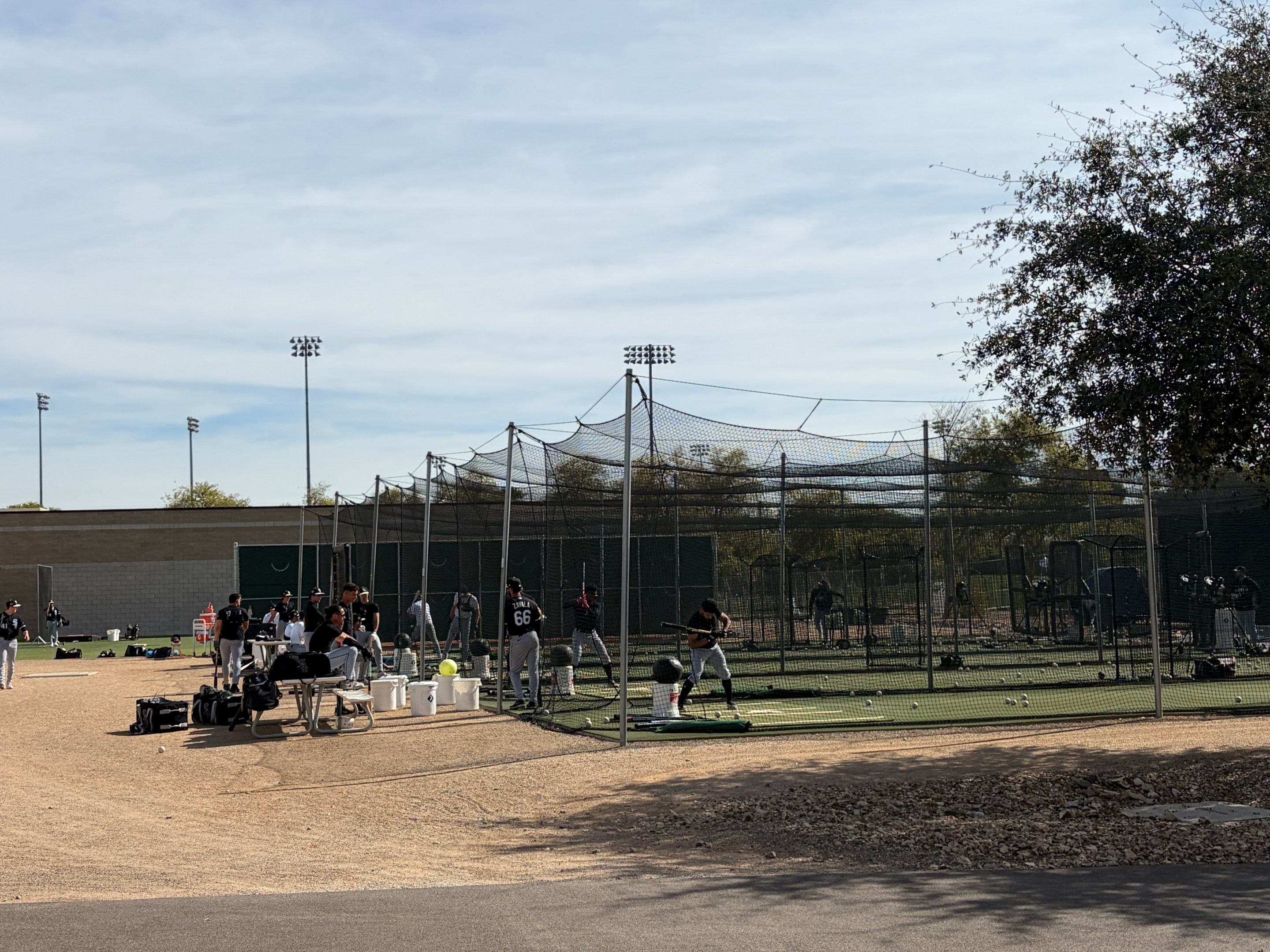
Assembled seemingly in response to that moment, the cages full of White Sox minor league hitters in the header photo are segregated by pitch shape. Johnson refers to this, the second half of practice in the batting cage after hitters have completed their personalized slate of daily routines and drills, as "geometry class." When geometry begins, hitters are asked to spam reps against a machine recreation of pitch shapes they'll see that night, or just see eventually; an oddly horizontal left-handed slider, a super-verty right-handed four-seamer, all the many possibilities the game of baseball offers.
Johnson says they've been effective finding pockets of time for minor leaguers to use the Trajekt machine during spring, even though the major league roster and a project like Munetaka Murakami getting acquainted with MLB pitching takes priority. And another measure of organizational uniformity the Sox will have this season, beyond HitTrax at all the affiliates, is with individualized pregame scouting formats that are supposed to newly mirror the big league version in quality throughout the organization, including three keys at the top of the report for each hitter to remember in the box, even if no other piece of information sticks.
"We've talked about this internally, even a certain degree with our major league guys, but definitely on our side, one thing we've noticed is just better quality of at-bats early in spring," said farm director Paul Janish. "We just seem to have guys that are diagnosing pitches a little bit earlier than than what you feel like they typically do in the spring training environment."
Johnson obviously has worked with (and worked well with) hitting director Ryan Fuller during their two overlapping years with the Orioles. It was Fuller who first pitched him on coming over to run the Sox hitting operation through the minors, and who playfully enjoined Sox Machine to talk to Johnson about how he's going about it.
But Johnson points out that his actual job interview involved him talking to Janish, Chris Getz, Josh Barfield, and Will Venable, all on the same day, and that talking to that group is ultimately what closed the deal. Part of their alignment was about the need to expose hitters to what major league pitches look like at game speed and movement level, and to do it often and in different ways. Since the Trajekt ultimately doesn't travel to the affiliates, Johnson has to sell the youth on the necessity of the purpose behind more low-fi methods, and why so much of the breezy work of smashing flips has been replaced by machine reps of 88 mph sliders.
"The other day when he had a live BP against Hagen Smith, and [second round pick Jaden Fauske] struck out, and it was OK, we were walking back to the backfield after and he was kind of wide-eyed," Sherman recalled. "He was just like, 'Man, like, I've never seen anything like that,' And I said, 'Jaden, that's perfect. The next time you see that. I don't want that to be the reaction. I want you to be like, 'Wow, that's some really good stuff. But I built a solution to combat that.' And he was like, 'I understand why we train the way we train now, because that was crazy.' And I was like, 'Yes, that was crazy, but you have to remember, Hagen Smith is not playing the big leagues yet.'"
Johnson was still playing through the end of the 2022 season, and jumped right into coaching the following year as the Orioles' Double-A hitting coach, before shifting to be their "upper level" hitting coordinator the following year, and spending this past season as an assistant major league hitting coach. As a result, his last few years have been spent helping hitters navigate the gulf between the high minors and the majors, which Johnson argues is larger than ever, and working with players new to pro ball is a fresh challenge.
What he tries to enjoy is the larger strides he can see young players make when exposed to new information, or new feedback for the first time. For a player like Anthony DePino, beloved by the org's analysts for his hard contact but already on an especially individualized drill program because too much of it is on the ground, the feedback he gets from reps with overweighted balls that exaggerate the imperfections in the angle at which he strikes the ball, is pretty immediate. A heavy ball that is topped goes straight into the ground, clipped contact that might normally make a loud sound before dying short of the warning track now spins impotently in the air before swan-diving.
For projects that take more buy-in, like Johnson's disdain for flips and tee work, the latter of which he diplomatically refers to as merely "better than you sitting on the couch," but exemplify low difficulty reps that don't resemble game environments, this is where he wields his big league experience.
"It's like, 'Hey Billy [Carlson], this is why we want some of these movements to change, and it might not be that hard for you right now in in rookie ball or Low-A or High-A, but if we make some of these changes now, you don't have to worry about it when you're in the big leagues," Johnson said. "There's some perspective that I can bring when you know a Billy Carlson says, 'Well, what do the elites do? How did they train?' And I can be like, 'I know this is how Gunnar Henderson trained. This is how Jackson Holiday trained.' And when he hears that, he's just like, 'Oh, cool. Let's do it.'"
The ubiquitous black medicine balls on top of a bucket positioned behind the plate in every batting cage came with Fuller last year, a physical representation of the heart of the strike zone, where every pitch should be fired on. The rack of connected baseballs laid in front of the plate, meant to provide a visual reference point to compare the width of a baseball to the width of the strike zone is new, but quickly becomes part of the scenery. Drills with short bats, meant to challenge hitters to move and bend their bodies to the baseball, and long bats, meant to require efficient turns to get the bat head out to meet the ball in front, have also long been features of hitting instruction.
Where Johnson is cutting against the grain more is his insistence upon "darts," a term for practice reps where the coach throws overhand, mimicking a pitcher's delivery, with all the touchstones of their release angle and wrist position having an effect that must be factored in. It can and is often used for exercises that he admits might look weird at first blush, like throwing from a steep angle to challenge hitters who swing down on the ball to much to keep their contact in the air, or throwing from an extreme side angle to train a hitter against over-rotating.
But hitters typically use soft tosses or tee reps as a way to simplify things, slow their swing down and focus on specific elements or moves. Johnson wants to preserve that work, but with darts, just to have it synced up to the same practice of tracking a ball out of an overhand delivery. After all, darts can always be thrown slower or made less difficult, but the larger goal is to provide more challenging work to make development happen faster.
"Some guys are like, 'Sherm, I've always done this,' and that's okay if you've always done this, but you've never been in the big leagues, and I've seen what it looks like on both sides -- player and coach -- and I would love for you to go play there for a long time," Johnson said. "As soon as you get into pro ball, it's the urgency. Because next year, there's a draft class coming. Next year, Chris Getz and the front office, they might just go get a free agent. You never know, so you need to get better. There needs to be some urgency. You need to understand: This is going to take time for me to get better, but I need to attack this."
Johnson reels of anecdotes on how the likes of DePino, Caleb Bonemer and Kyle Lodise have quickly embraced this emphasis on accelerating the developmental timeline. But at the risk of making a transition with a cheesy pun, the element that stood out when Fuller first called attention to the changes in White Sox hitting practice was the prevalence of color-coded Driveline-branded training bats, aimed specifically at boosting bat speed.
"It's pretty much since performance camp, every other day they've been swinging the green, red and blue bats," Johnson explains. "Two of those are overload bats; one of them is a handle load, one of those is a barrel load, and then the blue bat is an under load. They're swinging those in threes. It's three swings at the red bat, three swings with the green bat, three swings with the blue bat. Most people would think it's invasive. It's not, especially when these guys get used to it.
"A lot of these guys just want to swing it now all the time, but we're doing that every other day. It's just in their drill work. Some of them like to use the under load bat on some of the machines that we do, especially the [lighter] foam balls, which is great, but it's just getting these guys to move in a way that they need to in the game."
The broader idea, beyond just swinging heavier bats will build up speed in the long-run, is to build out hitters' comfort with attacking a diversity of pitch shapes, with different versions of their swing to account for different counts and game situations, to prepare them for all the chaos that modern pitch design has in store by the time the game starts. While the Sox clearly no longer abide by a traditionalist fear that this sort of experimentation will radically alter swing mechanics for the worse, that's also what the guardrails they've put in place for usage are meant to address.
"Everybody's talking about [Sam] Antonacci right now with the bat speed gains that he's made, and seems like he's hitting the ball harder,' Johnson said. "William Bergolla [Jr.] is another guy that, so far, the early numbers suggest that he's hitting the ball harder and he's swinging the bat faster, which is a good thing, right?
"Bryce Turang did this last year, and you see the jump that he had. Bat speed is important. I don't think it's a bad thing. I think it's a really good thing. We're definitely trying to do a little bit more damage as an org this year, and it's been encouraging. Just the way guys have a taken to the program, they kind of crave the program. Now, guys are trying to swing it every day, which we can't do, but it's been encouraging."
Johnson can be forthright about the principles the Sox are chasing -- imagine being on the receiving end of the 'you've always done it this way, but you've never been in the big leagues' zinger -- which is part and parcel with installing a new program. But the other side of his memory of striking out against Valdez that day is being a rookie too sheepish to speak up in hitters meetings, even when he felt he had observations to contribute. The flood of different drills and exercises and major league-style reports at an early stage is aimed at priming Sox hitters to already have a concept of what they'll be asked to look for when they arrive in Chicago, how to address it, and eventually coming up with their own ideas of what works.
"When they get to the big leagues," Johnson said, "The biggest compliment I could hear from from Sho [Derek Shoman] and Joel [McKeithan] is, 'Hey man, these guys get up here and they're right; they know the plan, and it feels like we only have to tell them once. They're craving the information, and it's more of a conversation.'"