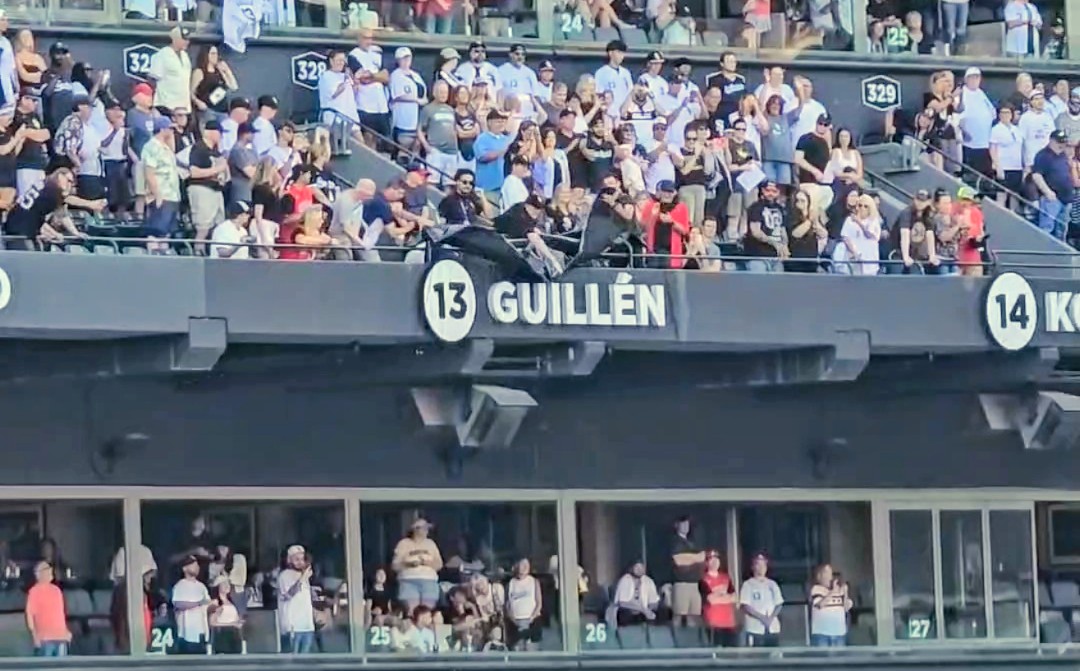
Besuited with the flag of his native Venezuela proudly displayed on his lapel, Ozzie Guillén walked hand-in-hand with his wife Ibis into Rate Field's conference and learning center for a media availability about the greatest honor of his career.
Immediately, he cracked a joke.
"A lot of bad things happen in this room."
It killed. When Ozzie Guillén is around people who understand the White Sox, he always has a hold on his audience. He is probably the only man in the world who could get a Sox crowd to applaud Jerry Reinsdorf, as he did during his number retirement ceremony speech, and of the people who would try to attempt it, the only one who knows he would need to forcefully prod the fans into compliance.
"The White Sox organization, in their life, they don’t have a better manager than me to give you guys quotes," Guillén added.
Sometimes it seems like that carries as much weight than his professional resume.
Lightly covered these days in discussing his legacy is that Guillén played 13 seasons in a White Sox uniform, made three All-Star teams, won a Rookie of the Year award as well as a Gold Glove, and was an everyday regular throughout one of the competitive stretches of the franchise's history. Now, it largely provides historical framing to his collection of amusing Terry Bevington anecdotes.
"It was Tony Phillips who told the manager, 'If you fall asleep, you will be the manager of the year,'" Guillén said, flipping his managerial origin story from a typical tale of learning under the greats, to simply transcending the cronyism that produced countless mediocrities across the sport. "I know I wasn't a bad manager because I played with bad ones. I compete against bad ones, terrible. They have a job because they're friends with the general manager, or they talk very good. But when I was playing, I say, 'Oh my God, this guy is managing?' It's no doubt -- I told my wife, I said -- 'I will manage.'"
Not only did he manage, arguably no manager in a White Sox uniform has ever had as much success. Guillén delivered the only post-Deadball era championship in franchise history, he never helmed a last-place team, and Tony La Russa was the only other Sox skipper to make the playoffs multiple times. Sure, Fielder Jones and Kid Gleason would be able to make similar claims if they managed during the divisional era, but if Guillén's tenure took place in the current playoff format, he'd have helmed four playoff teams over a six-year span.
"I still believe that in terms of instincts for the game, [he's] one of the best I’ve been around, if not the best," said Chris Getz. "It’s really special."
Yet for the most part, on the day honoring the man's contributions to the franchise, no one spent all that much lingering upon Guillén's strategic brilliance, least of all the guest of honor.
"You're a good manager when you've got good players," Guillén quipped again. "You're not gonna win the Kentucky Derby with donkeys."
If he were merely the sum of his accomplishments, Guillén would be worth celebrating, but it's his overall presence in the White Sox universe that makes him essential. Which is ironic, because Guillén seemingly shouldn't be for everyone. He is often profane. His jokes can be pointed or even outright rude. The current state of baseball has pivoted into directions he doesn't care for, and he will share as much. He shares a lot, in spite of, or sometimes seemingly because it won't be received well.
"You hate me, I don't care," said Guillén, at the tail-end of an answer detailing his approach to managing. "I'm not coming here to make friends. I didn’t come to this country to make friends. I come to this country to have success."
Yet his resonance with his players and the White Sox universe at large rests upon his ability to shake out a balance from all his apparent contradictions. He would speak openly about his players' shortcomings, but earned praise for supporting them. In a managerial role predicated on communication, he garnered trust for simply not having a filter.
“Ozzie was the same person every day," A.J Pierzynski said while speaking at the dais during Saturday's pregame ceremony.
“You never ever struggled telling anybody what you thought," echoed Paul Konerko during his turn at the podium, with obvious appreciation.
Mark Buehrle recalled seeing the Marlins general manager and owner regularly going into the manager's office for postgame meetings during Guillén's tenure in Miami and thinking then that the partnership was doomed, and Guillén's comments on how much outside input managers have to deal with now would suggest he was correct. Yet rather than distance himself from the rest of the world as an expert who should never be questioned, Guillén's advocates portray his secret sauce as investing in people, and maximizing his players by caring for them.
"A huge, huge success for [2005] was getting everybody to trust each other and gelling together," said Buehrle, who recalled his kids regularly walking out of the Sox clubhouse after games with a paper Gatorade cup full of Swedish Fish produced by his manager. "He cared about baseball and performing well, but it was family first. [He'd always ask] 'How's the family doing? And are you doing OK?'"
The image the White Sox used across all their promotional material was that of Guillén lofting the World Series trophy above his head, when he was at the absolute zenith of his professional career and reputation, and he acknowledged that it was the moment that most clearly explains why his No. 13 was retired. Results are paramount in sports, and much of life, and in both his playing and managing career, Guillén got the sort of results at the outset that secure a lot of trust
"We love Chicago, I think we do a lot for Chicago and people respect him, and now to see his number [retired], we’re really proud," said Ibis Guillén, whom Ozzie praised for believing in him before he accomplished anything. "For him, it’s the first time a manager has had his number retired, so for us it’s a big thing, and our kids, my grandkids, will grow up with that. And that's very special for us."
More than having secured the recognition that he often stumped for, and his accomplishments deserve, Guillén spoke on Saturday at the ballpark where he always draws cheers, like a man who had sealed his familial bond with the franchise for eternity. Many years on the road and away from his family went into building the legacy, cachet, and seemingly endless supply of good anecdotes that Guillén has with the White Sox, and the tears that flowed on Saturday came most when he reflected on the idea that it will now be forever memorialized.
"Always in that conversation I hear my wife say, ‘Be patient, it will come, it will happen,'" Guillén said. "I'm going to look up and see the last name every day. To me, the biggest thrill when I see the number, the name out there is what it means to my grandkids to walk to this field and see that last name up there, that's the biggest thrill to me."