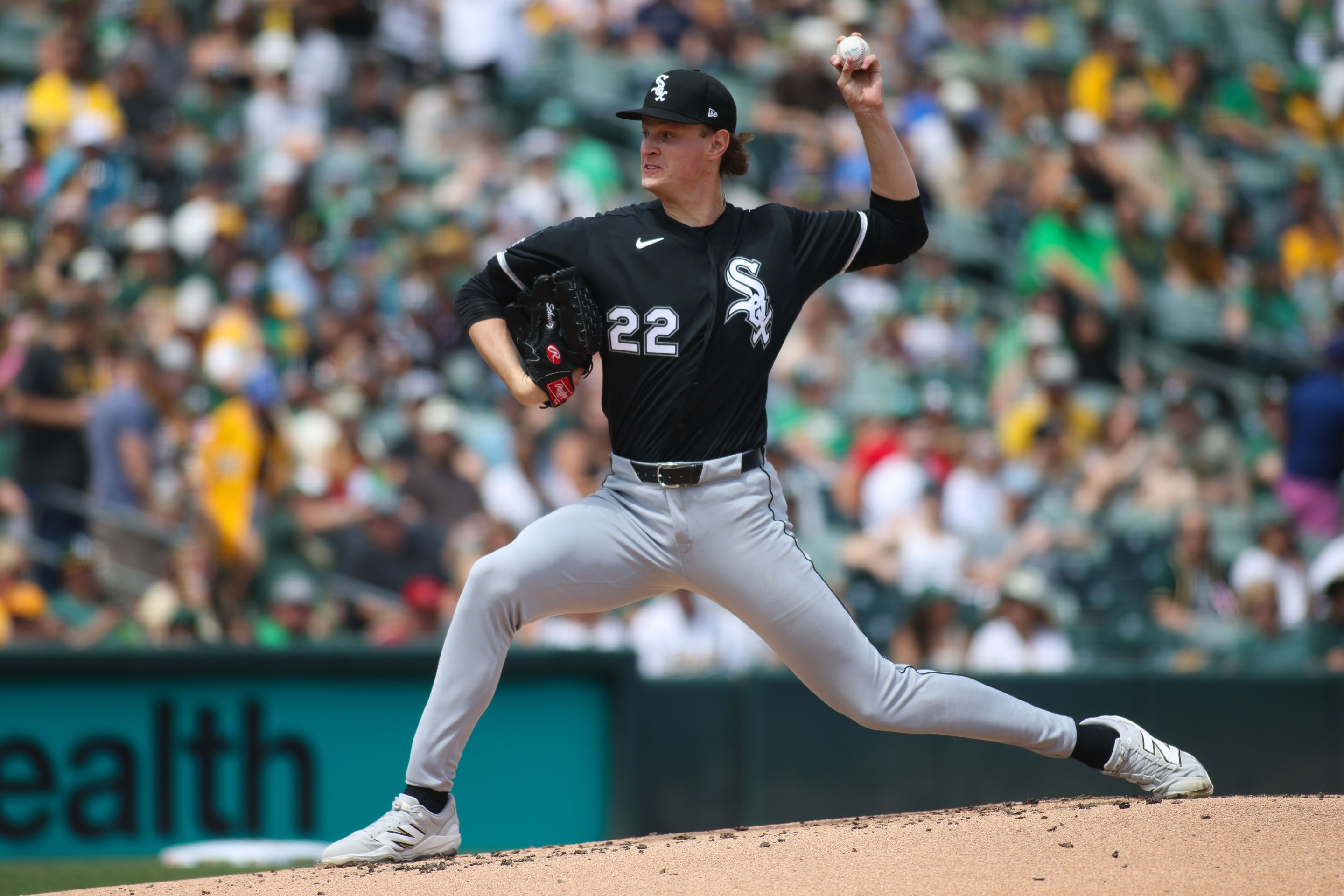
Based on what he'd shown in his first three starts in Triple-A this year, and the nervousness he both exhibited during and admitted after his mediocre MLB debut, the thinking here was that Noah Schultz's second start would provide a much stronger proof of concept with regards to his immediate viability in the big leagues, one way or another.
Perhaps the breadth of his arsenal would baffle hitters once he was able to throw strikes with everything. Perhaps he'd still suffer damage because his stuff plays a little too contact-oriented to overwhelm major league hitters. Or perhaps he'd still exude anxiety and struggle with control lapses that had been foreign to him at Charlotte earlier this month.
Schultz chose the most encouraging route in West Sacramento on Sunday, picking up his first career win with five innings of one-run, one-hit, one-walk ball against the Athletics in Sacramento on Sunday. In the process, he crossed nearly every item off his to-do list, including:
Calming down: In terms of stuff, all of Schultz's pitches operated within their normal velocity bands, and while his strike percentage was slightly lower his second time out, he only issued one walk, and it was somewhat considered (Nick Kurtz). The more consistent control led to more efficiency. He's thrown 82 pitches in each of his starts, but that covered five innings this time around, as opposed to four in his debut.
And while Schultz made no attempt to pretend he wasn't nervous the first time around, he said after Sunday's game that the butterflies were behind him.
“Learned a lot about myself, a lot of things. Calm myself down with nerves, and stuff like that, that hopefully are gone,” Schultz said after his teammates gave him the clubhouse beer shower that awaits any player who picks up his first MLB win.
Introducing the changeup: The Statcast data from his debut against the Rays initially said Schultz threw no changeups, but the revised data upped it to two. Schultz topped either number with three changeups over the course of his first seven pitches, getting a called strike and a swinging strike from Shea Langeliers in the same plate appearance.
It turned out to be an effective pitch all afternoon, getting more whiffs (three) than balls in play (two), both of which were oddly struck. He didn't always locate it perfectly, but it helped him with...
Having arm-side pitches to consider: Schultz survived against the Rays by throwing mostly fastballs and cutters in, because he was overcooking his softer stuff and not able to spot anything away from righties.
In Sacramento, Schultz was able to find the outside corner, especially the four-seamer. As a result, A's hitters had to protect against velocity both inside and outside.
Schultz had enough confidence in his four-seamer that he used it more than any other pitch, and by a clear margin:
- Four-seam: 30
- Sinker: 14
- Sweeper 14
- Changeup: 14
- Cutter: 10
And that's a considerable wrinkle in his scouting report considering he used it less than 10 percent of the time during his time in Charlotte last season.
The broader arsenal also makes it far less of a concern that Schultz hasn't demonstrated a feel for his slider yet. He generated just three swings on 14 pitches, but none of them were chases, and none of them were whiffs.
By run value, Statcast calls it the weakest pitch in his arsenal when it should be the strongest, and there are two ways you can look at it. It definitely leaves him more vulnerable to BABIP and defensive lapses, because if he's not getting swings and misses out of the zone with it, then he's probably going to underperform in terms of strikeouts.
But I'd seen Schultz starts from 2024 where he couldn't locate his slider out of the gate, and A-ball offenses could give him a hard time keying on his sinker and putting balls in play early in counts, and he had little recourse but to keep throwing it until the feeling came back. Here, he subdued a good major league offense in a hitter-friendly park, even though he effectively shelved his breaking ball the second time through the lineup. The other four pitches picked up the slack.
If he is able to flip the switch on the sweeper, then dominance potentially awaits. If its effectiveness is still hampered by the introduction of the cutter as was said to be the case last year, he'll still need a true chase offering to reach his potential. Yet Schultz has shown ways to get outs as he figures it out this time around.
More on Munetaka Murakami
By embarking on his second three-game homer streak of the season, Munetaka Murakami has resumed commanding the kind of national enthusiasm that has been in short supply on the South Side.
Over at MLB.com, David Adler pored over Murakami's Statcast data and put his batted-ball numbers in a leaguewide context. Murakami is the only hitter with two 114-mph homers this year, including the one off the 98-mph Elvis Alvarado fastball that he theoretically wasn't supposed to handle. He also advanced the Kyle Schwarber comp that Josh and James batted around on Monday's podcast.
Kathryn Xu also wrote about Murakami at Defector, which didn't command the "Blight Sox" tag. Instead, her reference to a Schwarber comp might be the reason for the post being filed under: "the chicago white sox currently have the same number of wins as the philadelphia phillies... much to consider."
Two White Sox prospects are Players of the Week
Indeed, no South Atlantic League position player could top Colby Shelton's production from the last week. As foreshadowed in Monday's Minor Keys, the Winston-Salem Dash third baseman earned Player of the Week honors by hitting .478/.571/1.043 against Asheville, even though the series wasn't played in Asheville.
But Shelton wasn't alone, as Braden Montgomery netted the Southern League's weekly honor by posting even gaudier numbers. He hit .600/.640/1.200 over six games against Rocket City, with a homer, two triples and five doubles. As Montgomery told James, he prides himself on his ability to process different things. If this keeps up, he may soon see a different level.