
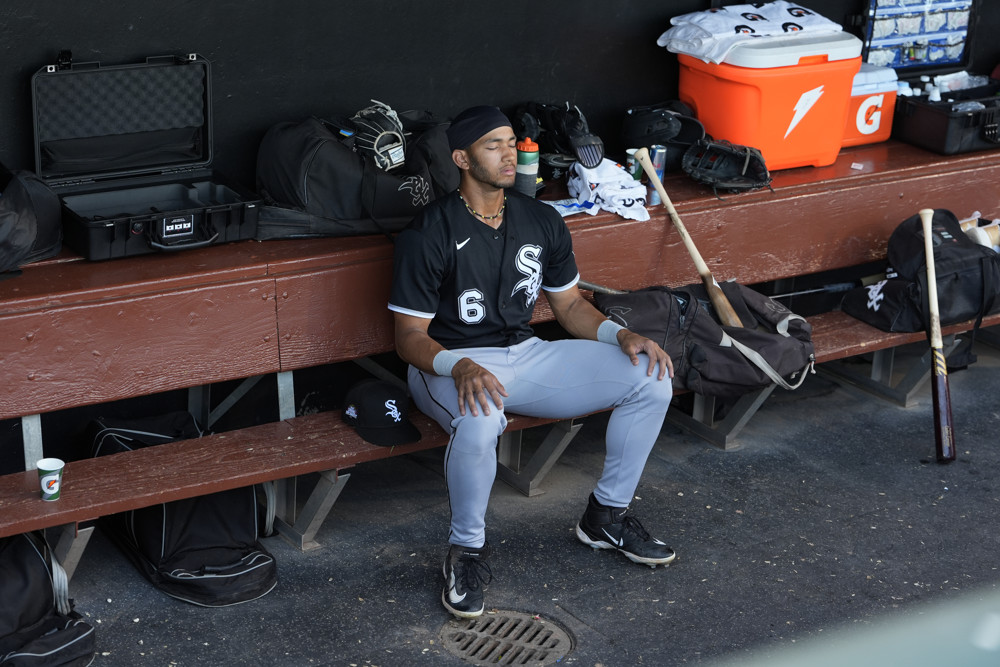
White Sox prospect outfielder Braden Montgomery is on the sort of heater that gets someone out of a return assignment to Double-A Birmingham in short order.
The newly 23-year-old switch-hitter is 12-for-21 over his last six games, with seven of those knocks going for extra bases and three leaving the yard entirely. It's also been a reasonable 23.1 percent strikeout in that span, if that even matters against this level of power production. Either way, it's good news for someone who values their time as much as Montgomery, who seems to prefer night games if only because it offers more time in the day to get prepared.
"What's working for me has been going into the day with a plan of how I'm going to move the needle forward from the previous day, going in and taking advantage of whatever training time have," Montgomery said by phone earlier this week. "It's limited, because we're at it each day. It's finding a way to maximize the short time we have to get some type of growth out of it."
Montgomery has ambitious goals and a maximalist approach to reaching them. He's a noted obsessive for the Trajekt machine, and failing that, machine reps that can replicate riding velocity or even nastier spin than he'll see in the Southern League. But that's just a single example that of a mentality that extends from the way he talks about wanting to see "different shapes, different velocities" in practice every day to how he thinks about managing his weight training regimen and sleep schedule.
So it can already be a little hard to pin him down on what he's working on, and then he goes and assures that it's intentionally that way.
"I want to be a winning baserunner, a winning outfielder, winning hitter, winning teammate each day," Montgomery said. "When things go wrong, the only way you know which this specific issue is by honing in on all of them. And so, yeah, I try to focus on on everything."
White Sox personnel were concerned about the ground ball orientation in Montgomery's left-handed swing in portions of spring, and his ability to switch between a flatter bat path for fastballs at the top of the zone versus scooping breakers toward the bottom. He's still at 47.1 percent ground balls for the year but is clearly on the upswing, what with all the balls going over the fence now, and thinks the issue was more about timing and contact point.
"I was never super worried about that," Montgomery said.
The more visible adjustment is that Montgomery has slightly but clearly opened his stance a tick from both sides of the plate. For someone known for being able to rotate and turn on inner half pitches super fast with tremendous forced, the tweak is aimed at forcing him to keep his front shoulder closed and allow him to stay on outer half offerings, driving them to the middle of the field.
"Really smart hitter who is able to see two swings side-by-side and understand the difference and make those adjustments," said hitting director Ryan Fuller. "It's really fun to see him hitting with power through center field. It's not cheating to the pull side, it's driving the baseball through the middle of the field."
The early results are obviously encouraging and befitting of someone whose physical tools might be the very best in the White Sox farm system. But if your goals are more oriented toward becoming a perennial All-Star for over a decade than just getting out of Birmingham, it's just a drop in the bucket.
"Every single day, each person is a little bit different, so I'm sure it's not going to be the end goal or the final touches I'll be making to my swing," Montgomery said. "It's just trial and error. You go down and implement of bunch of different things to see what will help sync up your movement patterns and your sequences. That seems to be something right now that's helped me; starting off open and then going into closed, that has helped promote staying closed."
Montgomery's production with the bat is the easiest way to measure his progress, because it's the most significant bellwether for where he can realize his star potential. A .333/.426/.688 (171 wRC+) line at Double-A suggests it's going pretty well and Charlotte won't be long now.
But the Sox have indicated there's meat on the bone for his baserunning and defense as well, both of which were targeted by pre-pitch movement work in spring that Will Venable himself oversaw in portions this spring, where he wound up dropping a description that Montgomery can vibe with.
"He’s just really cerebral guy, very detailed in how he goes about his work," Venable said. "Everything he does is with a purpose."
"That's a fair description, for sure," Montgomery said. "I've just always used my thought process to evaluate things, to get myself through things. Being emotional just isn't as repeatable. The more I can think through things, rationalize them, the more I understand them and the easier it will be to repeat."
There was a sub-70 percent contact rate for Montgomery at Birmingham last year (and at 68.9 percent, still is so far this season too), but with his production there, the Arizona Fall League and in big league camp this spring, it wasn't a given he'd need to return to the Southern League.
Farm director Paul Janish said Montgomery "definitely is going to be in the right frame of mind," and both the results and his installation of a helpful tweak would seem to prove him right. But those who work with Montgomery know he burns to reach the majors and measure his work and improvement against the highest level of competition, since a fractured ankle in his junior year kept him from potentially topping a 2024 draft class that has seen nine other first-round picks debut already.
Fixating on that might offer an emotional boost, but not a sustainable one. Instead, Montgomery tries to focus on just taking as much time as possible to make things as hard on himself as any opposing pitcher can be. The sort of streak he's on ends in either an adjustment from opposing pitchers, or a promotion to a harder league, and he wants to be ready for either.
"Preparation is everything; the more you can see it before you actually have to see it in the game, the better off you'll be," Montgomery said. "If you just do underhand flips the whole time, then you're not seeing everything you're going to be seeing in the game and sometimes it will surprise you.
"I don't like to be that way."