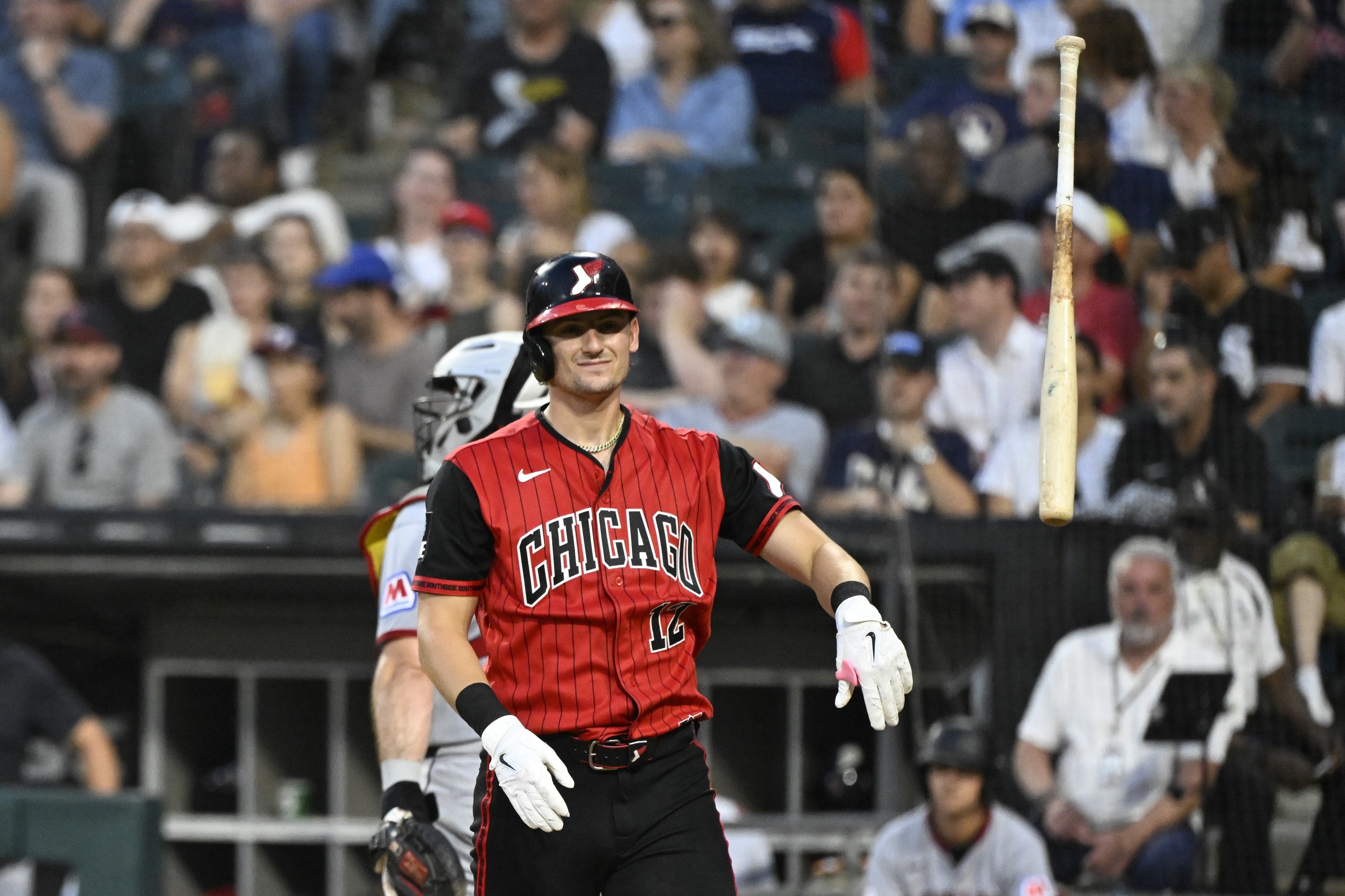
A couple weeks ago on the Sox Machine Podcast, I offered the idea that Colson Montgomery hasn't quite been right since missing a few games for a back injury in the first half of June, which Josh helpfully clipped.
On today's @SoxMachine Podcast, we explored the issues Colson Montgomery is having vs. RHP this season.
— Josh Nelson - Sox Machine (@soxmachine_josh) August 11, 2026
Jim Margalus may have found a line of demarcation when Montgomery tweaked his back in early June.
Presented by @AnkinLaw @FoulTerritoryTV pic.twitter.com/j4hcAsSCSr
As a writer, podcast clips always make me a little uneasy. If I'm wrong in text form, I have nobody to blame but myself, because I controlled the entire dialogue in my head, had enough time to investigate inclinations, delete sentences and rearrange paragraphs until I considered a point suitable for public consumption. If I'm wrong in podcast form, perhaps it's indeed because I thought wrong. But there's also the chance that I'm pivoting on the fly off something Josh said, and the excerpt doesn't quite distinguish reacting from full reasoning when I'm just trying to fulfill my duties of holding up half of a conversation.
Outside of a five-game resurgence capped by his game-tying homer against the Mets on Friday, Montgomery has continued to struggle, in a highly visible fashion, and without any real provided explanation. That leaves room for spitballing to take hold, and with my best guess circulating as something approximating a tangible explanation, I may as well try to convert it to something more concrete.
⚙️⚙️⚙️
Here's where I offer the disclaimer that I am decidedly Not A Scout. Also, I typically pause when offering injuries as a reason for struggles when the primary parties aren't willing to cede it, whether because it's a cop-out or just strangely invasive. But over the years of watching Montgomery matriculate through the minor leagues and cut an unusual form as a starting shortstop at the major league level, it's apparent when he's able to create action, and when something is gumming up the works.
I'm thinking back to Montgomery's first season at Triple-A in 2024. It wasn't the season where he missed time for back and oblique issues, nor was it the one that started so abysmally that the White Sox sent him to Arizona. This was the season in between, which caused a lower level of alarm by being consistently flat. I watched him for a second-half series in Nashville and my takeaway was "What can he drive?" Then I turned to Statcast, which showed a very limited hot zone for good contact, when lesser prospects could cover a wider area.
Montgomery was able to fall back on his plate discipline and at least draw some walks to preserve his OBP that season, but there was nothing dynamic about his presence. When he fell apart at the start of 2025 to trigger the Arizona reset, the extent of the struggles were severe and surprising, but maybe they had to be in order to appropriately confront them.
Watching Montgomery the last couple months brings that 2024 form to mind, albeit with a few differences. He's a more aggressive hitter than he was during his prospect days, and he's facing tougher pitching, and the combination is making it difficult to rein in his chasing.
But also unlike 2024, Montgomery actually looked like his best self for the first two-plus months, which is what draws my attention to that brief absence in early June. You can kinda work backwards from the results alone and call it a day:
| Span | G | PA | BA | OBP | SLG | BB% | K% |
|---|---|---|---|---|---|---|---|
| Before | 64 | 270 | .225 | .322 | .479 | 9.3 | 30.7 |
| After | 60 | 253 | .197 | .253 | .373 | 6.8 | 37.5 |
But given that Montgomery runs hot and cold even during the times when he's built a legit All-Star case, it runs the risk of being too reductive. It's more about the feel of his plate appearances, and those have grown worse over the course of the last month.
After his 0-for-4, three-K performance against the Rangers on Monday night, Montgomery has now struck out in 40 of 90 August plate appearances, and the last two strikeouts against Kumar Rocker demonstrated the increasingly frequent frustration with the viewing experience.
With the bases loaded in the third inning, Rocker tried to attack Montgomery up and out of the zone, but he left his first two fastballs thigh-high and over the outer half. Montgomery fouled them both off, as well as a rolling slider that was just off the plate. Rocker then executed a pitch at a desired location, and Montgomery swung over a buried slider for strike three.
The next time up, Rocker didn't even have to set up Montgomery. He simply threw three sliders below the zone, and Montgomery swung over all of them.
Two plate appearances, seven pitches, seven swings, four whiffs, nothing close to in play.
It's one thing for Montgomery to chase sliders below the zone, or fastballs above it, because those who watch the White Sox are accustomed to seeing aggressive hitters expand the zone without a pitcher compelling it. It's another thing to miss mistakes multiple times in the same plate appearance, and that has me mulling over the same question we batted around in 2024 -- except given the skyrocketing nature of his strikeouts, it's less "What can he drive?" and more "What can he put in play?"
And when you compare the pitch maps that resulted in batted balls in play on before and after the back-related absence, you once again see that zone shrink. Here's before:
And after:
The 100-percent version of Montgomery is far from a perfect hitter, but it's one who combats the holes in his swing by hunting zones and attacking earlier in counts, giving him more chances to outthink a pitcher, or damage a mistake. He didn't necessarily need the GPS activated for the app to yield productive results; approximate location would get the job done.
The current iteration of Montgomery, just like the one in 2024, seems to lack any real pliability or responsiveness in his swing. Athleticism might be another way to put it, as it's one Montgomery emphasized over any specific swing changes from his Arizona sabbatical last year. You can look at that ghastly three-chase K and say it's mental, but I'm more inclined to think it's downstream of physical issues, whether we're talking about injury or merely the recurrence of bad habits that are difficult to correct without being taken out of circulation.
(Speaking of old tendencies, Statcast's bat tracking shows Montgomery's attack direction becoming way more pull-oriented since the absence in June, going from 7 degrees pull-side to 13 degrees.)
⚙️⚙️⚙️
Based on Will Venable's pregame comments Tuesday, it sounds like he's also considering it more of a corporeal concern.
"[Mental breaks are] something that's always on the table as a solution for guys. I just don't think that we're there yet with him, or that we're going to get there with him," Venable told reporters.
"First of all, he went through this really tough stretch and he had some really good swings on our last road trip. So I get the question and the bigger body of work maybe recently. But I think that right now he's in a good spot. [...] Just the other day I was complimenting Colson on the way that he's continued to carry himself, even when he's not feeling his best and feels like he's underperforming, and obviously coming short of the expectations that we all have for him. I thought he's handled it great and he's given me no expectations that he needs a mental break."
There are just a couple of problems with taking Venable at his word. A manager probably doesn't want to invoke the word "mental" unless both parties are on the same page, as Royals manager Matt Quatraro learned when Salvador Perez expressed displeasure at the phrase "mental breather" as the reason for leaving him out of the lineup in April. There's the whole mind-over-matter aspect with physical limitations, which is not exclusive to Montgomery, either. It's the same reason why Noah Schultz's knee wasn't identified as a culprit in his 2025 struggles until the team had to explain an IL stint, and why you don't learn about the severity of hockey injuries until after a team is eliminated from the Stanley Cup playoffs. Full disclosure would explain so much to the viewer, but it doesn't really help the guy who's gutting through it.
There also isn't a direct replacement at this time, an additional factor making it unwise to divulge a problem without a way to solve it. Luisangel Acuña has a .409 OPS in the second half, and while a Chase Meidroth-Sam Antonacci middle infield could probably get the job done, that moves the hole to left field.
Nevertheless, the situation continues to grow increasingly awkward. Venable has tried to mitigate the issue by sitting Montgomery a little more often, and batting him lower in the order, but the game will eventually find the guy with a 44-percent K-rate no matter where he's hitting.
This is why trading Jacob Gonzalez back in July made me uneasy, even though I understood the full benefits to the draft pool. He'd shown that he could help the White Sox weather Munetaka Murakami's injury, and were he currently producing in Charlotte, he'd be a logical choice for getting Montgomery off his feet. (Sure, Gonzalez has struggled as Pittsburgh's primary shortstop, so maybe that'd be another dead end, but I wouldn't consider that experience directly transferable.)
As it stands, if Montgomery can't course-correct in short order, perhaps Kyle Teel's return to an expanded roster offers the next chance at a real reconfiguration. In an ideal world, you probably wouldn't want a rusty Teel taking DH at-bats from Andrew Benintendi and Randal Grichuk, but if Montgomery continues striking out nearly half the time, perhaps you move Meidroth to short, Antonacci to second, and see if you can get away with Benintendi playing six innings of left field for a couple of games. None of these are enviable options, but in order to get to the postseason, the White Sox are going to have to dig deep, accepting the risk of rupturing a sewer line in a quest to find water.