The White Sox are 27-27 since the beginning of June.
That's mostly viewed as a victory, since the White Sox lost 102 games last season. But even within the prism of assessing them as a 2026 contender, that snapshot includes going from one game back in the AL Central to three games ahead, a lot of playing without Munetaka Murakami and a lot of playing through very difficult stretches of schedule; such as this current one against the Yankees, Rays, Red Sox and Guardians.
So far, fittingly, they're 4-5.
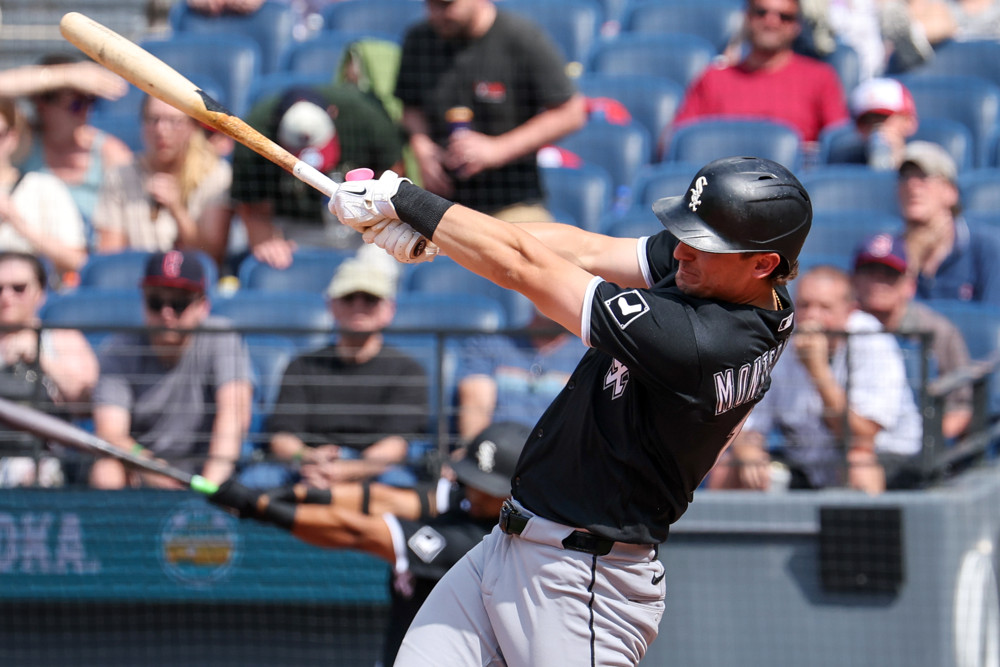
Another way to look at the White Sox leveling off since June is that it has correlated with the cooling off of Colson Montgomery, who has hit .190/.256/.386 in 49 games over than span, with a 36.2 percent strikeout rate, and a 7.7 percent walk rate. That's not a fair burden to put on any single player, let alone a 24-year-old in his first full major league season. But in both cases, it shouldn't be surprising that Montgomery, nor the White Sox themselves have fits and starts in their development.
Just like it's pretty impressive the Sox are already kinda good, and it's pretty impressive that Montgomery already looks like a ~3 WAR player, and logical to assume that the acclimation process one of the team's most promising young hitters is going through is similar to what the third-youngest position group in the sport is dealing with writ large.
"Colson just eclipsed his one-year mark of being a big leaguer, so to think that he should be perfect every day obviously isn't reality," said hitting director Ryan Fuller. "You look at his metrics underneath, and he'll be the first one to tell you it's not where we want it to be, but he's working at addressing it. So, like all these guys, it's problem-solving, and you let them know, 'You're struggling right now. That's part of the process. No big deal. Get back to work.' So, look forward to seeing him make adjustments."
Montgomery will slam his bat down after his strikeout, roll his eyes after a popup, but his on-field reactions are some distant relative of Liam Hendriks' approach of unleashing a blizzard of expletives after a poorly executed pitch. After the initial venting, you get fairly zen responses about his results in the clubhouse.
"You always have to be calibrating and adapting to the game, what the game is telling you," Montgomery said. "You have be aware of it."
Despite his understanding level, Montgomery's chase rate is up this season (30.5 percent to 32.5) and his contact rate is down (69.6 to 66.2). But rather than getting worse, his norms are still being established. Because, over one year in, the way he's being attacked by the league's pitchers is still evolving.
"You get pitched a certain way for so long, you think that's how they're going to attack you and you're aware of what they might try to do to you," Montgomery continued. "And then, like [Friday], I got pitched a totally different way of how I got pitched the past couple of weeks. Just one of those things you just have to be mindful of. You've got to be aware of the situation. That's where you can get into trouble is if you're not being aware, and you're just up there, and you're like, 'Why are they suddenly throwing down and in? Or why are they suddenly throwing up and in?'"
For answering these sorts of questions, Will Venable likes to boil down games to how each side executed and performed against fastballs. Montgomery is a left-handed power hitter with a naturally lofted swing, and exists in an age of baseball where every pitcher is supposed to develop at least one option for how to avoid it. That means he's hit 46 home runs in 179 career games and can pack a lot of production into a tight window, and will also hit valleys that have a consistent look.
"Each guy has a miss in their swing, there's a part of the zone that you're not going to be able to cover," Fuller said. "We see with Colson most of the time he's going to miss under fastballs."
"Not everyone has a ride fastball to where I might miss under it," Montgomery said. "I'm not gonna change how I swing just based on what the pitcher has, but at the same time, you have to pick one or the other. If he throws a four-seam and a sinker, two-seam, you can't try to cover both, right? Because you're not going to be able to. So you just kind of have to pick which one that you do the most damage on. So I think we know which one I probably do more damage on."
In case you don't, Montgomery is slugging .327 against four-seamers with a 35.7 percent miss rate, and is slugging .544 against sinkers with a 32.4 percent miss rate.
"It's so hard too, because you face guys like [Cam] Schlittler who has three different fastballs, or even Nick Martinez, he's got three different fastballs. It's just too much for you to try to think about and handle, and in the moment, you're not going to be getting ready to swing, 'Oh, it's the four-seam, better get on top of it,' or 'Oh, it's the sinker, I gotta get under it.' It's literally you just have to pick one, and it's usually the one that you feel like you can do the most damage on. That's how I go about it. Which one am I going to be able to do damage on? Because that's my game, do damage."
Even in acknowledging this eternal cat and mouse game, and Montgomery's ingrained predilection for launching sinkers into orbit (not coincidentally, he's slugged .629 against changeups this year too, which have a similar shape), there are micro-adjustments he can make to fight back against a stretch that sees him missing and popping up four-seamers more than is tenable. He wants to commit to sinkers when available, but when he's aware that pitchers are going to try to make him uncomfortable at the top of the zone with four-seamers, Montgomery wants to be willing to get uncomfortable in response.
"It's just about calibrating, and there are just things you can be mindful of," Montgomery said. "I'm not going to change my swing and swing down on the ball. It's more like I might try swinging just above the ball, think above the ball but you're not actually swinging above the baseball, you're just thinking that. I'm still going to have an [upward] swing of the ball, but not as much as it usually is."
"It's 'How do I make that swing adjustment where it's not a foul ball,' but the one where, when he's really rolling and his bat path is in a good spot, it's a hard line drive or a home run," Fuller said. "Colson will be the first one to tell you, 'I'm one swing away, I'm one adjustment away,' and what they're doing right now for the next two hours in the cage, he's going to be calibrating to make that adjustment."