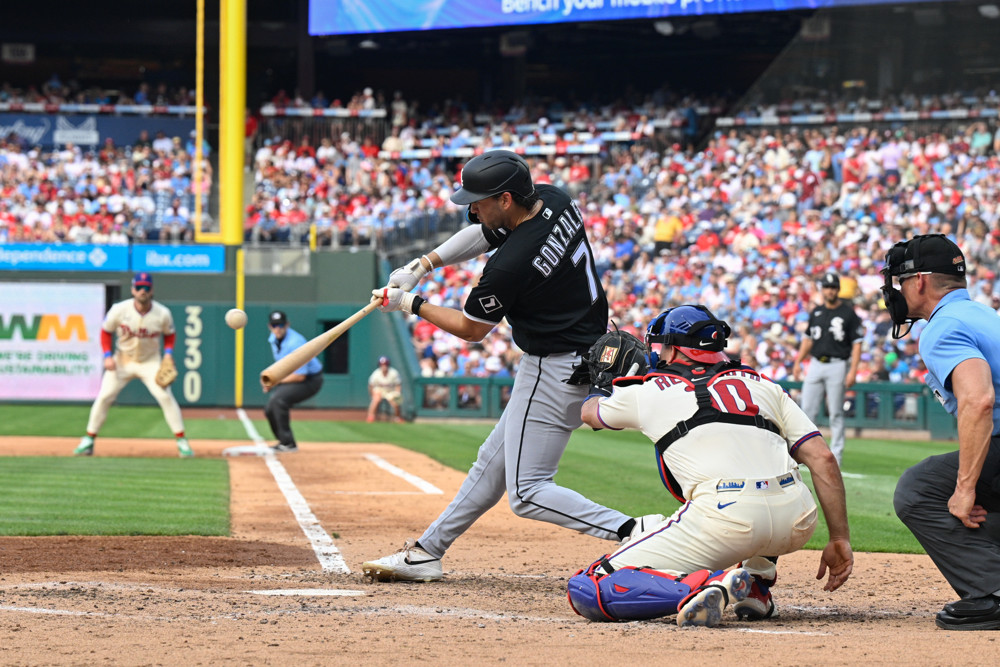
Please bow your heads for a moment of silence to commemorate the 14-minute period where the White Sox officially had more bats than spots.
After Jacob Gonzalez was optioned to Charlotte to clear a spot on the 26-man roster for Munetaka Murakami's return, the White Sox traded him to Pittsburgh along with Brandon Eisert for the 34th overall pick in the draft and Triple-A lefty reliever Jaden Woods.
The Pirates were able to flip the 34th pick because it's in a Competitive Balance Round. This one has a slot value of $2,897,400, the addition of which gives the White Sox the biggest pool in the draft at $20,489,500, or $21,513,975 when including the 5 percent overage the White Sox usually indulge. This gives them a pick in between their selections at No. 1 and No. 41, which happens to be Landon Thome's projected range.
But to the extent that a Gonzalez trade can be classified as "risky," these would be circumstances to facilitate that label.
Sure, Gonzalez was just about written off before he'd bashed his way back into the White Sox's plans, yet still found it hard to make a dent in the major league depth chart when everybody's healthy. That made him the most expendable of the White Sox with trade value, so it's not a surprise to see him dealt this month.
At the same time, Gonzalez had just proven capable of helping replace Murakami at first base for more than a month, rallying from an 0-for-28 slump to hit .351/.400/.541 in the 12 games before Murakami returned.
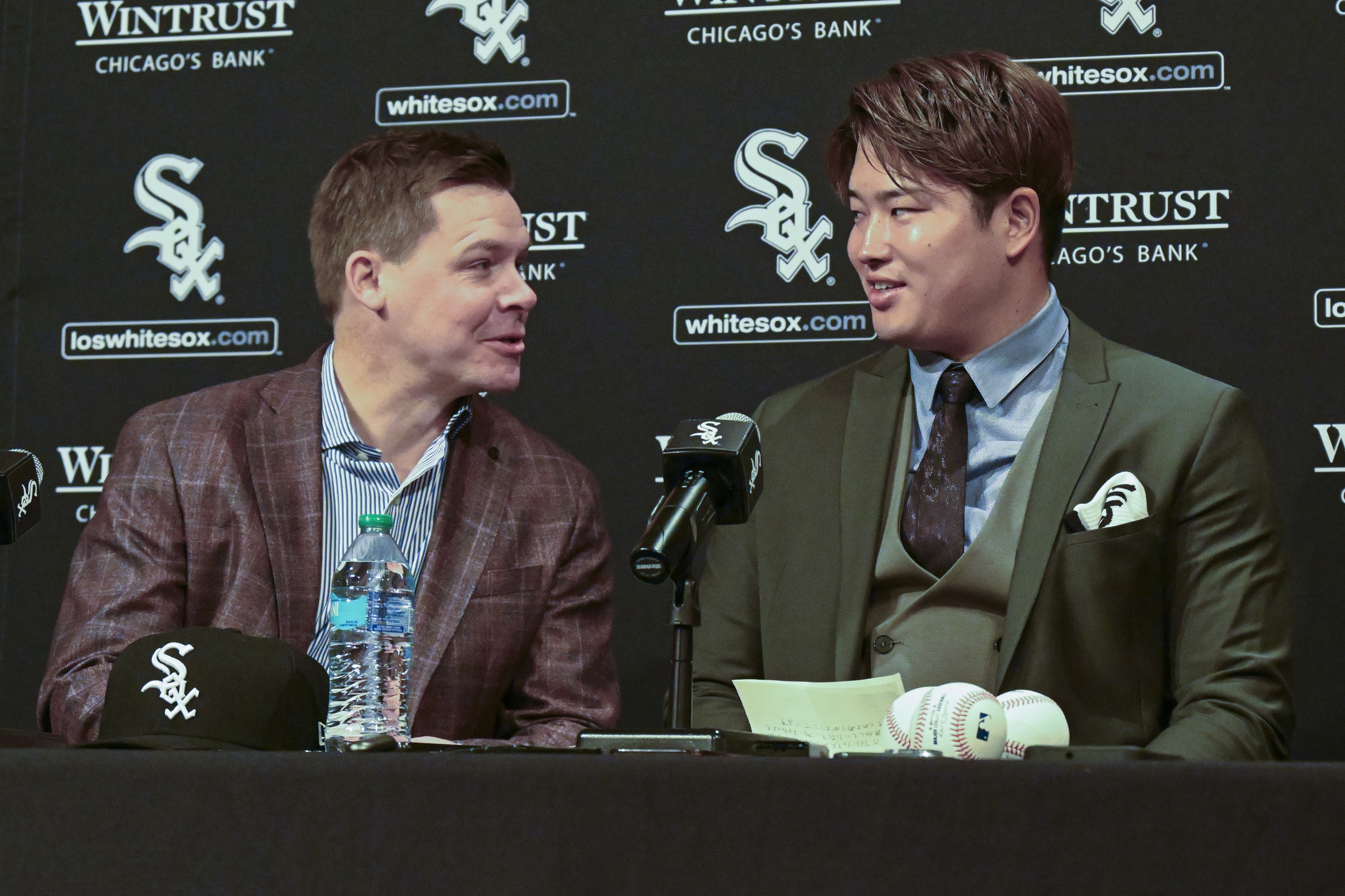
“While I was gone, the whole team was really being as one and carrying the team together, as well as Jacob Gonzalez replacing me at first base,” Murakami said via interpreter, in a postgame presser that began within minutes of the news breaking. “He was really successful during that time.”
Should the White Sox suffer another injury, there isn't a bat in Charlotte that inspires anything near the same level of confidence. Illustrating this point, when the White Sox needed a position player and Gonzalez was already on the roster, they had to resort to Junior Pérez. In fact, they're still resorting to him.
Gonzalez was removed from Charlotte's game at 6:54 p.m. CDT, shortly after the White Sox's 6:40 p.m. first pitch at Rate Field, so that's how long the White Sox's excess lasted. In the short term, they're flirting with undercutting their immediate depth. In the long run, should the White Sox use that pick on prep shortstop, it'd require considerable luck for a 34th-overall pick to turn out meaningfully better than Gonzalez in his present state.
And that's assuming there's a firm idea of what Gonzalez's present state actually is. The Pirates will be exploring it in ways the White Sox couldn't ...
The Pirates, meanwhile, plan to play Jacob Gonzalez at shortstop, filling in for Konnor Griffin, who is out with a torn tendon in his thumb. Gonzalez OPS'd nearly 1.100 in AAA and has more than held his own against big league pitching. Eisert joins a Pirates pen in need of help.
— Jeff Passan (@JeffPassan) July 11, 2026
... and if Gonzalez's production carries over to regular play up the middle, then the bar becomes even tougher for a new draft pick to clear.
The reliever part of the deal is similarly prioritizing future interests and chasing a higher ceiling, in the sense that Eisert can readily fill a spot in the front end of many bullpens in baseball, but Woods possesses a hard sinker/slider combo that is one tweak and one level away from being more reliable against lefties, and thus easier to deploy later in games.
Looking at it from the White Sox's side, the best way to overcome those odds is with volume, and were they still at least one year away from contending, the calculus wouldn't nearly be as complicated. It'd look something like:
more draft picks + the biggest draft pool = best possible chances at getting multiple impact players out of one draft
But in this particular season when the White Sox are tied for first place in the second half, there's an least one unknown variable that makes it hard to determine how much the subtraction of Gonzalez hampers their ability to weather any more misfortune they're forced to endure. Perhaps they'll replace him over a deal or two before the deadline to replace the layer of protection he represented. Perhaps Gonzalez is more of a depth infielder than a first-division starter, and he's marginal enough to make the shot worth taking regardless of how it turns out. Or perhaps regression really takes a toll on both the White Sox and Gonzalez in the second half, and Getz was correct not to chase mirages.
For the time being, though, it feels like the draft deadline compelled the White Sox to act, Gonzalez was found money that burned a hole in Chris Getz's pocket, and now we'll see how much he's exposed.