When looking back at the sorts of pitchers who have signed three-year contracts over the years, they can largely be grouped into pitchers you hope can keep it going, or pitchers who seemingly have more to offer than their top-line stats indicate.
Pitchers who sign for longer tend to have histories that explain such a commitment. Pitchers who sign shorter contracts have flags that can be easily gleaned from a quick look at a FanGraphs or Baseball Savant page.
Three years is murkier, at least when age isn't an obvious factor. You know why somebody like Chris Bassitt or Nathan Eovaldi signs a three-year deal, because they'll be much closer to 40 than 30 by the end of it. The three-year, $55 million contract Dallas Keuchel signed with the White Sox likewise attempted to strike a balance between a Cy Young past and concerns about a lurking decline.
When the pitcher is 29 like May, and when he signs a deal like the three-year, $52.5 million contract he's reportedly reached with the White Sox, it's a tacit acknowledgement of the fact that a pitcher hasn't quite achieved what teams think are possible, and the hope largely rests on there still being a window to peak. On one hand, you'd rather a team prioritize future contributions over past performance, which is hard to do in free agency, yet there tend to be reasons why past performances have underwhelmed.
It takes me back to Tyler Chatwood's free agency in 2017, because I remember looking at the list of free agents, seeing his age, stuff and commendable efforts to navigate Coors Field and thinking he could be a fit for a White Sox team that needed pitching, but wasn't in a position to pay a lot for it. But the market was equally excited by those characteristics, and the Cubs ended up paying him three years and $38 million, which was $8 million more than FanGraphs estimated on such a contract.
Those on the outside saw a lot of intrigue, but Chatwood's main flaw -- control -- followed him out of Colorado. He led the NL in walks over just 103 innings in his first year with the Cubs, which forced a shift to the bullpen, and while he was able to serve a purpose after the initial disaster, he never realized the perceived latent value.
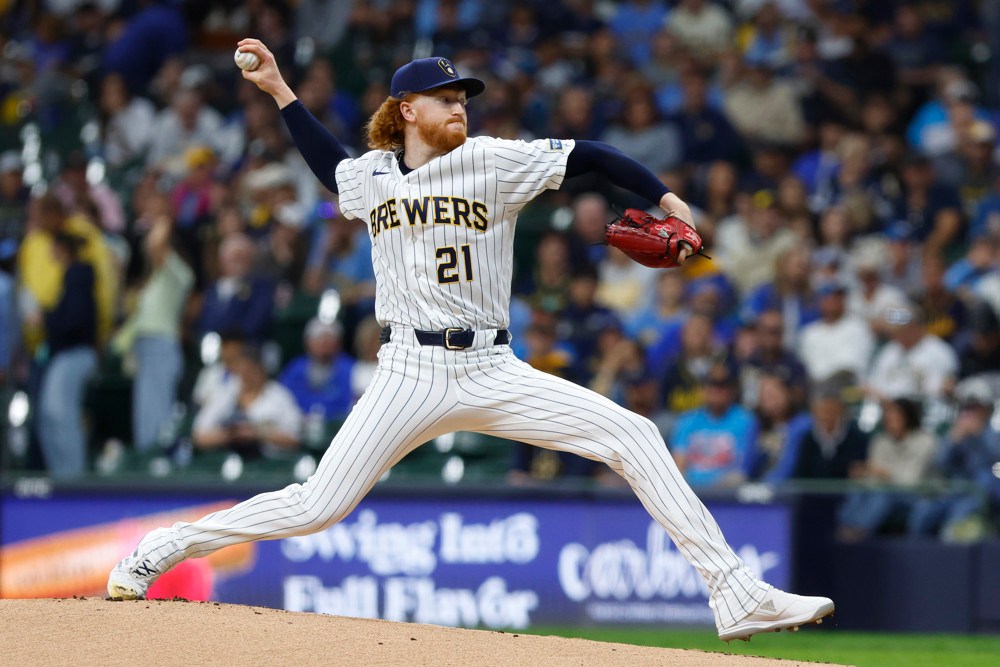
May isn't Chatwood because he throws more strikes, and that should allow him to maintain the floor of a feasible fourth or fifth starter over the duration of the contract if his body permits. But I also wouldn't expect the White Sox to be able to unlock meaningfully more production, because his chief vulnerability -- left-handed hitters -- is just as persistent. It's been an issue throughout his career, but let's just focus on his last two years, which are his two healthy, 100-inning seasons:
| Year | vs. RHB | vs. LHB |
|---|---|---|
| 2025 | .256/.325/.386 | .261/.357/.495 |
| 2026 | .239/.284/.368 | .269/.358/.397 |
There's good news there, in that he was better at limiting lefty damage. Cutting slugging by 100 points without cutting batting average is an accomplishment. Because he doesn't have a changeup or an over-the-top curveball to neutralize lefties, he raised his arm slot and shifted from a sweeper to a cutter as his primary weapon, and it seemed to help a little.
The bad news is that lefties still give him a hard time, which makes it hard to know how much he stands to benefit from mere regression. His ERA (4.70) was considerably higher than his FIP (3.63), mostly because he allowed a .350/.398/.513 line with runners in scoring position. That led to a terrible strand rate, and that tends to be something that evens out. However, in an increasingly left-handed league, it could also be the case that May just faces too many of lefties to make clean exits routine.
Between that and his rocky health history, it adds another uncertain starting pitcher to a White Sox pool that's loaded with them, which is why it's difficult to be enthusiastic about the signing in isolation. Now, if spring training rolls around and May is distinctly the second-best starting pitcher the White Sox sign this offseason, then it has my attention. For the time being, Sean Burke is still on his own tier when it comes to the likelihood of lots of useful innings, and the White Sox would be well-served to give him some company.