NASHVILLE — One of my goals to enhance Sox Machine’s coverage of the 2026 MLB Draft was getting more first-hand looks at top prospects. When the college baseball schedules are released, I always take a gander at Vanderbilt’s because we have our Jim Margalus stationed there. It so happened that this season LSU would be visiting to start SEC conference play. What a great opportunity to not only check out Derek Curiel, who was our third-ranked preseason prospect, but also watch two of the top college baseball programs in the country square off.
It was a valuable experience this past weekend. Visiting Vanderbilt provided some much-needed clarity to help re-rank Sox Machine’s top 2026 MLB Draft prospect list.
Fading Derek Curiel
I’ve now seen in-person our preseason top three prospects.
- Roch Cholowsky showed enough in Arlington against SEC teams to merit top ranking
- Grady Emerson, in my opinion, is still the top prep prospect in this draft class
- Derek Curiel’s leap forward is not coming to fruition
Curiel showed off impressive contact skills as a freshman. With added strength and a single-digit whiff rate in the strike zone, I figured that Curiel was poised for a 15-plus home run season. Playing for the defending champion LSU Tigers, who attract significant national attention, I believed his preseason ranking was ahead of the curve.
After watching Curiel in Nashville, I am confident he will not be in our Top 25, and perhaps not even the Top 40 — a significant drop for a draft-eligible sophomore. The decline is due to similarities with Brendan Summerhill, the Arizona outfielder selected 42nd overall by Tampa Bay last year.
Against Vanderbilt, Curiel went 4-for-12 with a double and a triple, scored six runs, and walked twice. While this was a solid series, his hitting profile remains limited. He continues to prioritize contact over power, and I question whether his current stance allows him to leverage his added strength.
The first thing I noticed in Curiel’s approach is his hand placement, positioned directly in front of his face and over home plate. His wide stance provides balance and allows quick hands to make contact. This stance is effective for a young player facing advanced pitching for the first time and focused on reaching base.
Now batting third in LSU’s lineup, Curiel lacks a true “A” swing. Most effective hitters drive off their back hip to engage the lower half, but Curiel only moves his hands back with minimal load. His body remains centered, and he generates only slight forward momentum when swinging. His swing is similar to Tristan Peters, currently in the White Sox system.
This approach leaves a lot to be desired, and so far, Curiel’s numbers are down across the board through 21 games. He’s hitting .329/.410/.463, or an .873 OPS. That’s a 117-point drop from where Curiel finished last season. Curiel only has one home run, along with six doubles and one triple. While this might be a 55-grade contact future value, I’m starting to think it’s a 40-grade power unless there’s a significant swing adjustment.
Defensively, Curiel is a reliable center fielder with good range and an average arm. At the professional level, he could remain in center field until a team acquires a more athletic option, at which point a move to left field is likely.
Preseason, I hoped Curiel would demonstrate 60-grade contact ability and, with added strength, reach 50-grade power while remaining in center field. Such a profile would warrant top-10 consideration. However, based on recent observations, he appears to be a fringe center fielder with strong contact skills but limited power potential.
While I remain hopeful Curiel will adjust his swing during the season, it is increasingly difficult to justify a first-round grade. Similar to Summerhill last year, Curiel may be available to the White Sox in the second round, a notable change from my expectations five weeks ago.
Boosting Jake Brown to first round grade
Although my interest in Curiel has declined, Jake Brown captured my attention even before his performance against Vanderbilt. After this weekend, Brown stands out as a player to watch.
Last season, Brown played 64 games with 46 starts, posting a .320/.407/.528 line, eight home runs, and 48 RBIs. Despite these strong numbers, preseason expectations varied. He was not included in Sox Machine’s Top 50, though I considered him a third-round talent, placing him in the top 100. MLB.com ranked him 54th, while Baseball America ranked him 136th.
After 21 games, Brown’s performance warrants a top-30 ranking in all MLB draft publications. LSU's Jay Johnson, an experienced coach of highly touted MLB prospects, has praised Brown’s development.
“He's a terrific athlete, one of those guys who has upside,” said Johnson after Friday's game. “The more he plays, the more he can develop. And I believe he will continue to do that. I mean, it's a special athletic talent. A competitor, great toughness, and a great work ethic. He’s all of the above.”
Before LSU’s midweek game against Grambling State on March 17, Brown had already exceeded last year's home run total. Through 21 games, he is batting .419/.495/.884 with 11 home runs and 37 RBsI. His walk and strikeout numbers are nearly equal (12 walks, 13 strikeouts), and he has adjusted his swing to produce more loft. In 2025, his groundball rate was 46.9 percent. Currently, it is 27.4 percent, with increased line-drive (23.3) and fly-ball (49.3) rates.
I observed Brown’s power firsthand last Friday. Against Vanderbilt starter Connor Fennell, he hit a 3-0, 82 MPH changeup 390 feet to left field. On Sunday, he drove a slider 455 feet to center for another home run. In the series, Brown went 5-for-11 with two home runs and nine RBIs.
JB Homer Counter: 1️⃣1️⃣@JakeBrown_14 | ESPN2 pic.twitter.com/kC9Q2fF1Tt
— LSU Baseball (@LSUbaseball) March 15, 2026
Reviewing his swing mechanics, Brown uses an open stance, stepping closer to the plate as he moves his hands from behind his head to his back shoulder. He does a better job of sitting into his back hip to engage the lower half and core than his teammate Curiel.
Brown currently plays right field and projects as a corner outfielder at the professional level. He reads the ball well, demonstrates athleticism on diving plays, and has a strong arm. LSU reporters have noted he does not cover as much ground as Curiel, so center field starts are unlikely this season.
With two-thirds of the season remaining, Brown’s performance places him among the top college outfielders, such as TCU’s Chase Brunson and Sawyer Strosnider, and Texas A&M’s Caden Sorrell. This positions him as a mid-to-late first-round pick, making it unlikely he will be available to the White Sox in the second round.
Braden Holcomb bashing his way to top-100 consideration
Vanderbilt outfielder Braden Holcomb appeared on my radar when MLB Network Radio host (and Sox Machine subscriber) Mike Ferrin texted me to check out the home run he just called in Las Vegas. With 30 mph winds blowing out, Holcomb tattooed a fastball 461 feet off the center field scoreboard with an exit velocity of 116 mph.
HOLC SMASH
— Vanderbilt Baseball (@VandyBoys) March 1, 2026
116mph, 461ft 🤯 pic.twitter.com/eui8r9ula6
Holcomb’s first two seasons at Vanderbilt were modest. He split time between first base and left field, posting consecutive sub-.900 OPS seasons without reaching double-digit home runs. Despite his 6-foot-5-inch, 240-pound frame, he struggled to generate the quality of contact needed to leverage his physical tools.
Last summer, Vanderbilt coach Tim Corbin hired Jason Esposito as an assistant coach. Esposito previously played for Corbin on the 2011 College World Series team and later served as an assistant hitting coach for the Cleveland Guardians after a brief minor league career.
With Esposito on staff, Vanderbilt hitters are adopting major league preparation methods, and Holcomb has been one of the primary beneficiaries.
“It's solely his approach”, said Corbin when asked what’s been the biggest change for Holcomb at the plate.
“He's doing a good job of staying off of tough pitches and getting better counts; using the middle of the field and not so prone to being pull heavy.”
In the two games I observed, Holcomb went 3-for-7 with four walks. He demonstrated his power by driving a 93 MPH fastball from LSU’s Casan Evans to deep right center.
He goes by Holc for a reason 💪
— NCAA Baseball (@NCAABaseball) March 14, 2026
Braden Holcomb extends the lead for the @VandyBoys over LSU in the 4th!#NCAABaseball x 🎥 SECN+pic.twitter.com/a57gFM2LSl
Holcomb uses a closed stance with a leg kick, loading on his back hip. He often does not get the barrel out in front of the plate, resulting in many of his home runs to center and right-center field. He lets pitches travel deep, which could be a challenge professionally as pitchers attack him inside with fastballs.
While I have reservations about his stance, Holcomb’s physical attributes enhance his draft potential. Vanderbilt is currently playing him in center field due to injuries, though he appears out of position. At the professional level, Holcomb would be better suited for left field.
While a right-handed version of Gavin Sheets may not be immediately compelling, I am monitoring Holcomb’s progress this season. His work with a former MLB coach has already yielded positive results, and continued improvement could make him a notable power prospect. I estimate his signing bonus in the $750,000 to $1 million range, similar to Kyle Lodise, the White Sox’s third-round pick last year. For organizations seeking outfield depth, Holcomb could be a strong candidate beginning in the third round.
“His work is professional, and when I see him every day, he's doing the same thing,” said Corbin.
“He's learning how to be a pretty good leader, too. He really does a good job inside that dugout during the course of the game. Always keeps it light with his teammates, keeps it going, and keeps them up. Even when we've had tough ball games, you always hear his voice. It's very encouraging to watch him mature.”
Remember the name: Vanderbilt RHP Wyatt Nadeau
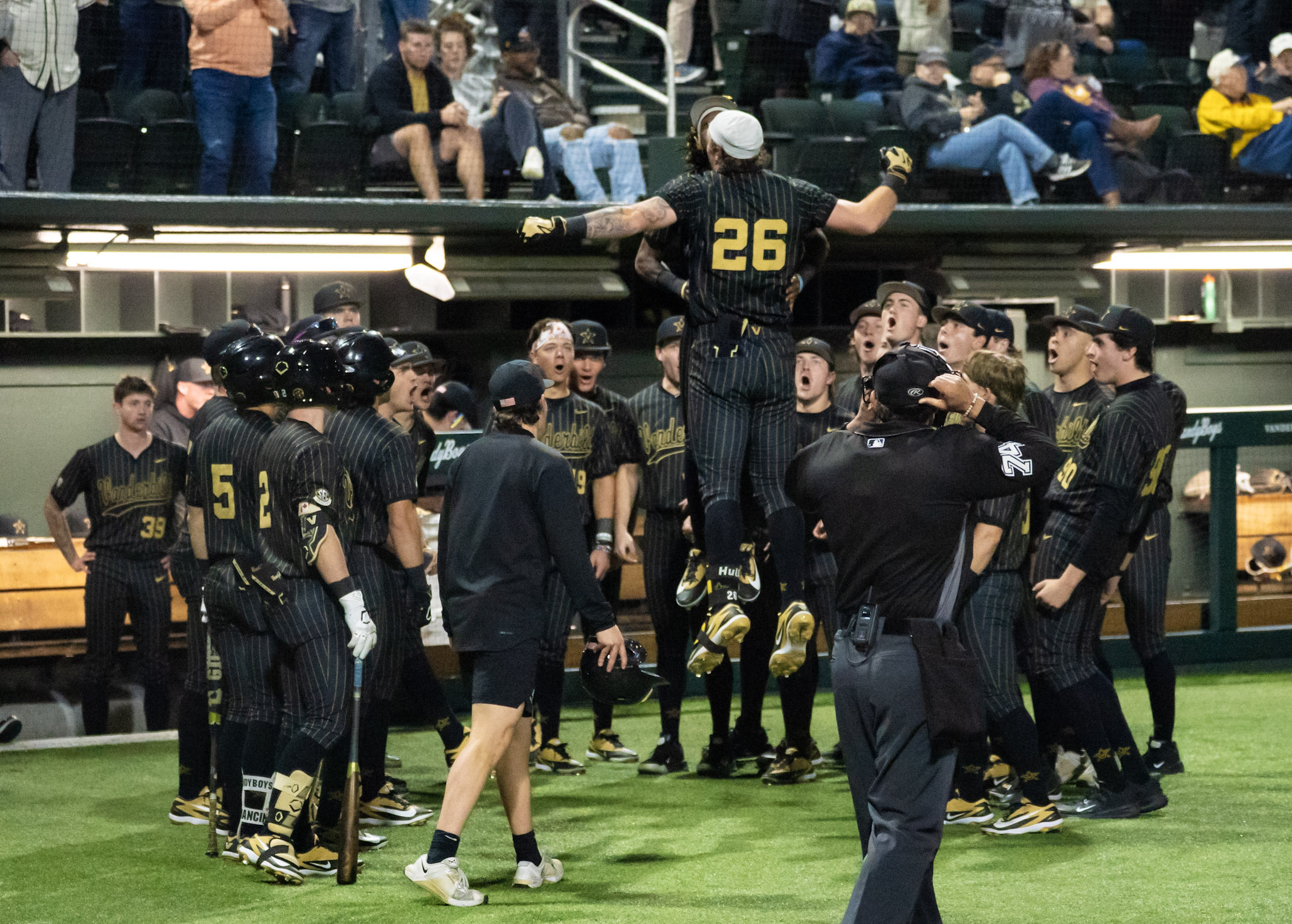
Vanderbilt won the first game against LSU thanks to a walk-off home run hit by Logan Johnstone. It ended a wild 13-12 affair that featured a total of 23 hits and 21 walks. Both schools used five pitchers in the game, and that was a significant amount for Vanderbilt, which was already missing righty Austin Nye due to bicep soreness.
In Game 2, Vanderbilt started freshman Wyatt Nadeau. I had no knowledge of Nadeau before walking into the press box, and was beyond thankful for Vanderbilt beat reporter Aria Gerson of The Tennessean giving me a scouting report. In bullpen sessions, Nadeau had hit 100 mph with his four-seamer, but starting against LSU seemed a bit desperate. According to Gerson, Vanderbilt only had five healthy pitchers entering that weekend series.
In his previous outing against North Dakota State, Nadeau pitched four scoreless innings, recording seven strikeouts and four walks. Counting on Nadeau to handle a starter’s workload against LSU was risky.
Nadeau is every bit of his 6-foot-6-inch frame, and at 19 years old, he could still grow. He has the prototypical build of a power pitcher sought by MLB teams. Hailing from Gorham, Maine, he was ranked as the 278th prep prospect by Perfect Game. Before Nadeau threw a pitch, I was stunned by how a kid this big, largely unknown but with big-time stuff, found his way to Vanderbilt from Maine.
Then Nadeau started to pitch, and I, along with LSU's lineup, quickly found out about his potential. Touching 97 mph in the first inning and complementing it with an 89-91 mph cutter, Nadeau overpowered LSU’s top hitters, including Jake Brown and Derek Curiel. He struck out the side on 14 pitches and retired the next six batters, effectively dominating LSU’s lineup the first time through.
Corbin is known for relying on pitchers who demonstrate dominance, as seen during the tenures of Kumar Rocker and Jack Leiter. In the fourth inning, Nadeau faced challenges when Steven Milam led off with a double and advanced to third on a wild pitch. After walking Brown, Nadeau’s errant pickoff attempt allowed Milam to score and Brown to advance to second, leaving Nadeau to face Curiel with no outs.
Curiel lined out to center, but Brown advanced to third with one out, and Nadeau then walked Nick Yorke on four pitches. With limited bullpen support, both Nadeau and Vanderbilt were in a challenging position.
Vanderbilt’s third baseman Brodie Johnston then made a pivotal defensive play. On a sharply hit ground ball, Johnston’s timely throw to second initiated an inning-ending 5-4-3 double play, keeping the score tied at 1 and providing momentum for Nadeau.
When asked if Nadeau built momentum off that double play, he said, “Heck yeah. I mean, those two guys [Brodie Johnston and Rustan Rigdon] got a special connection on and off the field. Just a great turn and really changed the momentum of the entire game.”
In the fifth and sixth innings, Nadeau recorded four more strikeouts while allowing only one baserunner. Given the uncertainty surrounding Vanderbilt’s pitching, Nadeau's performance was a godsend.
With an 8-1 lead entering the seventh, Corbin allowed Nadeau to face the lineup a third time. The Tigers did manage to score two more runs against Nadeau, but the freshman walked off the mound completing seven innings in his first SEC start.
Strikeout No. 🔟 for the freshman!@wyatt_nadeau pic.twitter.com/6BlOTps6WM
— Vanderbilt Baseball (@VandyBoys) March 15, 2026
“They got a really good lineup,” said Nadeau postgame. “But I trust my stuff. I got confidence in me, and I just feel like when I attack, the results speak for themselves.”
Nadeau’s final line was 7 IP, 4 H, 3 ER, 2 BB, 10 K on 104 pitches. On pitch 100, Nadeau hit 96 mph with his four-seamer, which is an amazing feat of endurance to maintain that high level of velocity, no matter the college level.
After the game, Corbin was asked if this was the first time he had seen Nadeau maintain this level of velocity beyond 50 pitches.
“Yep, that’s the first time,” said Corbin. “I’m not making a comparison here at all, so don’t, but I remember [Kumar] Rocker’s freshman year and the buildup it took.”
“It was like he had to get to the third [inning]. He had to get to the fourth. He had to get to the fifth. It was a buildup before he started throwing what he did. That didn't happen all of a sudden, and I see that in Wyatt. It's a slow buildup. The only way you can do that is if you're efficient in the strike zone.”
Corbin was undecided on whether Nadeau’s performance against LSU warranted a move into the weekend rotation. In Game 3, LSU scored six runs off Vanderbilt pitcher Nate Taylor in the first inning. Junior right-hander Brennan Seiber limited LSU to three runs over five innings, but the bullpen struggled in the final three innings, allowing seven runs, four walks, and only two strikeouts. LSU won 16-9, and Vanderbilt’s momentum from their weekend wins diminished after a 5-1 loss to Indiana on Tuesday.
Vanderbilt’s limited pitching options may necessitate Nadeau's continued use in the starting rotation. If that does happen, it will be another tough test for Nadeau and Vanderbilt as they visit Starkville to face a strong Mississippi State team.
“You don’t find a lot of guys like him with that size and that type of arm strength. He’s also very athletic, not only executing pitches, but holding the running game and fielding his position,” said Corbin.
“He just had one inning where a little trouble, but I think outside of that, he controlled the first hitter. When you control the first hitter, you do away with third of the offense. I thought he crossed new barriers for himself personally. It was just very impressive for a young kid.”
Roch Report: Seven hits vs. Michigan, but also three errors
This statistic highlights an unusual trend: In 14 non-conference games, Roch Cholowsky has yet to commit an error. He delivered impressive defensive performances, including his showcase against three SEC schools in the College Baseball Classic two weeks ago. However, in six conference games, Cholowsky has committed four errors.
It's not a reason to hit the panic button, and the defensive mishaps haven’t cost UCLA at all. The Bruins have now won 12 straight games, and Cholowsky had a big weekend against the Wolverines, batting 7-for-11. He also hit his 10th home run of the season on Sunday.
That's No. 10 for No. 1 🚀
— UCLA Baseball (@UCLABaseball) March 15, 2026
📺B1G+#GoBruins pic.twitter.com/UeEfQieWWc
On Tuesday, Pepperdine held Cholowsky to a 0-for-4 night with an HBP. Cholowsky’s season line: .347/.485/.819 with 10 HR and 27 RBI. This weekend, UCLA hosts Maryland.
Other Draft Notes
- Alabama shortstop Justin Lebron left Saturday’s game against Kentucky early due to an ankle injury. However, he returned to play on Sunday, so nothing too concerning. In his first SEC series of 2026, Lebron went 3-for-12 with a home run and two stolen bases. For the season, Lebron is batting .304/.440/.684 with nine home runs and 20 stolen bases.
- USC finally lost, but they held Northwestern to just three runs in the weekend series. On Tuesday, USC won 7-4 over San Diego State as they improved to 20-1 on the season. The Trojans pitching staff has only allowed 42 runs on the season, and in two weeks, it will get its chance against UCLA in what is shaping up to be a must-watch series.
- The frontrunner for College Baseball Player of the Year is not Roch Cholowsky at the moment. Instead, it’s Georgia Tech catcher Vahn Lackey. In 21 games, Lackey is batting an absurd .459/.583/.932 with nine home runs and 31 RBIs. Lackey was Sox Machine’s preseason 19th-ranked prospect and top catcher in this upcoming draft class. He’s pushing himself into top-10 consideration.
NCBWA Top 25 Poll - Week of March 16, 2026
| Rank | School | Record | Last Week |
| 1 | UCLA | 17-2 | 1 |
| 2 | Texas | 18-1 | 2 |
| 3 | Georgia Tech | 17-3 | 4 |
| 4 | Auburn | 17-2 | 5 |
| 5 | Arkansas | 14-6 | 6 |
| 6 | Mississippi State | 16-4 | 3 |
| 7 | Georgia | 17-4 | 10 |
| 8 | Oklahoma | 17-3 | 11 |
| 9 | North Carolina | 17-3-1 | 12 |
| 10 | Florida State | 16-3 | 15 |
| 11 | Southern Miss | 16-4 | 7 |
| 12 | Virginia | 16-4 | 18 |
| 13 | NC State | 16-4 | 14 |
| 14 | Florida | 18-3 | 16 |
| 15 | Clemson | 16-4 | 8 |
| 16 | Oregon State | 14-4 | 19 |
| 17 | USC | 19-1 | 20 |
| 18 | Coastal Carolina | 13-6 | 22 |
| 19 | Kentucky | 18-2 | 25 |
| 20 | LSU | 14-7 | 9 |
| 21 | West Virginia | 13-4 | 23 |
| 22 | Oregon | 17-3 | NR |
| 23 | Texas A&M | 16-3 | 17 |
| 24 | Wake Forest | 15-5 | 13 |
| 25 | Louisiana | 15-5 | NR |
| Dropped Out | #21 TCU | #24 Tennessee |
Games I’m Watching This Weekend
Alabama at No. 14 Florida
Matchup to Watch: Alabama SS Justin Lebron vs. Florida RHP Liam Peterson
Friday, March 20 - 6:00 PM CT on SEC Network+
After a tough start to the season against UAB, Florida RHP Liam Peterson has found his groove. In his last four starts spanning 22 innings, Peterson has only allowed four runs on nine hits and four walks while striking out 41. Last year, Justin Lebron tagged Peterson for a two-run homer. This matchup between two top-10 prospects promises a compelling showdown.
Also Watch: Florida SS Brendan Lawson.
An early favorite to be a top-five prospect in the 2027 MLB draft, Brendan Lawson is off to a crazy start. In 22 games, Lawson has 10 homers and 29 RBIs while batting .409/.614/.985 with 27 walks and 15 strikeouts.