White Sox prospect David Sandlin has been cleared for around five innings, ~70 pitches for a little bit now, to answer the most pressing question about the real headliner from the Feb. 1 trade that brought both the 25-year-old right-hander, along with Jordan Hicks, to the South Side.
It just wasn't that clear until Wednesday night in Gwinnett, where he was efficient enough to strike out seven against just one walk over four-plus innings of one-run ball on 71 pitches, whichi lowered his Triple-A ERA to 0.75 over 12 innings.
However eager any Sox fan is to add another high-powered arm to a team that's bashing the baseball at a playoff caliber over the past month, that likely pales in comparison to Sandlin himself. Case in point: When his back tightened up on him during a light bullpen after taking a week off for the holidays and slowed his ramp-up for spring training, Sandlin thinks his overeagerness to impress his new team at the outset of camp led to a recurrence to a similar forearm issue that he dealt with in 2024.
"I wasn't super overly worried, it was more just like frustration of I know I needed to take a step back, let it calm down," Sandlin said in a recent phone interview. "Really, we just took that week off, and it felt good. Then, of course, when we started building back up, it was like, oh, like there's the soreness there, but like that's ramp-up soreness."
Sandlin has touched 101 mph and sat in the high-90s with his four-seamer since returning to action, so the arm is healthy enough. The reason his prior two outings at Triple-A Charlotte were limited to two-inning cameos dovetail with his central frustration with his game -- five walks and 103 pitches used over those four innings, albeit with no earned runs across.
"The walks aren't where we want them to be, but we know that's not who I am. I'm usually that kind of strike-throwing guy who fills up the zone," said Sandlin, who had been pulled for high single-inning pitch counts his two previous starts before Wednesday. "Talking to the pitching development and the staff here, it's like, 'Man, it's just like we're just one away from everything clicking,' and then we're really going to start rolling."
Sandlin has struck out 26 and just allowed one earned run in his 16⅓ innings between Winston-Salem and Charlotte, so what does it look like when he's rolling? The Oklahoma native trains at the same Oklahoma City facility that Davis Martin and fellow Sox pitching prospect Gabe Davis throw at in the offseason, so there are familiar places to turn for insight.
"You want to talk about some of the most nasty stuff in professional baseball and that's David Sandlin," said Lane Ramsey, former Sox pitcher and director of operations at Pitching WRX. "He's gonna throw some disgusting sweepers, a cutter at 93-94 mph that gets some pretty crazy horizontal movement. Obviously the fastball routinely touches 100 mph and he throws strikes with them all. He's a guy that that Chicago fans should be pretty excited about."
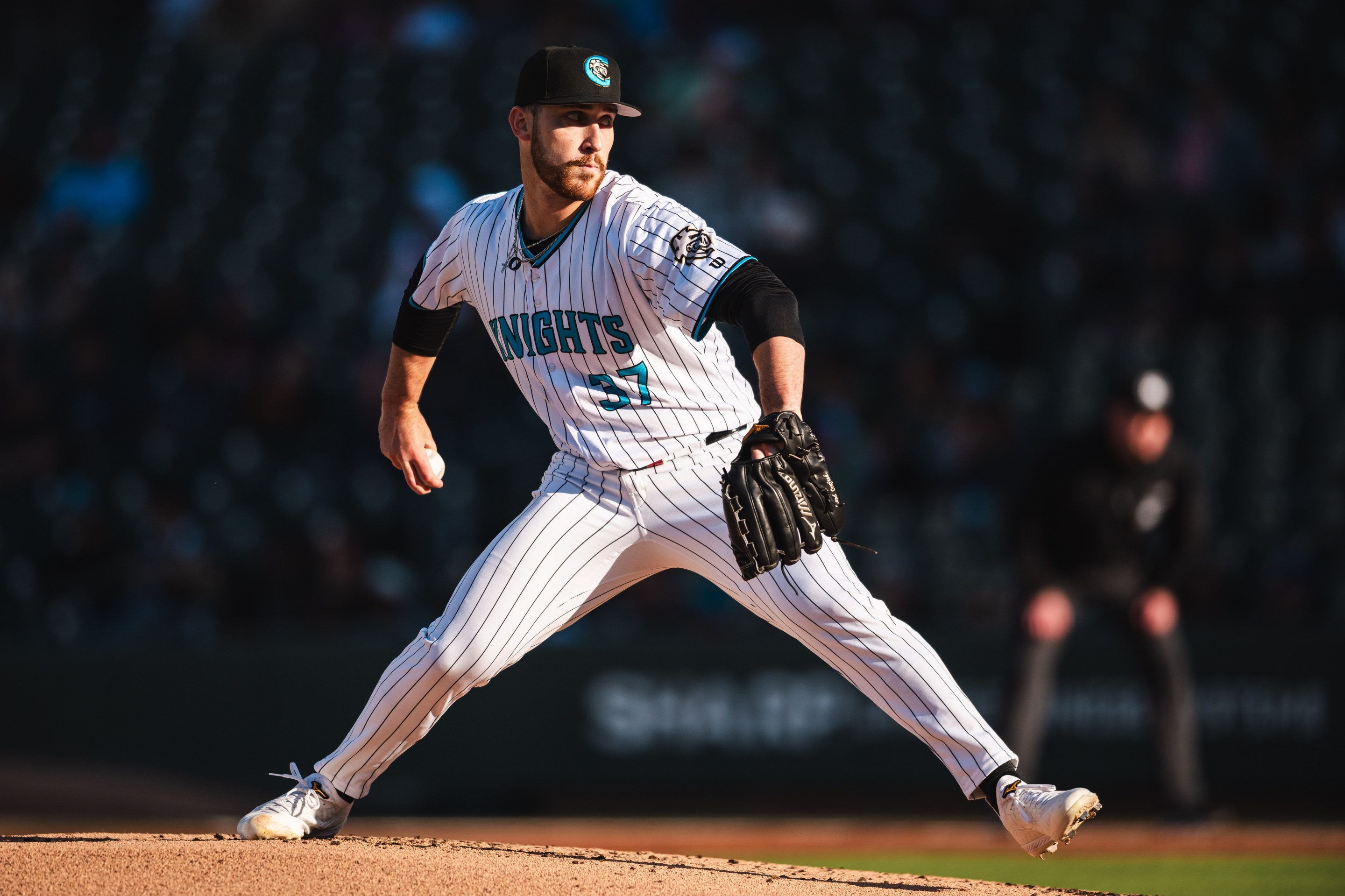
These days, the more a pitcher has a natural inclination to rotate their body in their delivery, the bigger counter-move rotating away from the plate they tend to have to start their motion. That makes it abundantly obvious how rotational Sandlin is, because the unique wind-up he developed at Pitching WRX in 2024 has him take a full step backwards before coiling his body, which is all designed to make sure he's on line to the plate when he finally unspools, and reduce the chances of a recurrence of the oblique injury he suffered before he had this mechanism in place.
Nothing demonstrates the contrast as well as just putting his wind-up alongside his delivery from the stretch.
Relatedly, making sure Sandlin can recreate the same timing and velocity out of his stretch delivery that he shows from the wind-up has been an ongoing project.
"First week here the velo dipped a little bit more, and then each outing after the velo has kind of maintained a little bit better out of the stretch," Sandlin said. "That's a lot of what we've been working on since I got back from the rehab, trying to make that stretch similar. It's been a mixture of mimicking it with the hands; I bring my hands up throughout the delivery, and that in turn will help bring that knee back for the counter-rotation. We've also worked on moving the front foot when I'm set, closer to allow less movement, to buy me that still quick pace to the plate."
Sandlin's second-to-last start opened with him pumping three-straight upper-90s four-seamers by Jud Fabian for a strikeout, demonstrating the temptation he faces to just lean on his talent for backspinning fastballs and ripping off glove-side breaking balls. But he has a specific memory of facing a rehabbing Andres Giménez, and the glove-first Blue Jays infielder ripping a perfectly located top rail 99 mph heater back up the middle for a single. That experience reiterates the need for building out his mid-90s sinker and his kick change as arm-side movers that make him better against left-handed hitters at the highest level.
"These guys can hit, they can hit velo, you've got to have other pitches too," Sandlin said. "As soon as I got traded over here, I was talking to [pitching coach] Zach Bove about having that pitch against the lefties that I can have for punchouts. The curveball has also taken a step forward as a weapon, but that was the only putout pitch other than a fastball. So just having something that dives away from them too, that way I don't have everything coming toward them, coming into their bats, to where they can maybe take a step off the plate and it makes it harder to beat them inside."
It's a wide collection of pitches, thrown at compellingly high velocities (the kick change often hits low-90s and gets tagged as a sinker), and to Sandlin's point, most of his pro career has been marked by low walk totals. So his explanation of the one thing that's missing so far -- or at least up until Wednesday night -- sounds a lot like something Davis Martin would say.
"Just getting back on that attack," Sandlin said. "The first outing [at Triple-A] showed it, where I threw 40-something pitches through four innings. Get strike one, get strike two. You can't strike anybody out without any strikes on them. So fill up the zone, and once you get to strike two, you can make a competitive pitch and they're either going to strike out or make some weak contact, and you get them out in as few pitches as possible."
Sandlin was perceptive enough about his roster situation with the Red Sox that he expected to get traded all offseason, only dropping his guard when it was close enough to spring that he actually attended their winter fan festival the weekend before the deal was completed. And the TVs in the Knights clubhouse work just fine, so he's perfectly aware of the tempting situation in Chicago as well.
He just wants it to all be in sync first.
"Right now I know where I am, where my feet are," Sandlin said. "I feel like all of us are ready to plug in whenever we can. The winning helps. You always want to join a winning ballclub. It looks like a lot of fun to be a part of whenever I get to to that time and I get all my stuff figured out."