FRISCO, Texas — When the Chicago White Sox won the draft lottery for their first No. 1 overall pick since 1977, it put a lot of pressure on my work covering the MLB draft. In a typical year, I've had to do due diligence on a range of players, because the White Sox's selection was partially determined by which names came off the board earlier. Now, the White Sox have their choice of any player, which makes a wrong call harder to excuse.
Luckily, Roch Cholowsky has made things easier. Because he entered the year as the consensus No. 1 draft prospect, I could circle the last weekend in February for the tournament in Arlington, Texas to watch UCLA face three SEC schools: Tennessee, Texas A&M, and Mississippi State. Another great weekend for Cholowsky, and only a serious injury would derail the hype train of him taken first overall.
But as I was booking travel, I figured I would check whether Grady Emerson’s high school schedule had been posted, because he's the obvious top prep prospect in this draft. At just 18 years old, I know some MLB teams would prefer Emerson over Cholowsky because of their age models and confidence in their player development. Yeah, Cholowsky is great, but over the next two months, he'll be a 20-year-old beating up Big Ten pitching. Emerson at 20 years old could in High-A facing better pitching and furthering his development, assuming he's not pulling a Konnor Griffin and making a case for an Opening Day roster spot.
Sure enough, Emerson and Fort Worth Christian were playing in a weekend tournament at Rock Hill High School in Frisco, Texas. The timing was right, too: Emerson was playing in the mid-afternoon while Cholowsky was set to face Texas A&M for the nightcap back at Globe Life Field. A 100-mile round-trip was a worthy endeavor to learn just how great Emerson is, and whether I should not count him out for the first overall pick.
⚙️⚙️⚙️
Last summer in his second year with Team USA, Emerson went 9-for-26 with two doubles and walked eight times. Entering his senior year, Emerson decided to transfer from his previous high school in Argyle to Fort Worth Christian. Awaiting Emerson was former major leaguer Rusty Greer, who played nine seasons with the Texas Rangers.
An outfielder who accumulated 22.4 WAR during his career and hit more of his 119 career homers against the White Sox than any other team, Greer was known for throwing his body around with reckless abandon. Those diving catches would take a toll on his body, but they also created moments like the one that helped preserve Kenny Rogers' perfect game in 1994.
Greer has known Emerson since he was 10 years old, participating in his defensive camps. Even in his pre-teen years, Greer could tell that Emerson was special.
“I know people say, well, how can you tell at 10?” said Greer.
“You don't know if they're going to be a big leaguer or not, but you can tell they have actions. You can tell that they have a little better arm than the other kids standing around. You can tell they're paying more attention. You can tell that their aptitude is better. And so that's kind of where it started.”
After closing his camp, Greer tried to get into the college coaching ranks, but found it tough to break through the close-knit group. When Fort Worth Christian first called a few years ago, Greer said he wasn’t interested, but he was more receptive after another fall the following year. After interviewing and settling on what the job entailed, Greer was sharing his major league expertise with teenagers.
“I enjoy coaching. Watching players go and do what you've taught them to do, that's rewarding,” said Greer.
“Are there frustrations involved? Yeah, there is, but when they execute something that you practice, that's where it becomes rewarding. I enjoy it, and you know, it fills my time and my baseball kind of fix. It's been fun for the last three years.”
The Texas sun was glaring, and it was a warm 84 degrees that Saturday morning, so the temperature was conducive for some offensive fireworks from Emerson. But as I walked from the car, the crosswind reminded me of walking along Wacker Drive on a Chicago spring day. Up to 25 mph gusts were blowing straight out to left field on the diamond, so any home runs from the left-handed swinging Emerson would have to come via the oppo taco variety.
I wasn’t alone making the journey. Scouts from at least a dozen MLB teams were also in attendance to see how Emerson would fare playing his fifth game in three days.
⚙️⚙️⚙️
Even though it’s high school baseball in Texas, where the quality is typically far better than what we see in the Midwest, Emerson didn't see premium velocity that day. In his first at-bat, on a 3-0 count, Emerson’s timing was a bit late, and he flew out to left field. It was a curious swing decision to be so aggressive against unpredictable pitching, but Greer advocates for that level of aggression. An example of his major league experience informing his coaching, Greer believes that 3-0 is the best pitch his hitters should see, with a fastball coming down the middle. Instead of an automatic take, Greer wants his hitters to crush.
In his next plate appearance, Emerson did, hitting a sharp line drive to center field, resulting in a two-run double. While I thought that was Emerson’s plate appearance of the day, Greer disagreed postgame. He offered the following plate appearance in which Emerson fought off an inside slider to deep enough left field, resulting in a sacrifice fly.
Adjusting to the game situation and how pitchers attack in a single at-bat are areas Greer is trying to help Emerson understand.
“I’ve worked on him with the thought process of hitting. What’s our plan? How are we approaching the at-bat? Hitting is hard, man. We all make mistakes. What do we do next to correct that mistake? Can I make an adjustment in between pitches?” said Greer.
“He understands his body and swing. So when we make a correction, let’s say 'stay through the ball just to the left of the batter’s eye.' The next swing, through the ball to the left of the batter’s eye. It makes my life way easier.”
On Emerson’s last swing, he hit a towering fly ball to right field that had the look of being a home run. But the wind had other ideas, and a strong gust knocked it down, resulting in a deep flyout. Emerson was visibly upset, thinking he had a dinger. It would have been great to see in person; a positive argument for the big debate entering draft day: How much projected power does Emerson have?
“I think the game’s pendulum at some point swings back towards the center. It is important for us to get on base and be able to hit a little bit,” said Greer. "I’ve read the same things regarding his power projection. Years ago, it was 'Can a kid hit?' Because we can teach power, but contact is natural. Now in today’s world, it’s 'How many homers are you hitting right now?'
“While power is good, the goal should be a well-rounded type of hitter. Power will come to Grady as he grows into his body frame. That’s where the power comes from. Let’s also understand that with all these kids we’re talking about getting drafted, once they are playing professional baseball, that becomes their job."
Greer makes a good point. Right now, Emerson only has his current strength and conditioning program through the school, and also works with a trainer outside of the team. He’s currently 6-foot-2, 175 pounds, and has plenty of room in his body frame to build more muscle.
“Once professional baseball is their job, they will get better. That’s why there’s a minor league system with professional coaches that can help these players get better. It’s the player's job to have the aptitude, make adjustments, and mature. That’s where the true growth of a player comes from,” said Greer.
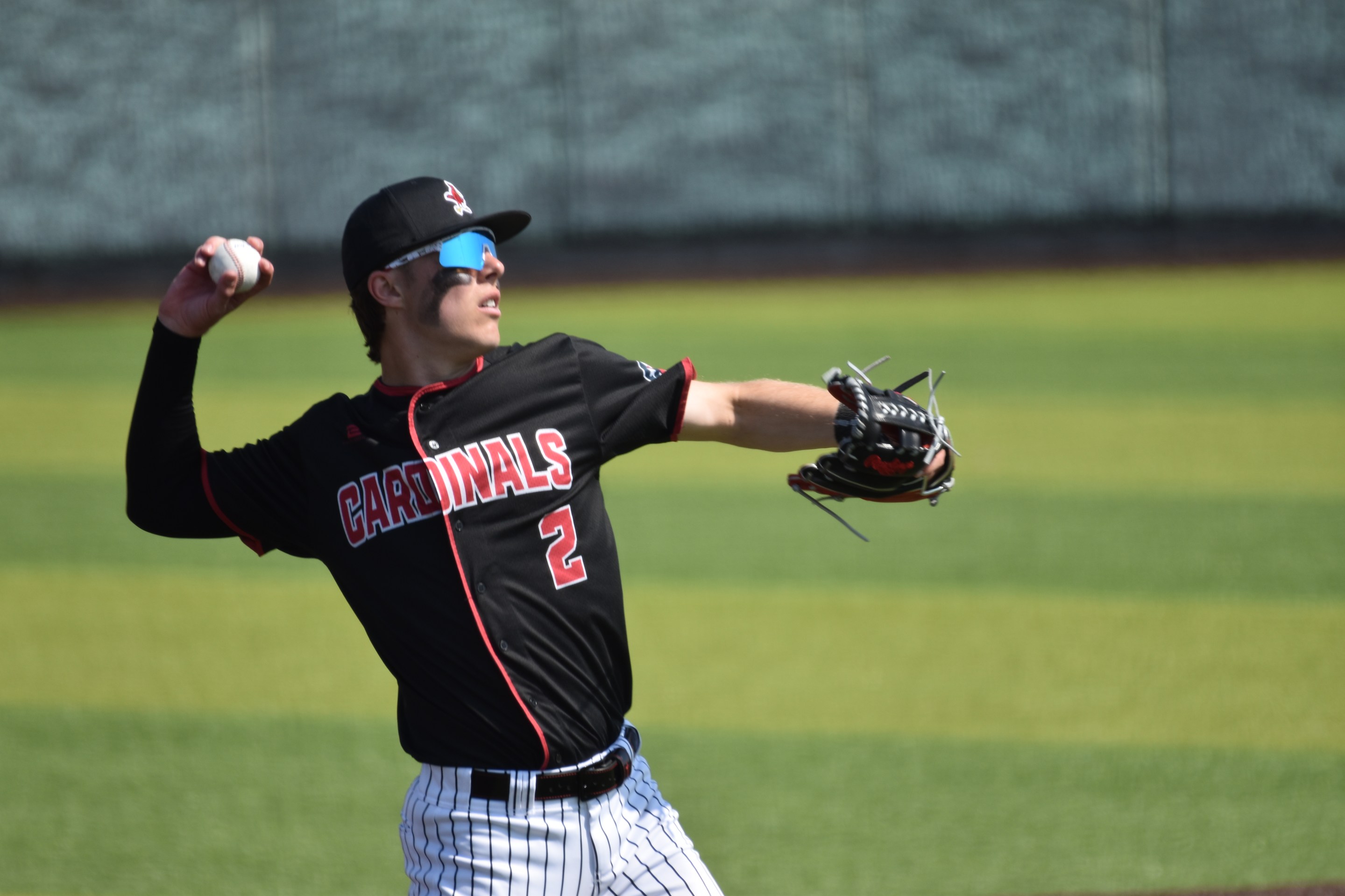
Where Emerson stands out from his high school peers is defensively. He made two plays that had me yelling “Wow” out loud. In the third inning, on a grounder hit to second base, Emerson caught the throw that was wide to his left. Then, making a pirouette off the bag for one out, Emerson made a strong throw to first, completing the double play, much to the dismay of the opposing teams’ family members in the stands.
The next inning, a sharp grounder off the artificial infield surface had eyes for sneaking through the third base hole. Emerson had other ideas. Showing quick feet, Emerson made the backhand stop and showed off his throwing arm by nailing the base runner at first base by two steps. I spent the previous day watching college shortstops struggle with that play, but Emerson made it look effortless.
“There’s been a couple of things defensively we’ve tweaked a little bit, just angles to the ball and things of that nature,” said Greer. “Great thing about coaching Grady, you tell him once, and it’s done. There’s no pushback. He’s, 'I’ll get it done,' and he gets it done.”
Eavesdropping on scouts' conversations during the game, several were impressed by Emerson’s athleticism. They liked how fluid his swing is, the great use of hands both at the plate and in the field. With a major league presence at every game, I wondered how teenagers handle that type of spotlight.
It helps to have an ex-major leaguer as your coach who has been there and done that.
“I think the biggest piece I can help him through this entire process of the draft is dealing with scouts and people that are outside of Fort Worth Christian,” said Greer.
“I’ve got experience with my son (Mason) and Bobby Witt Jr. being best friends. I got to watch the Witts deal with this, since they live right down the road from us. So, watching that whole process unfold with Bobby in 2019, I called Alan McDougall, who was his head coach. I asked him what I can expect here? He walked me through the process, and I’m doing my best to help shield Grady, help communicate with scouts.”
“But Grady is so personable. He walks up on his own and shakes their hand. I don’t think they’re on his mind during games because of the experiences he’s had this past summer with Team USA and Perfect Game. All that stuff he’s gone through, he’s been in front of those scouts. So that’s not a shock to the system.”
Fort Worth Christian won, 9-6. After the game, I chatted with Greer about what I saw, and how I was wowed by the web gems made. Greer shared a story about the night before Emerson made a terrific play on a slow chopper with a perfect transition throw to first base. Even for an ex-major leaguer that’s hard to amaze with what he’s seen and done, Greer himself is left in awe with what Emerson does on the field.
“It's hard to say what Grady Emerson’s peak will be, when right now, it’s not his full-time job,” said Greer.
“But I can say that every day he’s getting better. That’s going to be the exciting part for me to watch when he leaves here. How much better does he get?”