ARLINGTON, Texas — With my notebook and recorder in hand, I was about to head to the elevator from the Globe Life Field press box as UCLA’s DH Dominic Cadiz grounded out to third base. I was there to cover the tournament drama, but this trip also served as an assignment to gauge the presumptive No. 1 pick, Roch Cholowsky, and take a closer look at his game against top competition. There were two outs, and Cholowsky was on deck. I realized I would not reach field level before Dean West’s plate appearance ended. So I decided to stay, watch Mississippi State’s on-field celebration, and then get to the dugout to interview Bulldogs coach Brian O’Connor.
Then a funny thing happened. West got hit by a pitch, and suddenly it was college baseball’s best player at the plate with a chance to tie the game.
UCLA and Mississippi State had already played what might be the best Sunday regular game of the season. The Bruins held a 3-0 lead early thanks to Will Gasparino hitting his fourth home run of the weekend. But State stormed back in the fourth inning, scoring three runs thanks to a Reed Stallman two-run homer and a Ryder Woodson RBI double. Tied at 3 in the seventh inning, freshman Jacob Parker (twin of 2025 fifth-overall pick JoJo) hit a sacrifice fly to give the Bulldogs their first lead. Noah Sullivan then tacked on a big insurance run with a solo home run in the eighth inning.
At the point he stepped into the batter's box in the ninth, Cholowsky was 2-for-10 for the weekend. My initial story was going to be about traveling to Arlington to see the future White Sox No. 1 selection have the worst weekend of his season. Which is fine; it’s important to see a player not only at their best but also at their worst in order to gauge their future value. Aggies right-handed reliever Ben Davis was tormenting UCLA hitters with his two-seamer on the outside corner, but he decided to change it up against Cholowsky and threw an 88 MPH cutter.
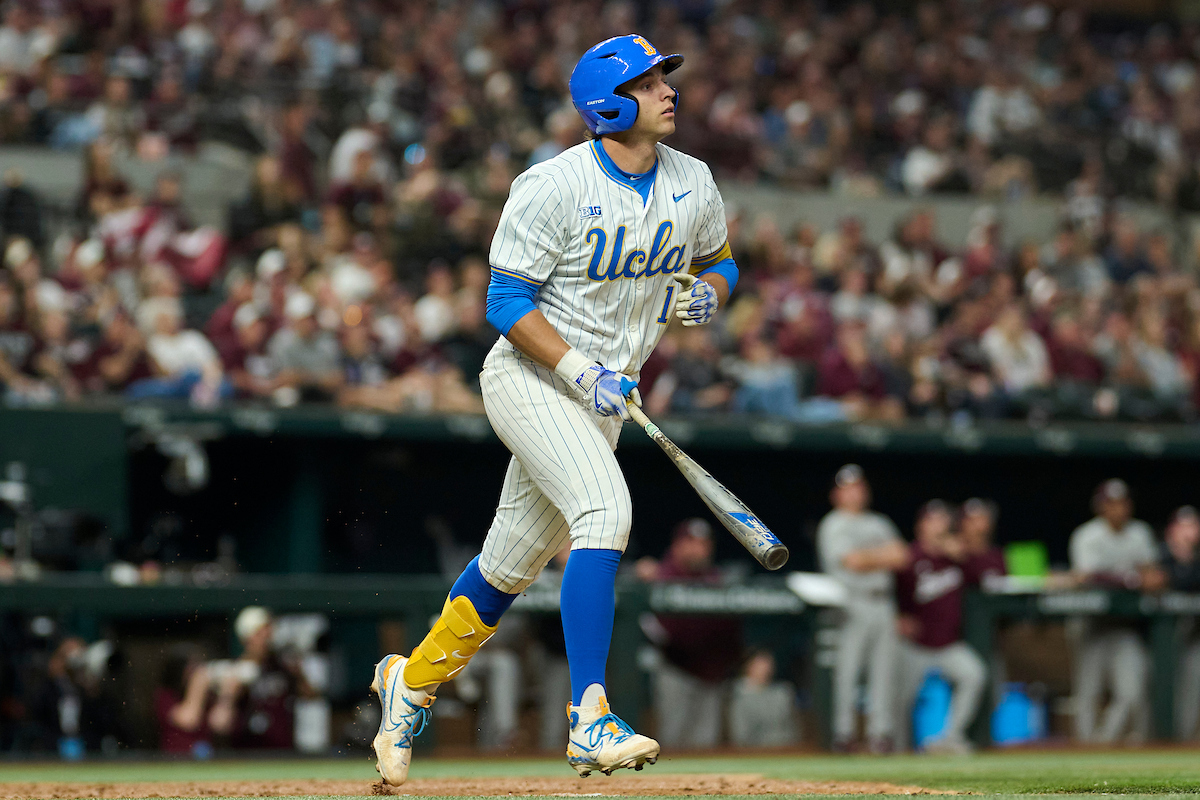
I will never forget the sound the aluminum bat made when Cholowsky unleashed on that pitch. It was that unmistakable crack that freezes everyone in the park for a heartbeat. The press box let out a mix of sounds conveying awe and disbelief as the deep flyball crashed into the left field upper deck. Statcast clocked the homer at 105.5 mph exit velocity and 439 feet. College baseball’s best player, in the biggest moment of a top-five matchup, delivered when UCLA needed him most.
Extending the game brought the volatile part of each team's bullpen into play, and the runs piled up in the 10th inning. The Bruins put up a three-spot, took an 8-5 lead, and needed the entire margin. Stallman hit a two-run homer to make it 8-7, but a third Mississippi State run in extras proved elusive. UCLA handed Mississippi State its first loss of the season, and took home the tournament championship hardware.
FREE PREVIEW
We hope you're enjoying our in-depth Chicago White Sox draft coverage. For all access:
Cholowsky's home run made it all possible, and it's what most will remember from this big weekend against three SEC schools. But now that I've gotten a chance to see his game in action, let’s break down what Cholowsky does well offensively and defensively, and what could use some work.
By the numbers: Roch Cholowsky Statcast data
Game 1 vs. Tennessee: 1-for-3, 2B, SF, HBP
- First PA: Fouled out on an 85 mph slider from Tegan Kuhns.Exit Velocity: 89.5 MPH, Distance: 150 feet, Angle: 68 degrees
- Second PA: Double off an 84 mph changeup from Tegan Kuhns.Exit Velocity: 92 MPH, Distance: 55 feet, Angle: 2 degrees
- Third PA: Sacrifice fly to right field off 78 mph curveball from Tegan KuhnsExit Velocity: 90.5 MPH, Distance: 308 feet, Angle: 42 degrees
- Fourth PA: Lineout to center field off 81 mph slider from Brandon ArvidsonExit Velocity: 100.2 MPH, Distance: 343 feet, Angle: 18 degrees
- Fifth PA: HBP on 79 mph changeup from Nic Abraham
Game 1 recap
Cholowsky saw some high heat from Tennessee RHP Tegan Kuhns, whose four-seamer was hitting 97 mph. Opposing teams typically attack Cholowsky with breaking or soft stuff, and he’s comfortable waiting for those pitches in the zone. His double was off a 0-1 changeup from Kuhns that Cholowsky did a good job of reaching down in the lower part of the zone.
His best plate appearance was in the fifth inning against Kuhns.
- Pitch 1: 84 mph changeup, foul
- Pitch 2: 84 mpy slider, ball
- Pitch 3: 95 mph four-seam fastball, swinging strike
- Pitch 4: 95 mph four-seam fastball, ball
- Pitch 5: 84 mph slider, ball
- Pitch 6: 78 mph curveball, sacrifice fly to right field
By starting with slower and breaking stuff, Kuhns caught Cholowsky off guard on pitch three with heat. Up 1-2, Kuhns tried again with the heat but missed, and he followed that up with a slider to see if Cholowsky would chase. When that didn’t work, Kuhns opted for a fourth pitch to fool Cholowsky, who recognized the spin and speed to stay back long enough to drive a deep enough fly ball to drive in a run.
That plate appearance, in a nutshell, showcased key skills for Cholowsky as a hitter. He has a good understanding of the strike zone and is strong enough to drive offspeed pitches for productive results.
Game 2 vs. Texas A&M: 1-for-4
- First PA: Single off 92 mph sinker from Weston MossExit Velocity: 86 MPH, Distance: 203 feet, Angle: 16 degrees
- Second PA: Pop Out off 92 mph four-seam fastball from Weston MossExit Velocity: 94.7 MPH, Distance: 142 feet, Angle: 66 degrees
- Third PA: Flyout off 81 mph slider from Gavin LyonsExit Velocity: 93.4 MPH, Distance: 198 feet, Angle: 59 degrees
- Fourth PA: Flyout off 87 mph changeup from Gavin LyonsExit Velocity: 93.5 MPH, Distance: 321 feet, Angle: 26 degrees
Game 2 recap
Even though it was well-struck, Cholowsky’s only hit of the game was off an inside sinker from Texas A&M righty Weston Moss. So often I see Cholowsky’s hands swinging through the zone are out over the plate. That’s great for covering outside pitches, but I noticed it’s also the same for pitches on the inner half, which is why he’s hitting infield popouts (Already has six infield popouts this season). But on this pitch, Cholowsky was able to bring his hands closer to his body to muscle it out for a single.
The other plate appearances are head-scratchers. Ahead 2-0 against Gavin Lyons, Cholowsky is swinging freely at a wide slider, and his last appearance against Lyons involved just a first-pitch changeup. UCLA was up big, and most of his teammates were having great nights at the plate. I wonder if those two at-bats Cholowsky was trying to force the issue.
Game 3 vs. Mississippi State:
1-for-4, HR, HBP. 2 RBI
- First PA: Groundout to third off a 96 MPH four-seam fastball from Duke StoneExit Velocity: 76.5 MPH, Distance: 3 feet, Angle: -40 degrees
- Second PA: Hit into double play off a 86 MPH cutter from Duke StoneExit Velocity: 87.4 MPH, Distance: 339 feet, Angle: 31 degrees
- Third PA: Flyout off a 92 MPH four-seam fastball from Maddox WebbExit Velocity: 99.7 MPH, Distance: 226 feet, Angle: 58 degrees
- Fourth PA: HBP on a 94 MPH sinker from Ben Davis
- Fifth PA: Two-run home run off a 88 MPH cutter from Ben DavisExit Velocity: 105.5 MPH, Distance: 439 feet, Angle: 26 degrees
Game 3 recap
Nine pitches in five plate appearances is a very Alexei Ramirez-like type of game from Cholowsky. His first, third, and fifth plate appearances were all off the first pitch, carrying over a very aggressive approach from the previous game. His hit into a double play was the result of a TOOTBLAN when Mississippi State center fielder Aidan Teel (Kyle’s little brother) made a nice throw to second base, catching Dominic Cadiz off guard.
The fourth plate appearance is one that Ben Davis wants back. He was up 0-2 in the count after Cholowsky fouled off back-to-back sinkers coming in at 95 mph. Then Davis tried to bust Cholowsky inside, but the two-seamer tailed inside. That’s one attribute of Cholowsky’s offensive game that I think will carry over: He’ll take pitches off the arm.
The last plate appearance, which we already covered in length, was a center-cut cutter that Cholowsky did not miss. For the weekend, Cholowsky saw a total of 37 pitches in 14 plate appearances (2.64 pitches per PA). He had 20 swings and only whiffed twice, finishing 3-for-11 with a home run, double, and two HBPs.
Cholowsky’s defense
After the game against Texas A&M, even though UCLA won by 10 runs, everyone in the press pool wanted to ask UCLA coach John Savage about Cholowsky’s defensive performance, as he had five assists and turned one double play. Although he had an off night at the plate, Cholowsky made a significant impact defensively.
“I think he’s the best offensive shortstop, as well as the best defensive shortstop out there,” said Savage.
“If you see him play, you play against him, you feel him on both sides of the ball. That's a credit to a player. It’s when you can feel him defensively as much as offensively in baseball.”
For the weekend, Cholowsky had nine assists and turned two double plays. On the season, Cholowsky has 33 assists, 15 putouts, and zero errors. He won the college Gold Glove last year at shortstop, and he’s the easy frontrunner to win that award again this season.
What impresses me most about Cholowsky's defense is his attack angles. He’s not the most athletic shortstop I’ve seen, maybe 50-grade speed, and that could be generous. But Cholowsky has a great first step and knows where to position himself. He has good range to his right and left, but is even better chasing shallow fly balls into the outfield. When charging slow rollers and choppers, Cholowsky maintains good body control with his running throws.
Speaking of his throwing arm, every throw by Cholowsky was on target over the weekend. Not one sailed wide or forced first baseman Mulivai Levu to reach or stretch. Each was perfectly placed at Levu’s chest. That’s the difference between watching games on TV and in person. The camera cuts are rarely quick enough to show how Cholowsky reacts unless it’s instant replay.
In my opinion, his defense is Cholowsky’s best attribute and most major league-ready skillset. He’s a plug-and-play shortstop, so there’s no worrying about him defensively. With the right partner at second base, it could even be a Gold Glove-caliber shortstop turning a high rate of double plays.
Final impression
Scouts will add their thoughts on how well a player carries the himself on the field and what kind of teammate he is in the clubhouse. Not being on the UCLA baseball beat, I don’t know Cholowsky at that level to gauge. But Savage raves about his leadership skills, and he holds his teammates accountable, especially when playing defense.
I witnessed this firsthand during a game when freshman second baseman Aiden Aguayo was unable to complete a double play. Between pitches, Cholowsky showed Aguayo how to transfer the throw from second base in that situation. While some shortstops might stay quiet and focus on themselves, Cholowsky seized the opportunity to help his freshman teammate.
Cholowsky carries a certain amount of swagger, knowing the bullseye is on him. He’s often the one amping up his teammates after a big hit or taking a hit on the elbow guard. Listening to Cholowsky in interviews, he’s always quick to draw focus back on the team’s efforts.
That being said, one question remains, and it's one we received in the latest round of P.O. Sox inquiries from Sox Machine subscriber John S.:
Josh, you had said shortly after the lottery that we should wait until Roch had a chance to see quality SEC pitching, to see how he looks. It sounds like other than the big home run, he didn’t look great at bat over the weekend. Do you really still feel he’s a 1-1 pick?
Josh's grades for Roch Cholowsky
These are my scouting grades for Cholowsky, which are more tuned to future value than his current form at UCLA.
Defense: 60. If you believe in 65’s, I would give Cholowsky a 65. He makes every play and can steal base hits on shallow flyballs. Excellent throwing arm, only question is total range. It might not be plus-plus due to his athleticism, but it’s still above average thanks to an excellent first step.
Power: 60. Cholowsky is strong and uses his lower half well in his swing.
Contact: 50. Cholowsky does a good job covering the outer half, but I worry in the professional levels how he handles inside pitches. He needs to develop a way to pull his hands in and still hit the ball with authority on the inner half.
Speed: 50, but pointing down. Cholowsky is not a speedster and not much of a base stealer.
Cholowsky’s defense at shortstop and power potential are strong enough to take him first overall. This profile already has a high floor and a high ceiling. If Cholowsky spends 2027 in the minors working on his hitting to better understand which inside pitches he can pull with authority, I think he will be a yearly 3+ WAR player.
A common player comp is Chicago Cubs shortstop Dansby Swanson, who was taken first overall in 2015. In 10 seasons, Swanson has accumulated 28.4 WAR with a .251/.318/.414 career slash line. With three seasons in Chicago, Swanson has been a 13.6 WAR player, averaging 20 home runs a season with a 102 OPS+.
I think Cholowsky can be better offensively than Swanson, but every MLB team would want a 4-WAR shortstop who has played at least 147 games in each of the last five seasons. Swanson is dependable and has taken his game to another level since 2020, his age-26 season.
Regarding a potential development timeline, Atlanta gave Swanson 470 plate appearances in 2016 before calling him up briefly. If the White Sox select Cholowsky first overall, I could see a similar scenario with his earliest ETA in late 2027. I strongly recommend avoiding handling Cholowsky as the White Sox did with Andrew Vaughn.
As for his future MLB position, let’s see how Colson Montgomery fares at shortstop in 2026. Cholowsky played some third base his freshman season, so that is a possible avenue if Montgomery proves worthy at short.