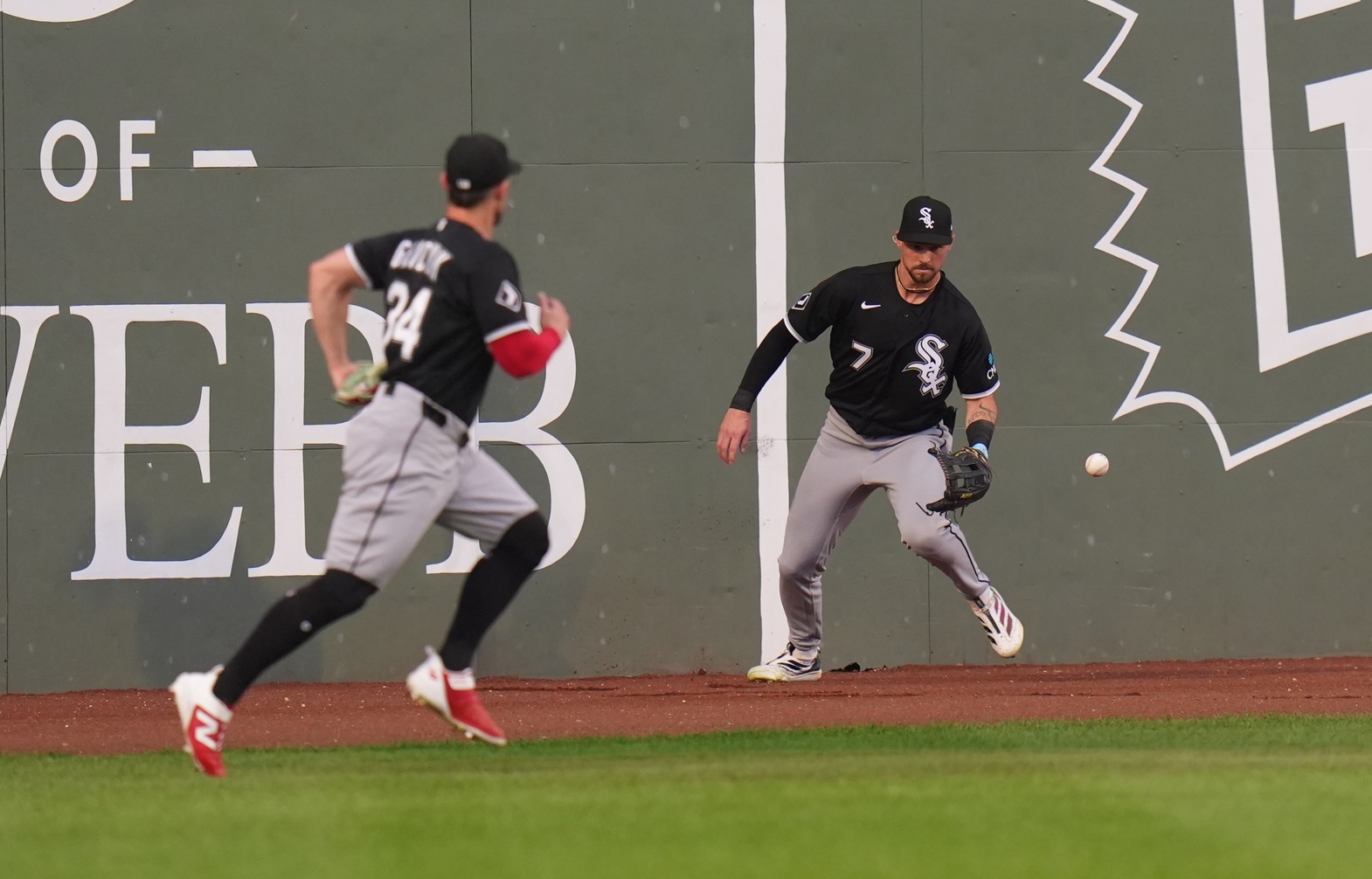
When the White Sox sent out two minor leaguers at the trade deadline on Monday for a two-time Gold Glove winner with a .234/.285/.385 career batting line, it made it clear they were prioritizing defense with their last roster slot for a right-handed outfielder.
In that sense, maybe Austin Hays was only ever competing with Randal Grichuk for a roster spot. And in either case, the Sox weren't going to extend more runway to get the version of the 31-year-old they hoped for when they signed him to a one-year, $6 million deal in February. The White Sox designated Hays for assignment on Wednesday, a few days shy of the 20-day limit for his rehab assignment for a left calf strain that has kept him off the active roster since May.
Grichuk has slowed from his initial torrid pace, but is still hitting .275/.312/.565 and has ingrained himself within the clubhouse culture to say the least. Hays hit .233/.250/.326 in just 12 total games, and all of that was three months ago. He slugged four homers in 11 games during his most recent rehab assignment. But this is a short-term choice for a veteran platoon masher; one has produced, and one has spent most of the year beset by leg injuries, and the only real variable in the decision was how long the Sox could reasonably maintain Hays as a backup plan.
The acquisition of Brenton Doyle on Monday was the team's most surprising move of the trade deadline simply because it filled a need the White Sox hadn't widely telegraphed, to say nothing of timing it right after Everson Pereira's best offensive game of the season. Instead, it's wound up closing the book on the team's initial Plan A for the outfield, with both Hays and Pereira DFA'd, Luisangel Acuña not starting a game in center since May, and Doyle entering into a platoon with Tristan Peters.
"Defensively, has driven his value in this game, but we also see quite honestly some offensive potential that hasn’t been tapped into here recently," said Chris Getz of Doyle. "Most recently this season with injuries and that stuff is behind him, we felt like adding Brenton Doyle not only to our group here but our projections, have led us to if Brenton Doyle comes to the White Sox, we’ll add wins in 2026 but 2027 as well."
In both cases, Hays and Pereira both have been hard to bank on due to injuries and can't be optioned, and after such a long recent stretch of having to put Junior Pérez in a lot of big spots, the Sox had more reason to be interested in alternatives than just Ryan Fuller's prescribed tweaks for Doyle's bat path, or their statistical model's enthusiasm for him.
Then again, it was only mid-June where Pereira's return from the injured list was enough to cause to ship out Derek Hill's brand of glove-first platoon outfield work to Philadelphia, where he's continued to catch lightning in a bottle (.275/.315/.522 in 74 PA) in a limited role, so Doyle's ability to become a multi-year solution will have plenty to alternatives to compare against.
More so than the outfield, the White Sox's deadline marked an inflection point for assessing their satisfaction whole free agent class. Dumping Seranthony Domínguez's salary after watching him slide from closer to low-leverage work was a big part of the value exchange of the Luis Castillo deal, which also marked moving on from Erick Fedde in the rotation, even if it seems clear enough that the 33-year-old right-hander met expectations. Broadly speaking, the Sox's free agent hit rate from this winter seems normal, but since Munetaka Murakami was both their biggest investment and their biggest, franchise culture-changing success in a shockingly competitive season, you kinda have to give them the win on this one.
Breaking it more into categories, it looks like trying to find high-performing but undervalued targets from East Asian pro leagues (Murakami, Anthony Kay) went great, identifying an emergent metric darling (Sean Newcomb) was smart, the bounce back candidate (Fedde) easily earned his salary. It's where proven performers with known warts were signed to fill spots on the roster where it felt like the Sox needed to do something (Domínguez, Hays) -- that's where the misfires occurred.
Through that same highly subjective framing, adding Doyle is leaning into the Sox's ability to unlock the sort of latent power potential they feel the 28-year-old has, which has fueled much of their season success. And adding Castillo during a career-worst season to date, because neglecting the rotation through the deadline wasn't an option, feels like a project that can go astray until more is known about their plans to restore his secondaries to previous heights.
"We think that there's positive adjustments that are going to have [an effect]," Getz said. "I think that there's going to be opportunity to perhaps tweak an arsenal or some of the delivery. And I look at Zach Bove and our pitching group, Brian Bannister, and what we've been able to do with some arms. Jordan Hicks comes to mind."
Hicks took some trial and error to get to his present state, in a manner that came together at a good pace for someone who is signed through 2027 and looks to be a key cog this October, but maybe was a little slow for anyone demanding instant success. And who would have? Since the primary goal of the Hicks trade was adding a prospect in David Sandlin, whom they valued for their long-term belief that the 25-year-old can be a part of the starter mix beyond 2026.
And that's the peculiarity of the needle the White Sox are trying to thread with their recent moves through the deadline. They're responding to immediate roster shortcomings ahead of the final stretch, like the need that Hays' and Pereira's injuries have created, but have mostly sought multi-year solutions to those problems which may require similar amounts of runway before their plans come to fruition.
Doyle and Castillo could both look like clear value adds by next June, Getz has reiterated how much 2027 matters in their evaluation of both, and help is help. But they could also look like shaky ones this August, when the thrill of this current White Sox season is every game feels like it matters most.