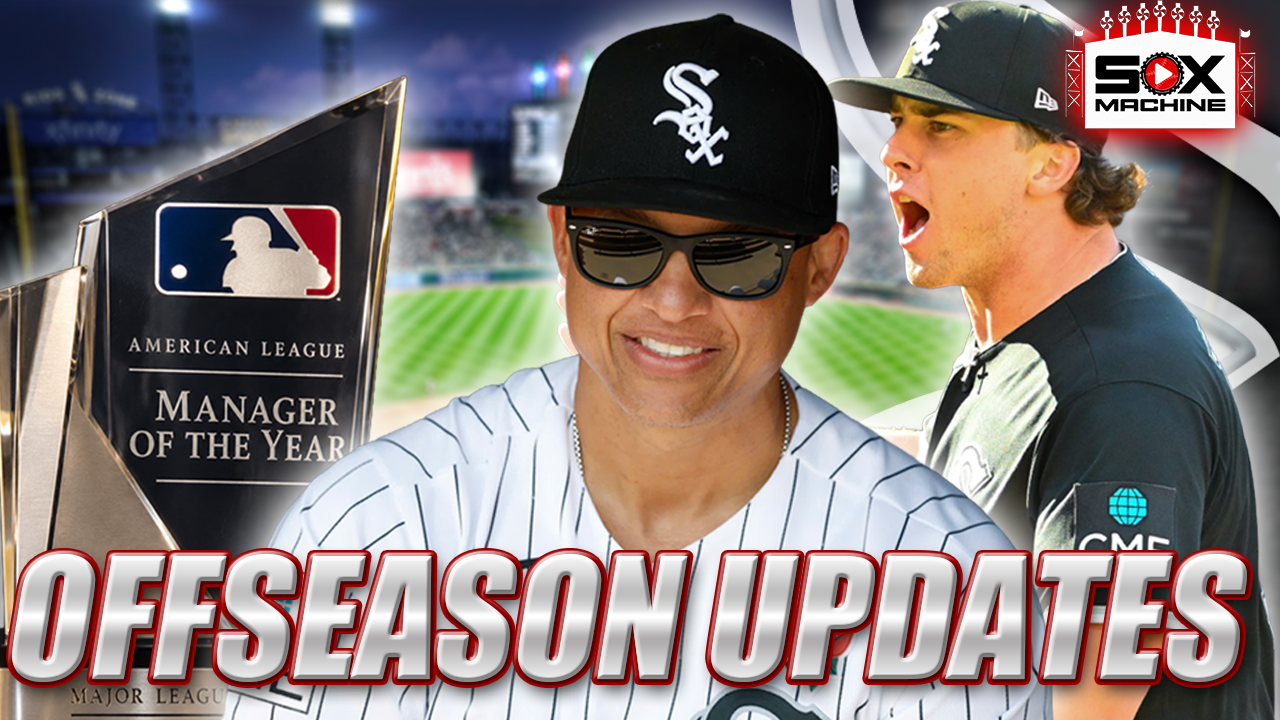
Will Venable rode an overachieving White Sox team to a Manager of the Year Award, but Chris Getz couldn't quite get the same bump toward an Executive of the Year nod, which instead went to Tampa Bay's Erik Neander.
Which stands to reason. While a manager might get credit for surprising the public and thwarting the projections, it's partially because the roster doesn't look that imposing, and probably hasn't for a bit. And while sometimes a team can spring a soundly constructed surprise because all facets are a year ahead of schedule, that can't be said for the White Sox. The rotation was unfinished, and while the offense packed a lot of punch, it also had the sort of swing-and-miss that showed why it wasn't necessarily designed to be playing in so many important games in 2026.
You probably want a little less incredulity around a team's successes before a front office can truly be trusted, and so that's why it makes sense that somebody like Neander would win top executive honors, which he did Wednesday night for the second time in his career.
That said, Venable's Manager of the Year Award reflects a higher-functioning White Sox front office, even if it's still far from a perfect machine. As much scrambling as Venable and his staff had to do in figuring out pathways to victory before and during games in 2026, Getz's administration worked hard to upgrade options throughout the seasons, both from inside and outside the system, mostly for the better (Randal Grichuk), although occasionally for the worse (Luis Castillo).
Getz has frequently referred to Venable as a "partner," most recently at the GM meetings, as relayed at the end of James' story about Venable's award ...
“He’s been a tremendous partner,” said general manager Chris Getz. “My hope is that Will and I can work together for a long time.”
... and what's peculiar about the White Sox is how long it's been since you could trust that a manager and general manager are "tremendous partners," which seems like something that should go without saying, at least at the beginning of tenures.
But it wasn't the case with Getz and Pedro Grifol. The former inherited the latter and didn't especially seem interested in propping him up as a leader, starting with the Dylan Cease trade in spring training that opened a giant hole in the rotation with no way left to fill it.
Maybe it could've been said about Grifol and Rick Hahn, but there was only about a 72-hour period where it would've been worth a damn. Once the White Sox started the season 1-9, the mold became impossible to remediate, and even Grifol bailed on investing further in the relationship, instead directing his flattery toward Jerry Reinsdorf.
Hahn and Tony La Russa? I'm guessing not. They won a division title together, but between Reinsdorf installing La Russa over the front office's wishes and La Russa's health issues rendering him unable to complete a second season, there probably wasn't enough time to jell even if they came around to each other.
You probably have to back to when the White Sox were Between Two Ricks, when Rick Renteria was promoted from bench coach by Hahn to oversee a true rebuild. That's probably the last time when a front office and a manager were on the same page, and it went well enough that Renteria signed an extension. Granted, Robin Ventura also signed an extension, but Renteria was actually credited with instilling a set of high-effort standards. That partnership eventually broke down under the strain of contending in 2020 -- the White Sox losing faith that Renteria could be The Guy, Renteria believing the White Sox didn't upgrade the team enough at the deadline to give him a chance of being The Guy -- but there was at least one term where it all went swimmingly.
And that's about it, even if you go back further. Ventura and Ozzie Guillén were both Reinsdorf favorites who convoluted the chain of command, as both were fired months or years after the on-field product deteriorated. And even though Guillén and Kenny Williams might've been tremendous checks on each other for 2005, the final years of that relationship showed the danger of relying on open-air volatility to propel the team in the correct direction.
Basically, over the last two decades, you only need one hand to count the years where a White Sox GM and White Sox manager were on the same page in a way that meant something, and it need not be an unmangled one. Perhaps that's the greatest sign to date that Getz has wrestled the operation out of the grips of Late Stage White Sox.
The next step is for Getz to announce a managerial extension like a normal person, which is something both Reinsdorf teams have proven incapable of doing. Hahn revealed Renteria's extension during the 2018 GM meetings, but in a peevish fashion that would become more characteristic over the last years of his tenure.
Renteria reportedly signed to manage the Sox for three years before the 2017 season, but general manager Rick Hahn said Tuesday that Renteria’s contract has been extended beyond the end of that deal in 2019.
“There’s no need to talk at this time,” Hahn said at the general manager meetings. “He signed an extension awhile back.”
Hahn didn’t reveal how long the extension was, only saying he was “extended into the future.”
So how did we all miss that big news?
“It wasn’t announced,” he said. “We don’t tend to advertise these things. We never even announced (it was) a three-year deal.”
Perhaps the White Sox didn't want to trumpet a Renteria extension after a 100-loss second season because it would have reminded everybody of the White Sox extending Ventura after a 99-loss second season. The White Sox did announce that one, and in the end, one contract would've been plenty.
But neither of those precedents apply to Venable, whose squad made history in his second season by nabbing a Wild Card berth after losing 100-plus games in three consecutive seasons. A well-adjusted team would treat a Venable extension like something to celebrate. Let's see if the White Sox have become that team.