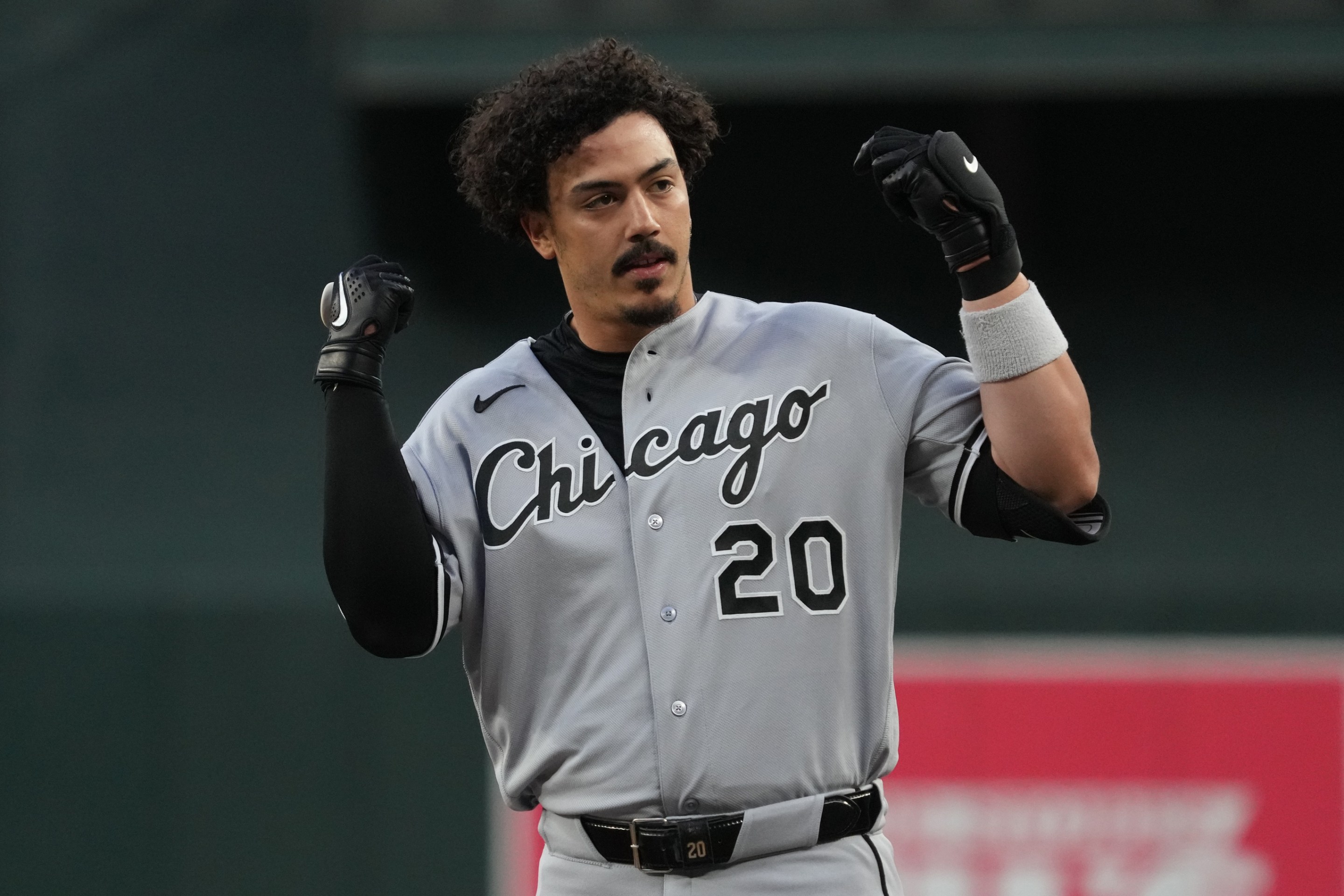
Back on April 18, the White Sox blew a five-run lead en route to an 11-inning, 7-6 loss to the Athletics in West Sacramento. Miguel Vargas drew a pair of walks, but otherwise went 0-for-4 to drag his average down to .153, and even the most hardened down-with-batting-average advocates would say that's not the kind of guy who should be hitting third.
If that snapshot more or less represented the rest of the season to come, then the conversation around Vargas would be rather straightforward. Maybe you tender him at the end of the season, maybe you don't. Maybe you trade him, or maybe he's a serviceable stopgap on the infield corners for one more year. Either way, the larger idea is that third base eventually opens up to be the final destination for one of the many shortstops in the White Sox organization, and Vargas is more like to be dealt for future considerations than be a part of Chris Getz's.
As it's actually played out, however, the White Sox and Vargas both hit their low-water marks on the same day, and have enjoyed a prolonged upswing since.
Since that agonizing defeat to drop to a season-low seven games under .500, the White Sox are 15-8 and sitting at .500 on the season after their victory over the Royals Wednesday night. And since Vargas finished that walk-off loss against the A's batting .153/.287/.306, he's hitting .324/.457/.635. That's good for a 200 wRC+, which is tied with Aaron Judge for the fifth-best in baseball.
Yet locally, he's been overshadowed twice over. There's Munetaka Murakami, whose presence atop the American League home run leaderboard has inspired thrice-weekly articles about baseball's failure to make a bigger bet than the White Sox did (the latest is from The Athletic's Sam Blum). Colson Montgomery also gets more national attention, partially because of his power exploits, and partially because he's a way better defensive shortstop than just about everyone envisioned.
There's no clearer example of Vargas' third billing than him homering over the first three games of this stretch we're discussing, but getting cropped out of the national fun facts because Murakami had his own five-game homer streak, and Montgomery reached four. The White Sox's M&M Boys made history with the lengths of their simultaneous streaks. Three guys with homers in three straight games? That had been done before. Multiple times, in fact.
Although unfair, it's easy to understand why Vargas is taking the backseat here. Murakami is brand new and was a subject of intense debate throughout the winter. What Montgomery's doing isn't novel, but reinforcing his breakout from the previous season on both sides of the ball eliminates whatever barriers were left in stoking genuine enthusiasm. In contrast, Vargas had a longer and far less exciting MLB track record, involving multiple false starts and painstaking progress that had only reached a modest level of stability as a second-division regular.
However, if you can set aside Vargas' more established and less exciting history, then he is every bit their equal. In fact, there's an argument that he's the most important piece, because his game has the most solid foundation.
Vargas' raw power might not be in the same neighborhood, but now that he's figured out the timing on his three-tick gain in bat speed, he's on a 35-homer pace, and was feet away from hitting his 10th of the season on Wednesday. He's drawing nearly as many walks as Murakami, a Three True Outcome king, yet he possesses the team's second-lowest strikeout rate and highest contact rate. A six-for-six performance stealing bases has him as the team's third-best baserunner per FanGraphs, and he's even raised his defense up to average. The result is a Statcast page that has a bigger surge of red than an Overlook Hotel elevator.
Because of all this, Vargas is running alongside Montgomery as the most valuable player on the White Sox, and a close second among American League third baseman to Detroit's Kevin McGonigle. But when you limit the time frame to the last 23 games, Vargas stands alone:
| White Sox | fWAR | AL 3B | fWAR |
|---|---|---|---|
| Vargas | 1.5 | Vargas | 1.5 |
| Montgomery | 1.2 | Okamoto | 1.2 |
| Antonacci | 0.7 | McGonigle | 0.8 |
| Murakami | 0.6 | García | 0.7 |
If the conversation is about which player should stand at third base at the All-Star Game in Philadelphia this July, then this chart is guilty of cherry-picking, as it omits the unflattering half of his season to date. But if the conversation is about whether the White Sox are for real, then this chart is worth taking seriously.
⚙️⚙️⚙️
It's fair to say that as Miguel Vargas goes in 2026, so go the White Sox. Hell, you could say that about his entire career on the South Side, going back to his first low-water mark shortly after the White Sox acquired him from the Dodgers at the 2024 trade deadline, which also took place in a stadium the Athletics called home.
Oh my god I’m so sorry Miguel 😭💔 pic.twitter.com/l8PHXrDVsW
— clarissa (@clarisssaaa_c) August 6, 2024
These White Sox were supposed to be a little bit better thanks to emerging talent like Montgomery and Kyle Teel, and perhaps a big boost from Murakami if the optimists won out. Vargas wasn't really a part of that conversation. Sure, he held a job to open the season, differentiating him from the bevy of out-of-options candidates the White Sox brought into spring training, but he was the uninspiring kind of 2 WAR player, without any defining strengths that can be complemented to get sneaky huge production out of the position.
Consequently, I'd only ranked him the 12th-most essential White Sox on Opening Day, and the algorithmic approach to determining importance didn't see a difference-maker with their preseason projections, either:
- ZiPS: .239/.329/.407
- Steamer: .238/.329/.405
- OOPSY: .242/.329/.398
Hell, even the rosiest possible projection, PECOTA's 99th-percentile outcome, put him at .254/.353/.461 with 24 homers over 592 plate appearances. Vargas' actual production so far in 2026, even with the lousy start, is outpacing it in the categories that count (.240/.376/.473).
Vargas could just be riding a heater that will eventually be diluted when his expected level of production returns, but with the components underneath the hood being so strong, it's worth entertaining the question of whether this version has staying power.
Prior to Wednesday's game, Chris Getz entertained that question as well.
"I'm going to steal the descriptive word that [assistant GM] Carlos Rodriguez uses: Is it sticky? Is what he's doing something that's going to be sustainable?" Getz told James.
"What I believe is what he's doing right now is sticky. You look at the underlying [numbers], the consistency of the swing, improvement on the defense, he's really blossoming into not just a major league regular, but a guy that is bringing that more value than just an average major league player."
Vargas' prospect stock was built on great swing decisions, and plate discipline remains his strong suit, as he somehow hasn't been required to sacrifice his contact ability to access more power. For that, Getz pointed to mechanical changes prescribed by Ryan Fuller that Vargas managed to implement.
"I remember talking to Ryan about some of the swing changes that he needed to make; 'How easy is this to accomplish? How sustainable is this?' And he said, 'This isn't an easy adjustment,' he did, 'But it is doable,'" Getz recalls.
"The other day, the game where he hit two homers, Ryan sent me a message. It was complimentary to the organization that we've been able to stay patient and give him the runway for him to go out there and do it, because there are different occasions across the game where you're not able to do that. And in this case we were, and he took advantage of it."
⚙️⚙️⚙️
Now Vargas has potentially given the White Sox something they can take advantage of, because if this version holds, it's like they signed an Alex Bregman without having to pay an Alex Bregman.
Had the White Sox made that sort of outside addition over the winter, analysts likely would have questioned the timing, but not the improvement to the on-field picture. Because Vargas is 26 instead of 32, because he was already on the roster, because he hasn't even reached arbitration eligibility, the White Sox are receiving the gains without any of the pains.
As long as he's playing like this, they're one player closer to contention, and that amplifies the effect of every subsequent breakout, whether it's Davis Martin being a first-quarter Cy Young candidate, or the Grindset Twins, Chase Meidroth and Sam Antonacci, holding down two positions instead of one. Kyle Teel's impending return feels momentous for precisely this reason, even if it's unwise to expect immediate results from a second-year player coming off a Grade 2 hamstring strain.
The caveat to this conversation is that Vargas regresses, which is probably more likely than Miguel Vargas: All-Star, but aside from the risk of shattered dreams, there's zero harm in indulging the most exciting possibility. A weak American League is inviting the White Sox into the party, and by the time the front office has to consider making a bet on the sustainability of Vargas' impact -- the trade deadline on Aug. 3 -- they'll have months of additional evidence either supporting or refuting the premise.
And the particular idea of a Vargas breakout is extra enticing, not just for what it means for the present and future, but for how it validates a little bit of the past. White Sox fans have seen enough tanking over the last decade to understand that most of it is "don't feel like spending" masquerading as a nobler cause, but a breakout like Vargas' wouldn't have been possible without the 180 games of low-stakes trial-and-error the dismal state of the franchise afforded him over the last two 100-loss seasons.
"[It's] obviously a testament to him," Getz said. "We were able to provide runway, and you can call it patience, but really it was just opportunity, and he's taken advantage of it, and I think we've supported him well."
As the White Sox gain legitimacy, such opportunities will ideally be fewer and further between, and the ones that emerge will be harder to support on such a generous timeline without dragging the team down. That's why getting something out of the years that didn't matter, specifically because of the forgiveness the team was able to extend, ends up mattering a great deal. Vargas' emergence might have taken many months longer than everybody hoped for, but if this version hangs around as the White Sox are ascending, then he's free to say he was right on time.