While the White Sox paid Austin Hays twice as much as the Mike Tauchman/Austin Slater platoon from last year for the 2026 season, they couldn't bank on getting greater health from the exchange. This is the third consecutive season Hays has missed time with a strained hamstring, and if the previous two years lay track for trends, then he's good for a strained calf at some point, too.
That said, at least Hays has become something of a subject-matter expert in the field of strain mitigation. He returned comfortably within the 2-4 week timetable, perhaps because he learned to pull up after it grabs.
"I've strained muscles before," Hays said in Kansas City back on April 9, not as a brag. "I went to get into another gear there with how far I had to go for that ball, and when I tried to push it to really get up to speed, I felt that sharp stabbing pain down low in the hammy. I knew it was my hammy right away. I tried to pull up off of it and get onto my other leg.
"I've had people tell me that when you feel it, if you take another another two or three steps, that's when you really go. So that's why I pulled up so hard the way that I did, and tried to jump on one leg so I could get off of it immediately. I don't know if that helped me or not, but initially, like I said, I thought it was a lot worse. But it was [a] low Grade 1 [strain], so maybe being able to pull up the way I did and kind of get off of it right away, might have saved me from making it worse."
There could be something to that, if only because Kyle Teel did his best to complete the play when legging out a double through his hamstring strain during the World Baseball Classic, and he ended up with a Grade 2 strain and a recovery that's slower than the more generous initial 4-6 week projection.
So credit Hays with some news you can use. It just doesn't instill confidence with how useful he'll be for the 2026 White Sox, especially since he wasn't allowed to complete his rehab stint in Charlotte. Instead, he'll be working his way back up to full-game privileges with Chicago, because when the White Sox lost Tanner Murray for the season with his shoulder injury, they had no other outfielders on the 40-man roster.
The White Sox outfield has been in various degrees of crisis for the majority of the season, but the Hays-for-Murray swap highlights a particular issue with the supply chain. With Braden Montgomery the only projectable true outfielder in the White Sox farm system, Chris Getz has been required to produce candidates from elsewhere, and the flaws with all of the sources have been revealed.
Let's set aside the small-potatoes deals -- waiver claims, minor trades or signings -- because they all face long odds, and the best way to overcome them is with volume. Even in higher times, the White Sox will still be inviting guys like Jarred Kelenic and Dustin Harris to spring training or purchasing the Tristans Peters of the world for depth.
Hays and Murray represent the other two channels -- the former fits the Outfielder the White Sox Can Afford archetype, and the other was an infielder pressed into outfield duty. The reason Hays was attainable for one year and $6 million was because along with the leg issues, he'd suffered through a kidney infection and a foot contusion, all of which sapped his production and/or limited his availability the previous two seasons.
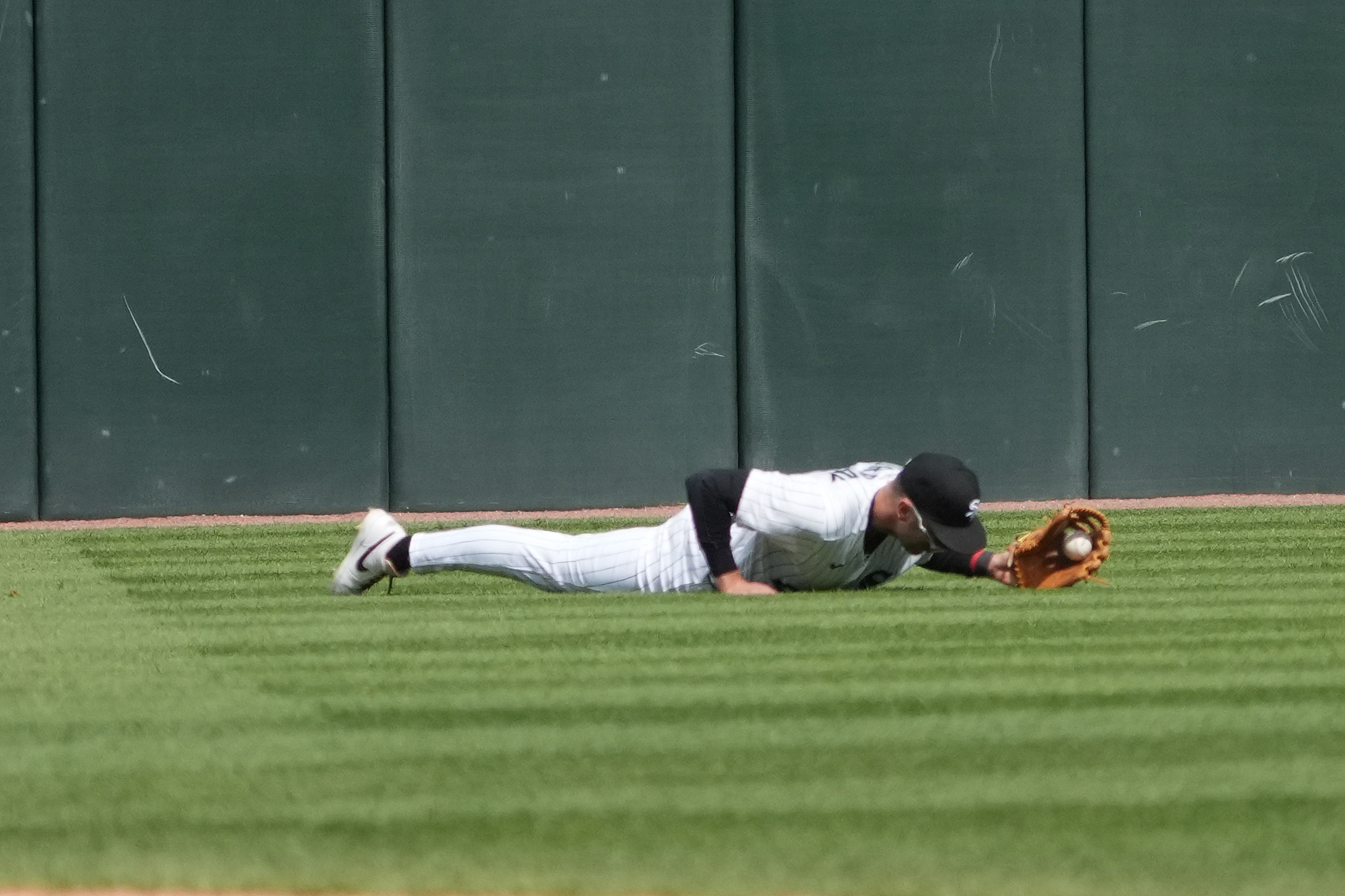
Meanwhile, Murray is one of a number of infielders the White Sox have extended into the outfield, and the Pyrrhic victory of his diving catch reminds everybody of the risk. It's possible a career outfielder might have similarly injured himself laying out like Murray did on Sunday, but somebody with more experience is more likely to have refined their technique to spread out the impact.
Other White Sox infielders-turned-outfielders have dealt with other issues specific to being unfamiliar with the position. Luisangel Acuña has had to change his target on throws from center field because his infield throwing motion produces two-seamers that tail well away from more distant destinations. Brooks Baldwin felt pain in his elbow this spring while throwing to bases before eventually undergoing Tommy John surgery to remedy the issue, and while the origin of his elbow issue was as murky as the decision to have the procedure, it brought to mind Tyler Saladino's UCL repair from 2014, as he injured his arm throwing home from left field.
The injury occurred when Saladino was playing left field, and he felt something in his arm when throwing out a runner at the plate, according to reports at that time.
But preparation has become the key, and the safety measure for Saladino, who has done consistent outfield work along with everything else.
"I'm making sure to play catch, and lengthen it out," said Saladino, pointing to the outfield glove in his locker. "That was the difference back when I did get hurt.
"Playing the infield my whole life, and then all of a sudden making a lot longer throws. I learned from that, and work on keeping those throws in during practice."
James asked Will Venable about such risks before Monday's game, and Venable said they had safety in mind, but a dive like Murray's wasn't the central concern.
"Maybe not in the sense of diving, but certainly with communication, we think that’s something that’s really important," Venable said.
"From a health standpoint and safety standpoint, communicating when you are getting closer to another outfielder or infielder, that’s something as someone who doesn’t play a ton of outfield, you would have to give extra attention to."
This is true enough, in the sense that a collision risks severely injuring two players instead of one, and Acuña's near-miss with Peters in Miami or William Bergolla Jr.'s current presence on the Triple-A IL could be top of mind. But the other actions aren't something to disregard, because unless Everson Pereira has staying power and can recommend some friends, the White Sox's roster-building strategy is reliant on some of these conversions panning out.
Sam Antonacci is the current career infielder hurling his body around left field and had himself a fraught ninth inning earlier just this morning. If the White Sox indeed draft Roch Cholowsky or another shortstop first overall in the upcoming draft, they'll have to consider shifting other important prospects as well, including but not limited to Caleb Bonemer. If the Sox can't trade their way out of it, perhaps more thought needs to be put into training in the high minors, rather than having the learning curve still be so visible upon arrival in Chicago. Because without adequate investment or preparation, something has to give, and right now, body parts are being forced to wear it.