The White Sox are, by their own admission, throwing a helluva lot at the 24-year-old Luisangel Acuña.
"Since the beginning of spring training, our main focus was to get him to be comfortable," said first base coach José Leger, who spends the most time on a daily basis aiding Acuña in his transition to center field. "Even though he played the position there, that's not his primary position."
"It's a lot for a young hitter, too," said hitting director Ryan Fuller. "New organization, he wants to impress, he knows he was part of a trade and there's a lot that goes in the personal side, too. Usually for all these guys, the more we try, the harder it gets."
And while he's not inclined to blame the myriad offensive and defensive adjustments he's undertaking, Acuña would also readily admit that it's a grind at the moment. Even after collecting his first extra-base hit of the year this past weekend in Sacramento, he's hitting just .197/.242/.213 on the young season, and Statcast metrics already have the fleet-footed utility man in the negatives for his jumps, routes and overall defensive performance in center field.
That seems like a lot to deal with for a young player trying to prove himself capable of holding down a regular role for a new organization, let alone one that acquired him by trading a franchise mainstay like Luis Robert Jr.
Counterpoint: Maybe it isn't.
"Honestly it hasn't been that difficult. You just need to trust what you're doing and trust the process, and I'm confident that sooner rather than later, the results are going to start to show up," Acuña said via interpreter. "It's not the first time that I've passed through this. I'm confident that I can get over this rough stretch, and the way to do it is to just keep working and keep trusting myself."
The "sooner rather than later" mention underscores the fundamental tension in this project the White Sox have undertaken. The physical tools Acuña brings to the table have been present. His sprint speed is top of the scale and been in use, as he's 6-for-6 on steals on the year despite only reaching base 16 times so far this season. His bat speed has rebounded from last year, and he's making plenty of contact (14.9 percent strikeout rate) despite his chasing going up.
A talented young player struggling to insert an organizational emphasis on keeping his weight on his back leg longer to elevate the baseball (59.6 percent ground ball rate), who is also seemingly pressing (career-high 34 percent chase rate), who is cycling through different setups to respond to coaching suggestions that he starts his hands lower, and recently dealing with issues of opening his front shoulder too early, all would suggest the remedy of optioning him to Triple-A. Major League Baseball is fast, and these are a lot of tweaks to install at full speed, and we haven't even discussed his defense yet.
But the nature of the bet the Sox made on a player out of options is that Acuña could handle these adjustments while still being a useful big leaguer.
"He's been unlucky, he's hitting balls hard [author note: likely referring to his 80th-percentile squared-up rate], plays have been made. 'How do I get back to hitting line drives, getting the ball off the ground a little more?'" Fuller said. "[It's about] making him feel as comfortable as possible, where it's not a test, where if you go out to each game and don't get a hit in a game you feel like i have to come back and think about the reason why. Being able to flush it quickly and trust that the work he's putting in every day -- because he's grinding every day to make sure he gets it right -- shows up."
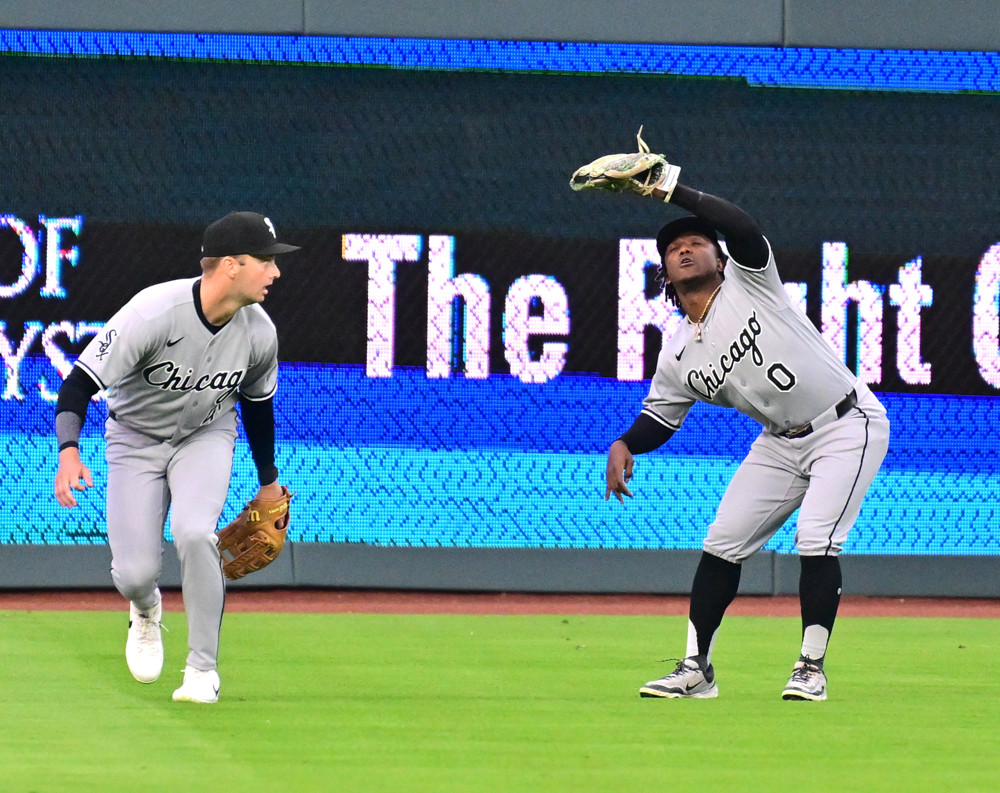
If Acuña's self-aware but untroubled quotes, his receptive responses about Sox coaching tweaks, or the sight of him making a catch in center in a nervy ninth-inning in Kansas City with the outfield positioning card in his teeth are any indication, the team has succeeded in making him comfortable. But his early defensive returns have demonstrated how much more there is to be a good major league center fielder than blazing speed and athleticism.
Especially for someone who came up as a shortstop, the emphasis on pre-pitch movements under Will Venable's staff has laid bare the learning curve that Acuña must navigate.
"I've been doing it in the same in the outfield as I do it in the infield just because I'm an infielder, right?" Acuña said via interpreter. "That's what I'm used to."
"You want to be earlier in the infield as opposed to later in the outfield; you don't want to land too early because then you get flat-footed," said Leger. "You're a little farther from the action, so the pre-pitch takes place just a tick after the infielders execute it. If you were to look at a low angle camera angle and you're looking at the pitcher, middle infielders and center field, you can see they work in sync. When the pitcher delivers the ball, you can see the middle infielders jumping up and down and their feet are hitting the ground as the ball enters the strike zone. But the outfielder, they have to wait just a little longer, so they're landing as the ball is hit."
Like Acuña, Leger's first language in Spanish, which has made him an essential point person in providing immediate feedback in the dugout about his defensive responsibilities. While Acuña's pre-pitch movement clearly has a ways to go, as both he and Leger admit and his Statcast outfield jump metrics bear out, the pair have also been at work on other projects.
After both issues figured prominently in the series in Miami, Leger has been on the soft-spoken Acuña to be more vocal in his calls in the outfield, which has been quite a hill to climb considering he's being asked to take charge of plays over more experienced fielders. And when two throws home sailed arm-side in Miami, Acuña got a lesson that he needed to reset his target on all his throws to account for the natural two-seam movement his short arm action generates, which never was as big of an issue on shorter infield throws. Leger said Acuña also needed to focus on setting his feet more on throws compared to the infield, where throws on the run are more necessary.
"He's learning and progressing daily," Leger said. "Our main focus with him was just getting to execute the pre-pitch [movement] on every pitch that is thrown. Sometimes you feel like you're isolated when you're in center or in the outfield in general, as opposed to where there's more action in the infield. So getting him to do the pre-pitch every pitch, do not take any pitch off. That and just the first step, making sure that that becomes a priority, because when you have a quick first step, he makes up for some bad reads."
Acuña has the speed to make up for some bad reads, and to make the most of his time on the basepaths. Given his offensive shortcomings, being able to ably pivot between defending shortstop and center field, or even elsewhere, are likely his surest route to being a useful contributor to a winning team. But at present, it looks like too much to balance while also being immediately help a White Sox team that isn't a winning one, but still feels real pressure to be better right now.
Or maybe the pressure isn't too great at all, according to the guy who should be the one feeling it the most.
"I don't feel pressure," Acuña said. "I know what I can do and I just go out there and try to do my best."