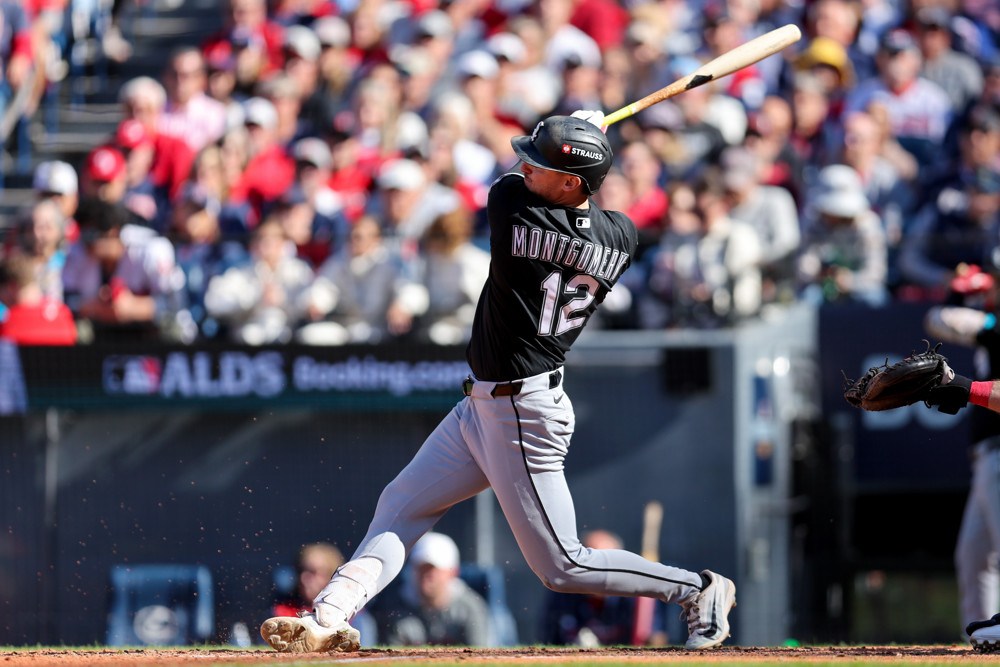
An inning after the wind knocked down a Tommy Pham drive that most everybody expected to land several rows deep behind Progressive Field's big wall in left, Colson Montgomery added the third and final run in the White Sox's Game 1 victory over the Guardians on Saturday in a less resounding way, but one that shouldn't be overlooked.
There's the matter that he kinda cued a grounder where he never hits them, which is how a 64 mph squibber ended up rolling past a wide open third base area and down the left field line. It also scored a catcher from first thanks to a proactive send by Justin Jirschele, a baserunning sequence that was far more effective than it was elegant.
But it's also worth noting that Montgomery produced that hit off a lefty in Erik Sabrowski. Combine it with Munetaka Murakami's thunderous two-run homer off Parker Messick, and all three of the White Sox's runs came from left-on-left successes.
By shank or by crank, foiling matchups has been a big part of the White Sox's success early. Their lefty-heavy lineup encouraged Joe Espada to throw a lot of southpaw relievers as part of bullpen games, but as it played out, it kinda lured Espada into using a lot of relievers who might not have ordinarily qualified for work in a postseason game.
That carried over into Game 1 of the ALDS. It wasn't unthinkable, because a lack of same-sided changeups allowed lefties to be a little bit more effective against Messick than righties, but capitalizing on that particular vulnerability -- if you can even call it that -- shortened Messick's afternoon and forced Stephen Vogt to use his bullpen longer than he's accustomed to. Guardians relievers pitched well enough, although partially because Pham's drive died in Angel Martinez's glove before it could touch the wall.
Through three games, White Sox lefties are hitting .409/.500/.591 over 27 plate appearances against lefties:
| Lefty | PA | H | 2B | HR | BB | K |
|---|---|---|---|---|---|---|
| Murakami | 8 | 3 | 0 | 1 | 1 | 3 |
| Montgomery | 6 | 2 | 1 | 0 | 0 | 0 |
| Teel | 6 | 2 | 0 | 0 | 1 | 1 |
| Peters | 5 | 1 | 0 | 0 | 0 | 1 |
| Antonacci | 2 | 1 | 0 | 0 | 0 | 0 |
| Total | 27 | 9 | 1 | 1 | 2 | 5 |
That chart captures the earned results for better or for worse, but there have been other productive plate appearances that chart doesn't capture. In the Wild Card Series, Montgomery got plunked by a 1-2 fastball from Houston lefty Bryan King to load the bases in the second inning of Game 1, which loaded the bases for Sam Antonacci's lone hit against lefties, a two-run single that extended the White Sox's lead to 3-0 (Kyle Teel followed with one of his two singles that chased King from the game).
Tristan Peters was also able to stay in that game against Bennett Sousa by successfully bunting runners to second and third, which set up #WILDPITCHOFFENSE one batter later to make it a 5-2 game. You might shrug at a sacrifice, but Peters made himself useful and allowed Will Venable to close out the game with his best defensive outfield alignment, with Peters moving from center to left for Brenton Doyle, and Braden Montgomery holding down right field the whole time.
Some of this success is pure luck, and others are calculated risks that are breaking the White Sox's way, but whatever the balance is, it's working. Whether it's keeping the better defenders in the game, allowing the righties in the lineup to gain the platoon advantage, or keeping bench bats holstered for higher-leverage situations, there are multiple benefits for every left-on-left success beyond the value of the individual plate appearances, and these little victories have added up to three victories in three games so far this October.