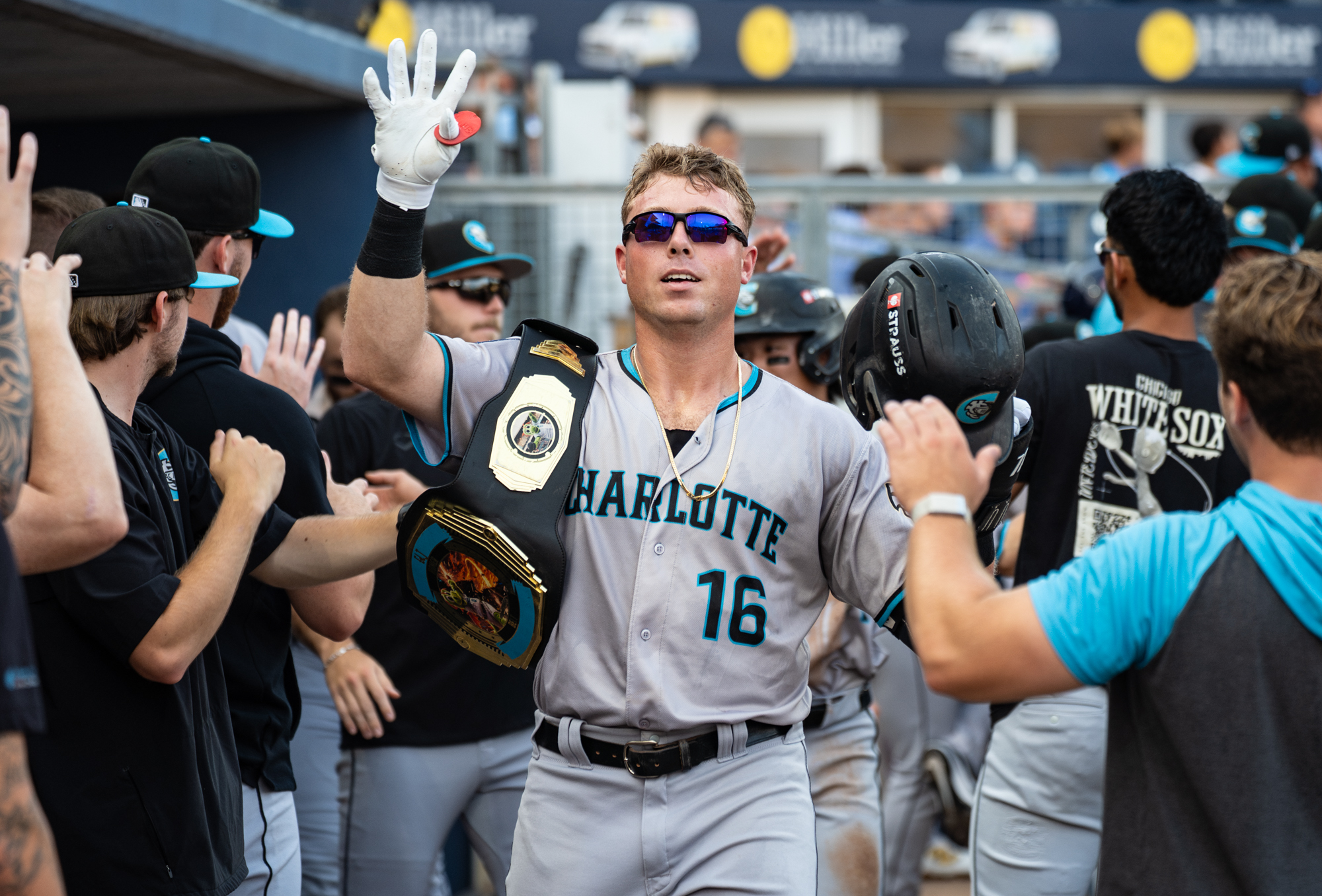
The headline and photo above this paragraph spoil the answer, but if you're reading this article on your phone next to a White Sox fan who knows ball, ask them who's the active leader in the the White Sox minor leagues in OPS since the start of June.
After the trade for Luis Castillo that sent Boston Smith to Seattle's Double-A affiliate, the answer is now Ryan Galanie, and with a little bit of room to spare.
Boston Smith, .300/.483/.639 over 178 PA- Ryan Galanie, .339/.386/.630 over 208 PA
- Ronald Cardozo, .336/.426/.567 over 162 PA
- James Taussig, .280/.377/.610 over 231 PA
If Galanie has flown under your radar, it's not necessarily because you've been sleeping. The origins are humble, as the White Sox drafted him in the 13th round after his senior season at Wofford College in 2023. He hit .276/.328/.422 in a season spent mostly in Birmingham in 2025, a respectable line for Double-A, but not particularly projectable for a 25-year-old first baseman. He followed it up with an unsuccessful showcase in the Arizona Fall League, and scuffled to open the season in Birmingham. The White Sox nevertheless promoted him to Charlotte mostly to solve immediate roster needs, and he spent the first couple months navigating the advanced sequences of Triple-A pitching in a platoon role with LaMonte Wade Jr.
Despite the restrained start, Galanie surpassed all of his previous power highs with more than a month remaining. It'd be easy to reflexively dismiss it -- or at least qualify it -- as a Charlotte creation, but then you look into his numbers and see that he's actually hitting slightly better away from Truist Field (.279/.358/.570). That includes three homers in Nashville when Charlotte visited late last month, and First Horizon Park has a reputation for containing a lot of loud contact.
Talking to Galanie there late last month about the shape of his production over his last 365 days -- a period that opened with a trip to the injured list after a pickoff throw hit him in the face -- every point for skepticism about his profile has a rebuttal with some substance.
The muted Birmingham line
Galanie's attempt to develop his pull power was a known project at Birmingham last season, but it was hampered by two different factors. The Southern League quieted bats like a weighted blanket in 2025, with an environment so pitching-friendly that Braden Montgomery got used to settling for doubles, and Sam Antonacci saw gunning for homers as a pointless venture.
The offense that the Barons designed to compensate for the suffocating environment involved a heavy combination of Antonacci, Rikuu Nishida and William Bergolla Jr. getting on base and running like mad. The subsequent number of opportunities with runners in scoring position allowed Galanie to accrue an organization-best 94 RBIs, although his 12 sacrifice flies contributed nearly as much to the total as his 11 home runs.
The combination of those elements turned Galanie into a drummer tasked with serving the song, rather than bashing the skins.
"There's guys getting [on base] all the time, the situation where the game is calling for a different attack and strategy, I guess is the best way to put it. Last year was definitely more of a line-drive approach in Birmingham," Galanie said, noting that Regions Field no longer looks as cavernous with the way the ball is flying in 2026.
"Last year was just trying to keep it low, line dives through the infield, find grass in the outfield. I'm still trying to hit line drives now, but I think I'm getting a little bit more under the ball, and Charlotte of course plays a part in that."
The poor AFL showing
The White Sox sent four position players to the Arizona Fall League after the regular season, and 75 percent of them thrived. Braden Montgomery, Sam Antonacci and Caden Connor had a grand old time in the desert air, but Galanie saw no benefits, hitting .212/.362/.231.
But Galanie also had trouble seeing other things, like the baseball.
It stemmed from a facial injury Galanie suffered missing a pickoff throw against Chattanooga on Aug. 9.
"It's just one of those freak accidents in baseball," Galanie said. "They don't happen often, very rarely do I miss a ball, ever, and it just happened to be in the middle of the game."
The result was a fractured orbital bone, external and internal eye bleeding, a deviated septum, and a left eye whose movement and pupil size doesn't always match that of his right. He returned a few weeks later taking eye medication and wearing a face guard (or "Kobe mask," as Galanie put it), but when a quiet finish to his Double-A season was followed by an inability to drive the ball in Arizona, it became clear that he came back with compromised vision.
"I went to the eye doctor and funny enough, I had a prescription that I now needed to wear," Galanie said. "I got that, but it was a little bit too strong, I got some headaches. I got it altered, and did a lot of sport vision training in the offseason because the orbital fracture shifted my eye in my socket, so instead of both of my eyes working together, they were kind of contrasting and working against each other. I had to refine that, and then along with the glasses I feel like I'm seeing better than I ever have before."
This year's slow start
At the time the White Sox promoted Galanie to Charlotte on April 17, he'd hit just .220/.389/.342 with the Barons. It was just the first 12 games, a sample size too small to inform in any way, but the move was more driven by the fact that Jason Matthews, a 29-year-old organizational player, was the only righty-hitting non-catcher on the roster.
Because of the imbalance, Galanie opened his Charlotte career in a soft platoon role with LaMonte Wade Jr., which limited his overall reps. But it did expose him to a greater concentration of left-handed pitching, which gave him the opportunity to shore up his production against them. He sported reverse platoon splits over his first two full seasons in pro ball, which he speculated last year was due to a lack of exposure, both in college and the minor leagues in which he played.
"I definitely feel like I found a lot more comfort against lefties this year," Galanie said. "A lot of the training that the White Sox told me to start doing, and then what we did throughout spring training and then to this year has helped a lot, especially here. We kind of play matchups a little bit more, I get to face a ton of lefties, whether I'm [starting] or not. We had so many lefties in my lineup that if I get surrounded by a couple of them, a lot of times teams have put in a lefty, and I just mix in and see it."
Consequently, his production with the platoon advantage has taken another jump.
- 2024: .177/.286/.279 over 91 PA
- 2025: .216/.294/.443 over 102 PA
- 2026: .276/.364/.526 over 88 PA
It's an important gap to close, because should Galanie crack a major league roster at some point, he can't count on everyday runway to make it work. His profile is not a metrically imposing one. Though his swing decisions are generally sound, he doesn't walk like a power hitter. His contact rate has dropped 5 percentage points this year, and while that partially reflects a willingness to get off his A-swing earlier in counts and accept a swinging strike on a breaking ball, it's still producing top-end exit velocities and hard-hit rates that are below the major league average, and even more below-par for a first baseman. That's why he's playing an unprecedented amount of outfield, which Knights coaches say he's athletic enough to handle, even if they're positioning him deeper for added forgiveness on his routes.
But underneath it all, he's responded to instruction, he's adjusting, he's improving, and he's now leading the system in offensive production while playing every day at the highest minor league level. It's hard to know what to do with it from here -- if this year's precedent holds with Smith and Jacob Gonzalez, the answer is "trade him" -- but until that happens, you'll hold up your end of the bargain if you merely notice it.