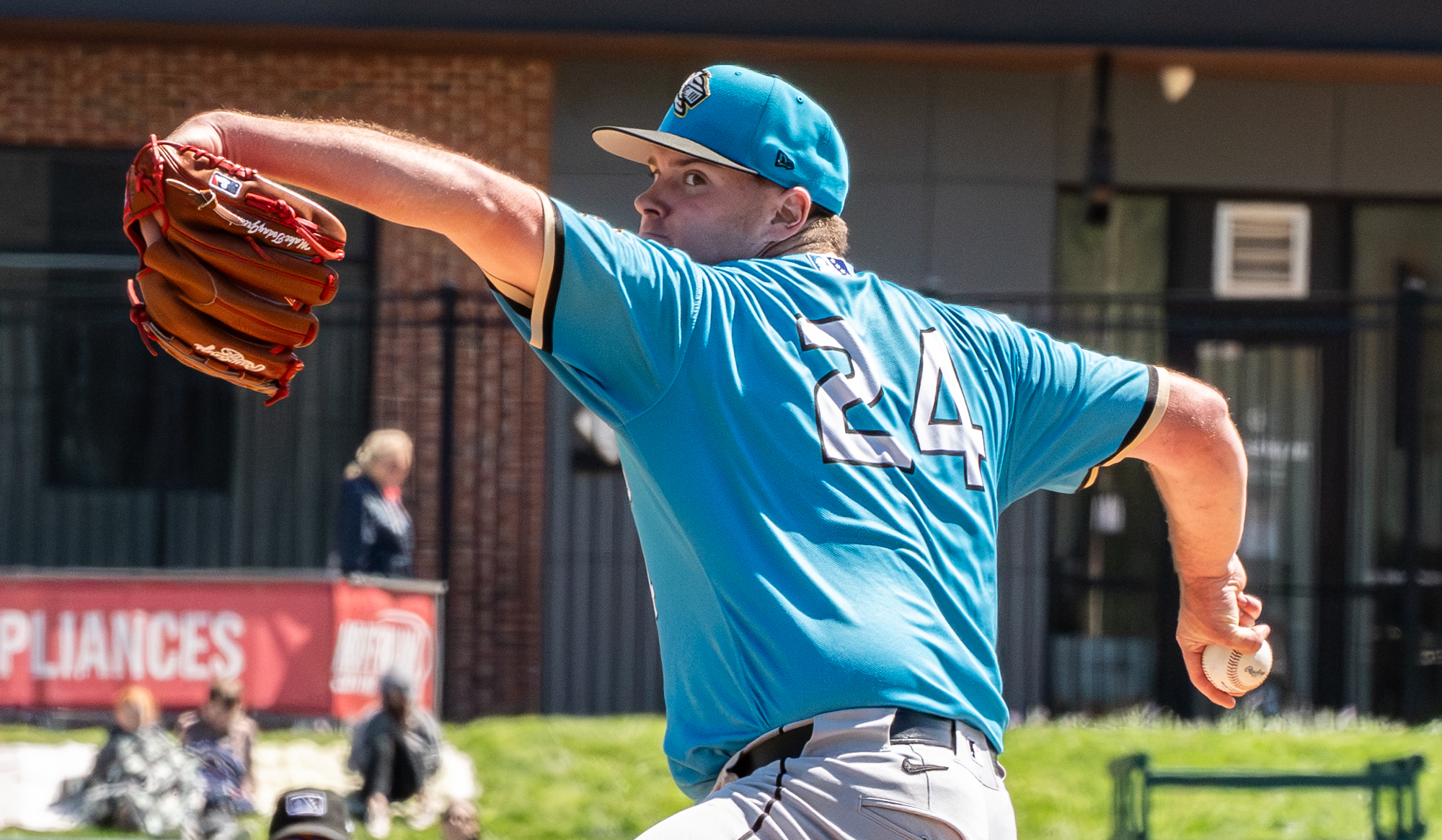
Tanner McDougal kind of set himself up for this.
Upon being added to the 40-man roster last November, the high-ranking, hard-throwing White Sox pitching prospect repeatedly stated his eagerness to be in the majors, and his understanding that debuting in the bullpen might accelerate his arrival.
"At this point, I'm just trying to do anything I can to help the big league team out," McDougal said in November. "Whether that's out of the bullpen, whether that's as a starter, whatever they need, I'm willing to do."
So while he was surprised on the specific July day he was called into Chad Pinder's office, and spoke with the Charlotte Knights manager and assistant general manager Josh Barfield about shifting to relief, rather than a slow build-up back to starting that wouldn't have him stretched out until mid-August, maybe he wasn't quite stunned. The White Sox have publicly said McDougal will get to prepare for next year as a starter, and this is merely a means of expediting the right-hander pitching in the majors after missing two months of his season with a flexor strain.
"I think it definitely could, and that's why I'm taking it in stride," McDougal said to Sox Machine by phone. "Whatever I can do to help up top is obviously the No. 1 priority."
In light of hamstring tightness that precipitated the flexor injury, and a shift toward now working more frequently, McDougal's daily workflow has become consumed with perfecting his physical recovery. The scheduled mid-week bullpens that a starter receives are gone from his schedule, but also daily catch play needs to be lighter and is more about just getting loose than practicing things via a lot of higher-intensity reps. The days he lifts weights can no longer float around between starts based on how he feels, they have to be regimented because the pitching schedule of a major league reliever, which he is now striving to be, is fundamentally unknowable.
So McDougal is now a 23-year-old who talks about "being dialed in on my vitamin routine" and red light therapy, alongside a battery of massages, saunas and cold plunges. Hamstring strains often stem from dehydration, so McDougal says he's drinking the most water he's ever consumed in his life, and concedes that he still enjoys the occasional soda like it's his dark secret.
"When you're getting drafted out of high school, your normal is rolling out of bed at 6:30 in the morning, going and playing two games, and then going and hanging out with your buddies that night, and then doing it all again tomorrow, and you don't feel a thing," McDougal said. "Obviously, I am not old, and I'm not claiming to be old, but as I've gotten older, I've started to understand that you've got to take care of your body, otherwise your body gets pissed off at you."
At least the mental side of recovery remains the same.
"Good, bad, or indifferent; you get 30 minutes to an hour to wash it, and then on to the next day," said McDougal.
McDougal has allowed one run over his five relief outings for Charlotte since returning, the double he allowed to Jose Barrero Tuesday night was his first extra-base hit yielded in that spain, and he's sitting 98 mph with his fastball. The basics of the argument for how he could help a major league bullpen are pretty strong, but as someone who has published some very rosy evaluations of McDougal in the past, this recent stretch (5.2 IP, 3 H, ER, 4 BB, 5 K) isn't him yet at the height of his powers.
"Zeros are zeros, and zeros are good," McDougal said. "But would I like to be missing more bats? Yes. Would I like to be getting through these innings in less stressful situations, as far as pitches go? Yes. But outs are outs, you can't take them for granted. So, I think there's definitely some refining to do, and I think there's definitely some stuff that is right around the corner."
McDougal thinks the fundamental job of filling up the strike zone is the same out of the pen, but that one of the benefits of relief is not having to think about saving pieces of his arsenal for second and third encounters. His velocity is clearly premium, but both scouts and metrics say McDougal's fastball lacks bat-missing shape when it leaves the top rail of the strike zone, and an optimized version of him might use his four-seamer 40 percent of the time or less.
Instead, per Synergy, McDougal has been throwing nearly 70 percent heaters since rejoining the Knights, and almost none of his curveball -- though there's a useful truism to refer back to when analyzing all of his post-rehab action to date.
"When you don't throw for two months, sometimes you lose feel for some things," McDougal said, extremely correctly. "So, I don't want to go out there and throw something that maybe I'm not trusting 100 percent."
He wants to incorporate the curve a bit more, and he did throw one on Tuesday, because he thinks even when it's playing more like a big, looping breaking ball, it will be an easy early-count strike-grabber. But the right-hander says he's been focusing on being fastball-slider out of the pen so far in light of how well the two pitches tunnel with each other.
It's just that his slider has sort of had an altered shape at times this year -- bigger movement, closer to 85 mph rather than 87 -- in a way that has made it more of a chase pitch.
It wouldn't be wise to overstate how much it's hurt him, because McDougal is running a 53 percent miss rate on his slider in Triple-A this year per Synergy Sports, and for the sake of comparison, Chase Burns is running a 51.2 percent miss rate on his slider this season in the majors. But he didn't get any whiffs on it Tuesday night, and McDougal certainly has thoughts about its varying shape.
"Spinning it more efficiently this year, so I think that's why it's getting a little bit bigger," McDougal said. "I would like to have the short, sharp slider, but I feel like I can kind of differentiate the two. Obviously, down the line, I want one shape, and whatever it's going to be, is whatever it's going to be. But right now I'm not necessarily worried about it, because I'm able to get outs with it and I'm able to somewhat control what I'm doing with it.
"So, we're not super worried about it. I would like it to be a little bit more consistent just because if I know I can throw this pitch here or If I start it here, it's going to do this. Where sometimes it is getting a little sweepy and slower, which I'd rather throw it harder. If it's going to be sweepy, that's fine, but I'd rather it be a harder sweeper or [a] bullet[-spin slider] than kind of loopy."
Longtime subscribers will not be surprised to know that slider shape was only one of the pitching nerdery rabbit holes this interview went down, with the other being an exploration of McDougal's emphasis on delaying his lower half rotation for as long as possible, to give his arm enough time to get into firing position by foot strike. But the takeaway would be similar.
The Sox may have accelerated McDougal's buildup from injury by shifting him to the bullpen, but the process of getting him in sync and pitching his best baseball after two months on the shelf remains ongoing. Like the other members of the vaunted Knights Opening Day rotation, and mostly due to injury, he's flashed the ability that inspired such spring optimism rather than sustained it. But after showing he can pitch three times in a week and handle multiple innings, McDougal hopes he's put himself in position where his workload capacity won't be in question.
His eagerness certainly never has been. It sounds pretty much the same as last November.
"Whatever is needed of me, that is what I want to be able to do," McDougal said about what frequency level he's building up to. "So I don't necessarily have an answer for you, other than the fact that I'm willing to do whatever it takes to achieve where I want to go, and help wherever I'm at."