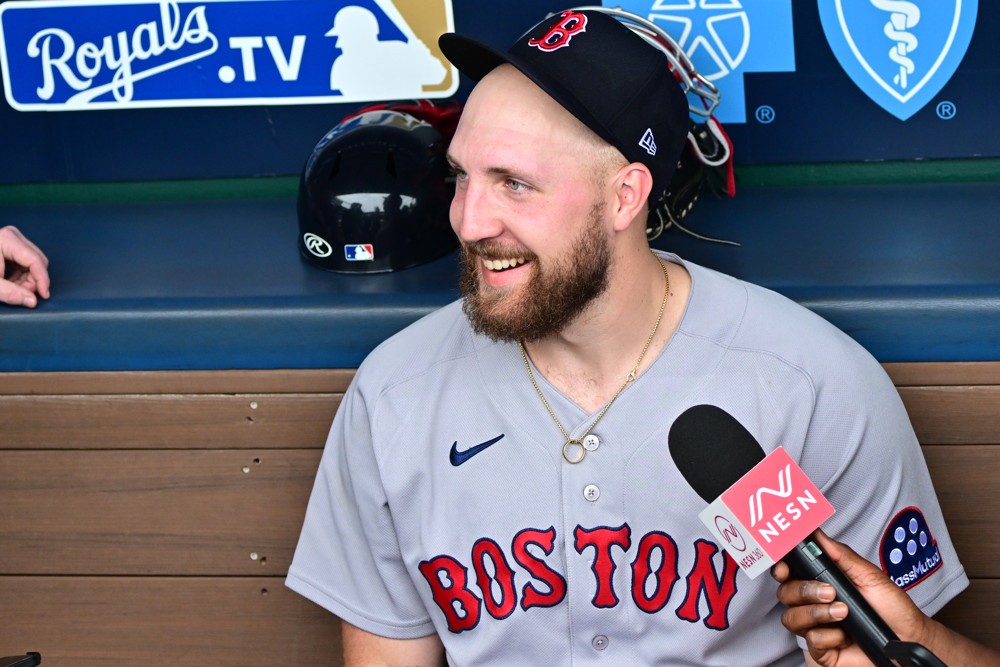
The week Braden Montgomery made an instant impact for the White Sox, Garrett Crochet's season in Boston took another turn in the wrong direction.
Crochet has been sidelined since late April, first with left shoulder inflammation, and then a lat strain he suffered while playing catch. He caused a panic when he said latter injury was "a lot worse than we thought," which caused him to go into verbal damage control detailing the relationship of both body parts and the risk of overcompensating.
“I was talking about my shoulder,” said Crochet. “I think we all, you guys included, from the information that I was receiving and relaying to you, wouldn't have expected the shoulder to keep me out as long as it has.
“When you're dealing with the capsule, it's a little finicky, and it's a very crucial component in overhead throwing, so it was really something that we didn't want to rush, and you add the lat into that. That's kind of what I was referring to. It's just taking longer than expected to bounce back from everything.”
Luis Robert Jr. has also been on the shelf since April, and while he's been seen throwing and doing light hitting, his situation remains unclear enough that Mets reporters are resorting to italics.
The Mets worked hard this spring to keep Robert healthy, holding him back at camp to strengthen his legs after acquiring the outfielder from the White Sox. Robert bought in to that process, doing everything he could behind the scenes to distance himself from his oft-injured reputation.
And yet, he couldn’t avoid the IL, suffering a new type of injury. To make matters worse, not only has Robert already missed a significant chunk of the season with this back issue, but after six-plus weeks on the sidelines, the outfielder and the Mets still don’t have any sort of concrete timetable for when he’ll be back.
These injuries continue to validate the White Sox's decision to trade both players -- whether it was Crochet at near-peak value, or Robert for whatever they could get -- just because their roster wasn't nearly complete enough to allocate so much money in the direction of one or two players, especially one with Robert's injury history.
That said, as the last round of rebuild trades showed -- particularly the Adam Eaton deal -- it's one thing for the trades to initially pass inspection, and another thing for them to be iterated upon effectively, which is where the Kenny Williams-Rick Hahn administration stalled.
It was at this point where the White Sox started extending players and locking down their core, and while there's a lot of conversation here and elsewhere over which players the White Sox should prioritize extending, the lack of cost certainty is almost a selling point for this front office.
Back when the White Sox explained their abandoned pursuits of Manny Machado and Bryce Harper by saying they might eventually have to trade away piece of their supposed core to afford them, if reflected an unwillingness to consider ways of pivoting from their first draft, even for good reasons -- like wanting to accommodate a younger, better and cheaper player they produced from within. As it turned out, they were right to lack faith in their player development engine, but whether that awareness was conscious or subconscious, it didn't help the team any.
At some point, perhaps in the near future, it'll make sense for the White Sox to strike deals with the players they want to keep around past their original team control periods, but for the time being, the open-endedness of the roster is able to absorb and account for all sorts of surprises, especially the good ones.
⚙️⚙️⚙️
In injury news that's only tangential to the White Sox, I've been following the disconnect that's been brewing in Baltimore between new manager Craig Albernaz and Samuel Basallo, who has been dealing with left wrist discomfort.
Basallo had spent a lot of the week out of the lineup. Albernaz said that he wants Basallo to learn how to play through pain, which seems like a knock on his toughness. Basallo has said that he doesn't control when he starts, which suggests that he's being benched beyond the time he asked off. Nobody is saying that's the case on record, but Orioles analyst Jim Palmer highlighted the space between the lines on a broadcast by questioning the timing of Albernaz teaching Basallo a lesson during a losing streak.
The interpretations of the disagreement cover the spectrum -- here's a defense of Basallo, here's a defense of Albernaz, here's one saying both sides need to solve it -- but it's mostly interesting from afar because Albernaz was a candidate for the White Sox's managerial vacancy two seasons ago, but reportedly removed himself from consideration before the Sox hired Will Venable. By waiting a year, Albernaz got to take over a far more talented team, but perhaps he missed out on what Venable to got to enjoy, which was no immediate expectations and the lowest possible leadership bar to clear.