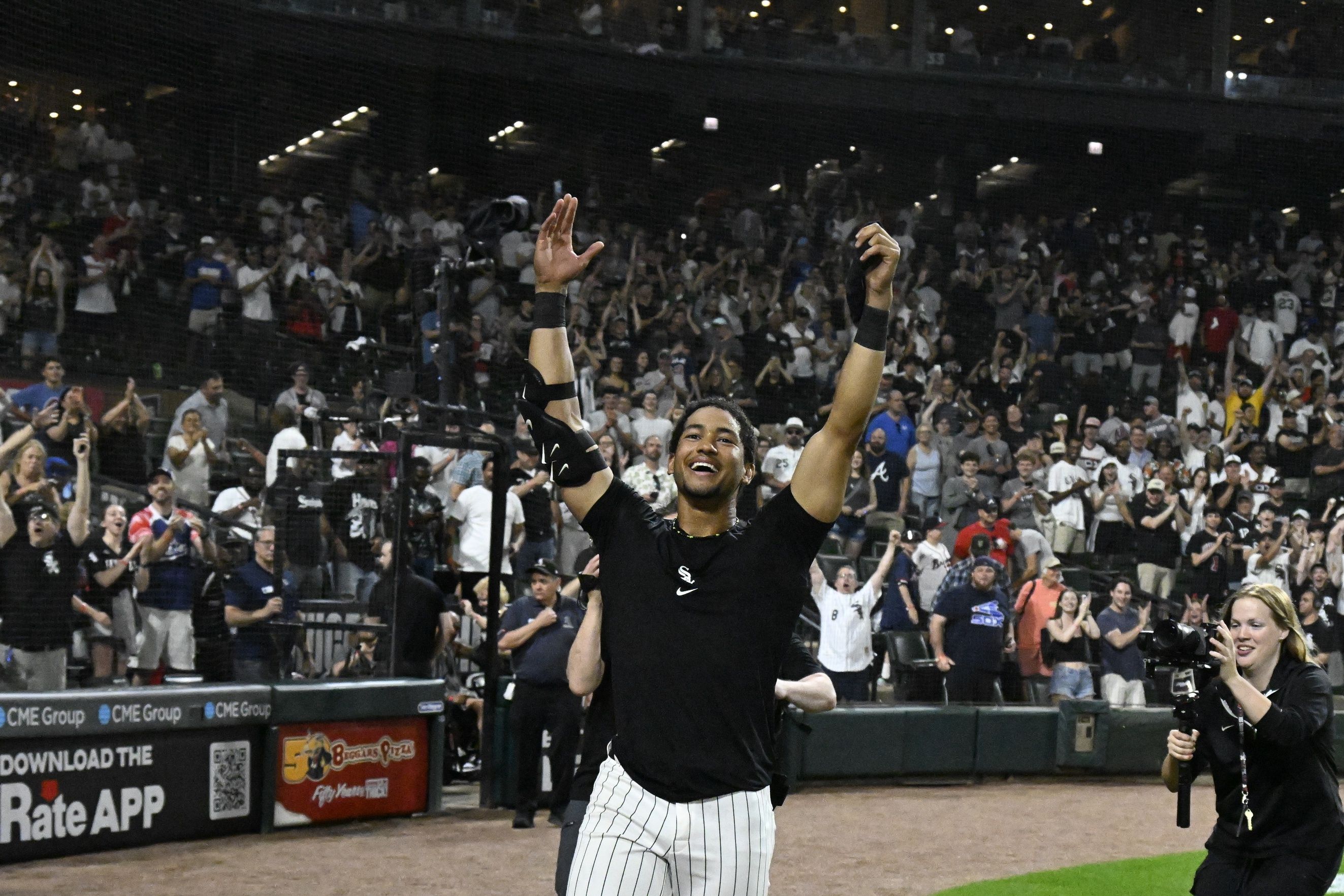
In one sense, Braden Montgomery showed exactly why the White Sox called him up on Tuesday, by slicing an 0-1 Raisel Iglesias changeup off the top of the left field fence and into the home bullpen for a two-out, two-run walk-off homer in a 6-5, 10-inning win over the Braves.
In another sense, he showed exactly why the White Sox called him up simply by coming to the plate and batting for himself in the 10th inning, regardless of what happened from there. The Sox have a lot of players who need an on-roster complement in order to succeed, but Montgomery isn't yet one of them.
Which is good, because Will Venable had blasted through all of his available bench players in the sixth inning, well before Montgomery's fateful at-bat. He pinch-hit Randal Grichuk for Tristan Peters and Edgar Quero for Luisangel Acuña, then pinch-ran Derek Hill for Quero. It kinda worked because Grichuk walked and Quero singled, yet it also failed because the Sox didn't get a run out of it, due to Venable not taking the bunt sign off for Drew Romo, then Hill getting cut down at the plate, which is something Quero could've done. Venable won more battles than he lost, but it didn't make a dent in the war.
It's the second consecutive game in which Venable exhausted all his best options by the sixth inning. It’s not inherently a bad thing, because all of the swaps are individually defensible, and perhaps more likely to pay off against a tiring starter or the front end of a bullpen than a relief ace. But ideally, his White Sox lineup would require a little less handholding, because that level of managerial activity is draining in multiple ways.
The obvious one is that the White Sox lineup becomes much easier for opposing manager to navigate over the remaining three innings, especially when he probably has his best bullpen arms remaining. The White Sox bullpen bought the lineup time to come through on Tuesday, but it couldn't keep the Phillies within reach on Sunday.
Venable also risks incurring a cumulative toll. It's reminiscent of September 2012, when Robin Ventura encountered expanded rosters for the first time in his managerial life and quickly lost a sense of which players deserved to make high-leverage appearances in major league games with postseason implications. Guys who spent the entire season in the minors like Leyson Septimo, Brian Omogrosso, Jose Lopez and Ray Olmedo were suddenly appearing in critical situations that affected a pennant race. Handedness was always Ventura's defense, but he never could answer the larger question about whether the bench players he was deploying at crucial major league moments were actually major leaguers.
It's not that bad right now, mostly because Venable is limited to a maximum of four moves, or three moves when Colson Montgomery has a stiff back, or Acuña is the only bench bat remaining. There are signs of strain, though, particularly his predilection for safety squeezes. Having Romo square around on three consecutive pitches until Matt Olson is close enough to adjust Romo's elbow armor shows the same sort of fog-of-war disorientation that requires correcting.
Credit Venable for seeing that himself after the game...
"That's 100 percent on me where we've got Olson crashing You have to just make an adjustment there, right? You put it on there with Romo and the element of surprise goes away. You're really desperate in that situation to be able to score another run. If you tie that game, Grant [Taylor]'s coming in the game, so want to do everything we can to scratch that run across. But you've got to pivot when the situation tells you to, and that's just something I didn't do a good job of tonight."
... but that's why it's also important for the White Sox front office to supply Venable with lower-maintenance options whenever possible, especially while Munetaka Murakami and Kyle Teel are still on the shelf.
The timing of Montgomery's arrival is therefore helpful, even during the times he'll inevitably look like a rookie. Both Venable and Chris Getz said he's here to play every day, or at least the modern version of "every day." His days off will certainly be calculated, but he's not going to be shielded, for better or for worse.
At this juncture, even "for worse" is ultimately for the better. The White Sox are ahead of schedule, but they're not at a point where they can isolate trying to win from trying to develop. Until they can spend on proven players, winning will require development. In lieu of optimal matchups, the next best option is productive learning experiences. You might not get anything out of Hill facing a righty, but there's value in Sam Antonacci seeing a lefty with runners in scoring position, just like there's value in Montgomery starting against Chris Sale even though his right-handed swing is weaker. The goal is eventual viability, hopefully by the end of the season.
Now, if Montgomery wants to look like he's already fully developed -- and in terms of musculature, that's already the case -- he's more than welcome. It's not out of the question, just because the White Sox seem like they've figured out how to reduce the learning curve for rookies, be it Antonacci this season or the other Montgomery last year. But assuming some slumps and adjustments are lying in wait down the road, it'll still be worth everybody's while to play him through it. That gives Venable at least one outfield spot that won't require helicopter managing, even if it's manned by his youngest player.