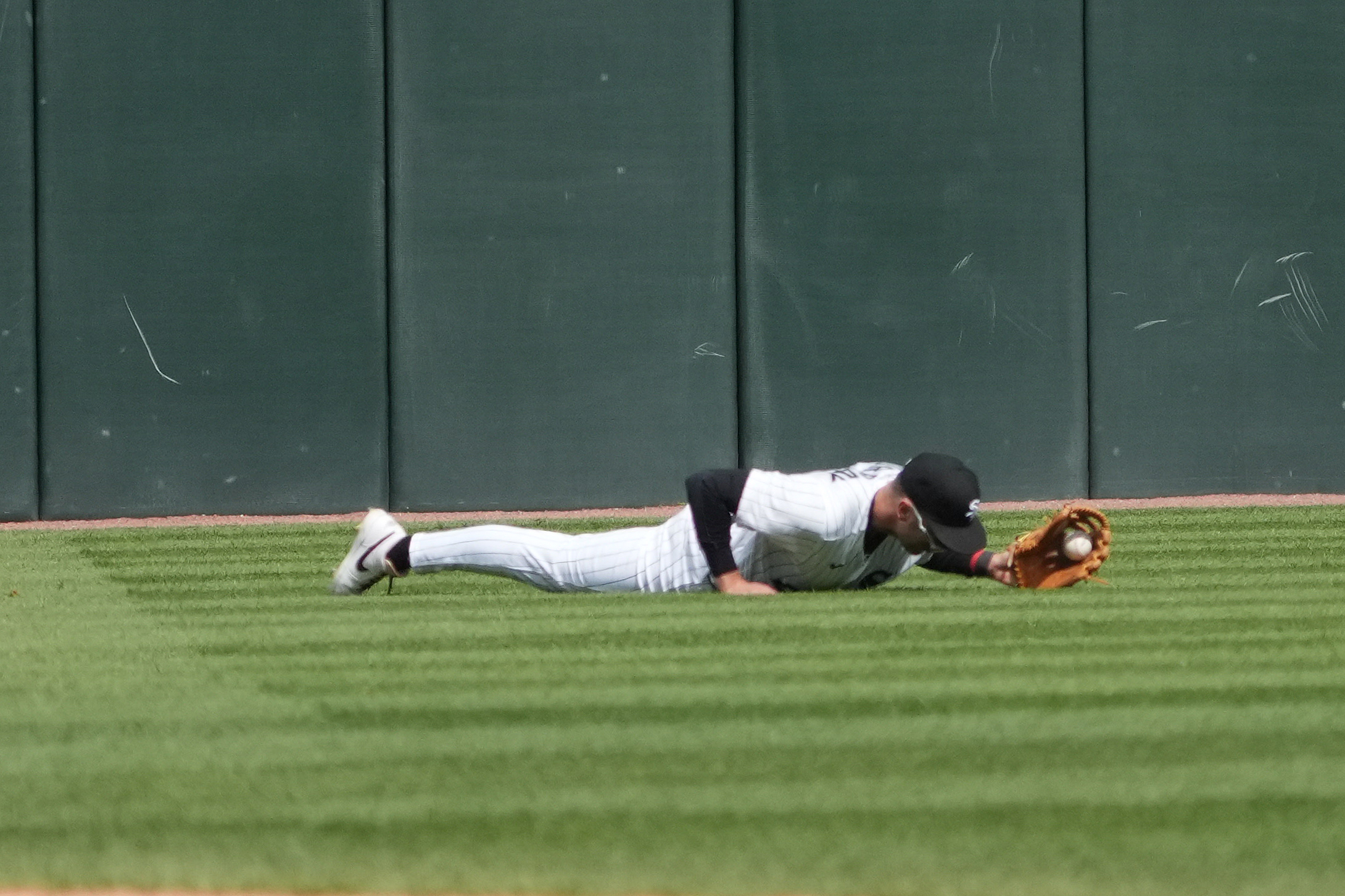

KANSAS CITY, Mo. -- White Sox hitters were saying the right things.
"It's a long season and it's a slow process," Lenyn Sosa said via interpreter. "You just keep your mind in the present, just try to do your best in the day you're at. Don't try to do too much. If you're doing something wrong, try to work on it to fix it. But not overthinking, don't try to be the hero, try to be yourself."
"We know what everyone is capable of and we know we’ll come through on the other side," said rookie Tanner Murray, who lifted his first career homer on Sunday. "Every team goes through it, ours just happened in the last couple of games. We have all the confidence in the world in each other and we’re going to break through with it."
To a degree, they were also doing some of the right things as well. The Sox offense is in the middle of the pack of the league standings for chase rate, and in the top half of the league for their rate of swinging at strikes. Maybe that's not enough to be outright impressive for a club that is prioritizing swing decisions as a means of transcending their more meager collection of offensive talent, but it doesn't look like it should be the seeds of the highest strikeout rate in the league (27.9 percent) either.
"When I've put it in play I've been hitting it hard," said Andrew Benintendi, who has struck out in 19 of 42 trips to the plate. "It's just the strikeout number right now is obviously not where I want it to be, and I don't think it will be there at the end of the year, so I guess we're just getting pitched tough now."
The White Sox are supposed to be hitting the ball harder this year too, not just because they added the plus bat speed Munetaka Murakami and Everson Pereira to an offense that had the slowest sticks in the league last year. But they're also prominent among bat-speed gainers this season, with Edgar Quero, Luisangel Acuña and especially Miguel Vargas among those who are prominently up from their 2025 swing speeds in the early parts of the season. But swinging faster has not immediately equated to swinging in sync.
"Just try to get into a good rhythm right now with my hands and my hips, trying to get into the same spot with both," said Quero, who has been tinkering with his hand placement to match up his adjustment to shrink his lower half load in the offseason. "Overall, feeling pretty good, seeing the ball pretty well and just need my attack point more timed up with the fastball."
"I'm trying to make some damage in the zone, and I have to swing harder," said Vargas of his 2 mph bump in bat speed. "Hitter's counts like 2-0, 3-1, those types of counts, I want to be aggressive, a little bit more aggressive and try to do damage in those types of counts."
And yet this group that is trying to narrow their approach, get into damage counts and swing harder when they arrive hadn't homered in seven games before Murray broke through on Sunday, and is still slugging .267 as a team in April even after a six-run outburst. The clubhouse is still reliably loose before games, the roster is young and optimistic about their long-term direction, but these are the sort of results that drive the manager to poke his head into a hitters' meeting or two.
"Try to not make it every hitters’ meeting that you’re saying something," said Will Venable. "[Saturday] was appropriate where, you may be see guys pressing a little bit. It’s April baseball and you look around this league and there’s a lot of teams that aren’t performing like they want to offensively. That doesn’t mean that we’re just OK with where we’re at offensively. But it’s a good reminder for guys who haven’t had a full major-league season yet and dealt with April baseball in the major leagues that this is kind of how it goes, you can’t look at your numbers and overreact to your current results."
"It's early, you look up at the board and see a bunch of people hitting in the .100s so it's maybe a little bit of panic there for a lot of us," Benintendi said. "But it's a long season."
Just as accepting the boom-or-bust nature of Murakami's production is easier to embrace in concept than when his whiff rates on breaking balls are tilting over 50 percent, all these soundly expressed offensive principles will resonate more if paired with some good results, rather than 20 consecutive scoreless innings. The prevailing sentiment from the White Sox coaching staff is that it would help if someone, anyone got hot, but it would really be nice if it was someone who was capable of carrying the Sox for a game or two. And there was a real sense that it should, and would be Colson Montgomery.
"Colson has looked fine to me; he's looked great, dangerous bat when he gets it going and covering pitches from lefties," Venable said. "You feel like he's always a swing away."
Montgomery is chasing less than last year and swinging at strikes more. His crucial RBI double Thursday night and some deep fly outs juiced some excitement that he was close to settling into a mode where he's ready to pounce on his pitch the moment he recognizes it, but no one would deny that much of his 2026 has looked a little tentative on fastballs in the zone at crucial spots.
"You're hobbling back and forth between hunting your zone, being selective to your zone and not getting too passive," said hitting coach Derek Shomon. "It's very real for hitters to experience that where in pursuit of hunting your zone, you do at points see some shots taken [this is Shomon's term for taking fastballs for strikes, based on repeated context clues] that otherwise get swung at and moved forward with authority. That's just an indication of that calibrating process and it's highlighting that stuff. He knows it, but it's also as a coaching staff highlighting that stuff and asking 'What happened here?'"
Montgomery's breakout on Sunday -- a homer and a double and hit-by-pitch, scoring two runs and driving in a pair as well -- wasn't built on crushing fastballs. He popped up one middle-in and belt-high with the bases loaded for the only out he made, but being able to jump on and hammer left-on-left breaking pitches nevertheless exemplified to Montgomery the benefits of trusting the approach he's spent the first couple weeks calibrating.
"It’s staying committed to my plan and where I’m looking," Montgomery said. "Not getting off that. There are times where you are trying to figure out how they are pitching you and things like that and get away from what you want to do. I say that all the time. Sometimes when I get off my game, I’m too worried about they are going to throw me, where they are going to throw me, trying to cover too many pitches or zones. It’s like dude, you have to simplify it and look at one spot and be ready for the one pitch you are looking for and put your best swing to it."
At 6-10, the Sox are a hair shy of 10 percent through their schedule. It's far enough along where roster turnover defined their four days in Kansas City, and there are enough scuffling bats to imagine that the nearing returns of Everson Pereira and Kyle Teel -- and surely soon, the promotion of Sam Antonacci -- could inspire some needed alterations to their lineup mix. But it's also still early enough where preaching patience can suddenly look sage after a single day's results.
When the White Sox arrived in Kansas City, Sosa seemed like a forgotten man on the roster. He'd been relegated to DH duty more often than not, struggling to find any offensive rhythm and 10th on the team in plate appearances even though Austin Hays has been on the injured list since Tuesday. Now after a multi-hit effort on Sunday, he's on a humble little four-game hitting streak, and is still espousing the same things.
"My preparation has been the same on a daily basis; the only thing I've changed is that during the game when I'm DH-ing, I need to keep my body warm," Sosa said via interpreter. "Besides that, it's been the same. The mindset is the same: just try to be in the present. Never think about tomorrow or in the future, just try to be in the present, and take advantage of what I have in front of me that day."