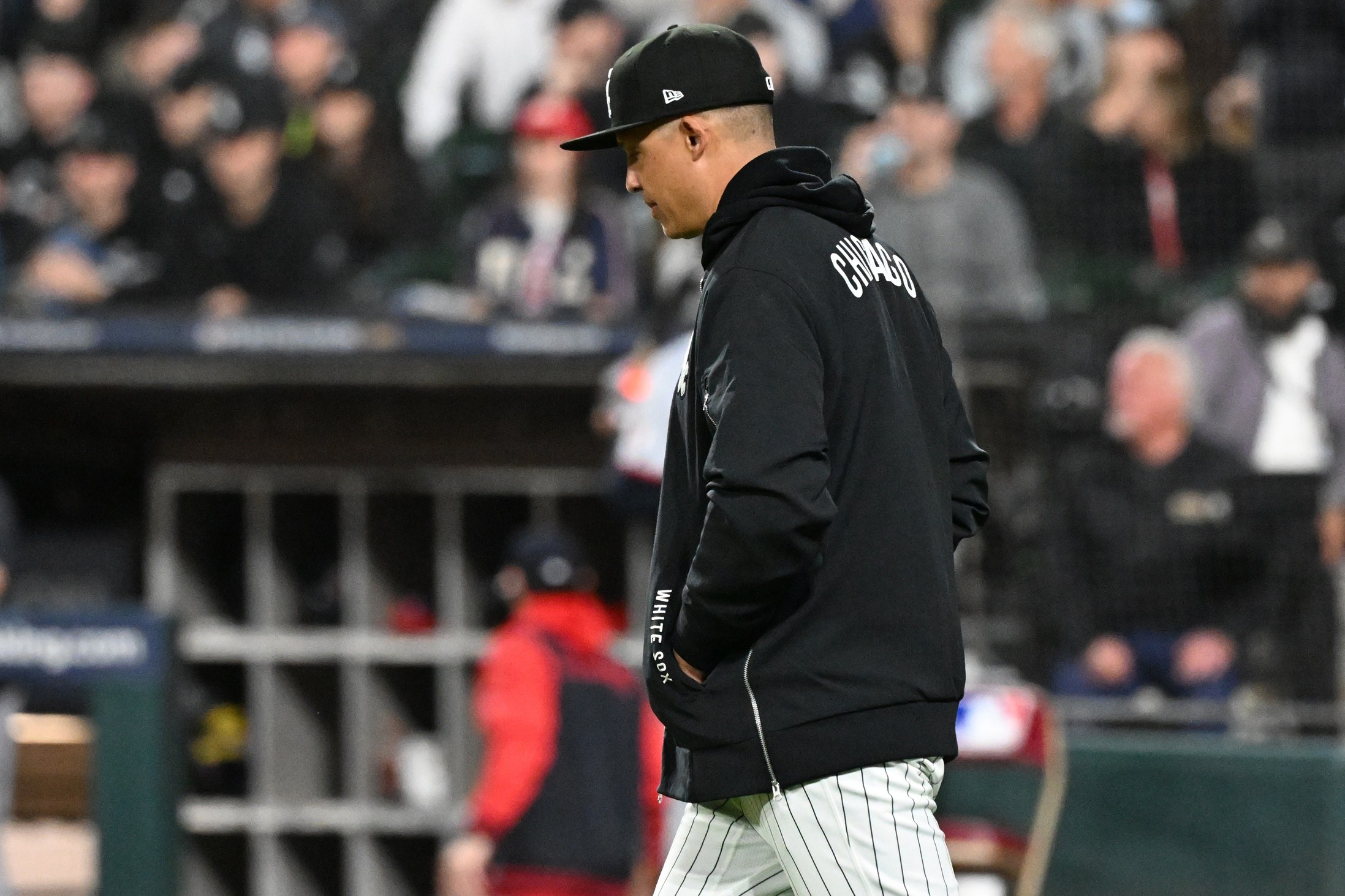
Speaking about a whole host of White Sox pitchers before the team's most recent victory against Toronto back on Sunday, Brian Bannister took a moment to note a Charlotte rotation that was low on filler and high on killers.
"It's a very unique Triple-A group," the team's director of pitching said. "Typically with where we're at, you'll sign a veteran on a one-year deal up here, you'll fill that Triple-A roster with guys who have been around for a little while. [The Charlotte pitching staff] is young, it is basically our system. It's very rare in that environment to see almost all prospects. As I look around, it's all our guys, they're all talented, they're all working together, practicing together. I think it's going to build a lot of camaraderie and chemistry that will eventually flow up here."
That flow starts today. Sort of.
Duncan Davitt is joining the White Sox today for the start of their series in Kansas City, although not necessarily as a starter. The Sox will eventually need somebody to take the ball when Shane Smith's spot in the rotation comes around on Sunday, and maybe Davitt will be the guy, but between an uncertain weather forecast, a rotation with efficiency issues and Davitt's own shaky start to the season, they might be more inclined to use him as a fresh multi-inning arm, rather than making any grander promises.
Davitt has allowed seven runs over eight innings in his two starts for Charlotte this season, including a two-out grand slam on a hanging 1-2 slider that spoiled his line on Friday. Still, there are signs of growth in the small sample. After experimenting with all sorts of different changeups in search of a weapon against lefties, Charlotte pitching coach Scott Aldred says Davitt has settled on a modified circle grip that is working for him.
"The change looks good," Aldred told Sox Machine last week. "He's been repping it a lot. It's a good pitch.
"I think the main thing with him getting consistent is building his delivery tempo right. It tends to get a little slowed down in the game, and I want pace throughout."
As Smith might attest, the speed and pressure of an MLB game make for difficult conditions with fixing tempos, so it might be a little early to expect Davitt to provide some sort of stabilizing force. His presence is more a matter of timing, both because he's on the 40-man roster, and because he's rested enough to make a relief appearance should the Sox need one immediately. If his engagement with the Sox is only for a series, this weekend should still provide him material for his next column for his hometown paper.
Even with Davitt's departure, the status of the Charlotte rotation remains intact, because he was their No. 4 starter on the schedule, and maybe fifth starter in terms of ceiling. Aldred still has the organization's three top pitching prospects, and it stands in stark relief to his first season with the White Sox, where he had to oversee a patchwork rotation thanks to a slew of Tommy John surgeries wiping out Plan A for Triple-A.
"It's nice having guys with stuff, for sure," Aldred said. "My part of it is making sure they know how to use their stuff and keep them in tune so that they don't get out of whack."
Nobody is more in tune than Noah Schultz. After slogging through an injury-plagued 2025, he's come out firing in 2026, building upon his impressive start with five more stingy innings on Wednesday against the Memphis Redbirds at Truist Field.
He gave up a pair of runs in the first, although one was unearned because Darren Baker made a wide throw to new first baseman Jacob Gonzalez, who went to apply a swipe tag before the ball was in his mitt. Schultz shook off the error to record the third out a second time, and ended up retiring the final 13 batters he faced, resulting in another impressive line on his game log.
Wednesday's outing built upon the themes Schultz established in his first two starts. He once again filled the zone with 52 of 73 pitches for strikes. Better yet, he threw first-pitch strikes to 15 of 18 batters, and 32 of those 52 strikes were called strikes or whiffs. He also demonstrated the wider variety of fastballs that diversifies what had been a pretty standard sinker-slider attack. He threw as many four-seamers as he did two-seamers (17), and mixed in 11 cutters as well.
The suddenly viable cutter is the new wrinkle he struggled to introduce last year.
"I've just been able to throw it for such a high percentage of strikes," Schultz said after his start in Nashville last week. "Last year, there were times that I'd throw the cutter and it'd be good, but then it would alter the shape of my slider, which we didn't really want to tinker with. [...]
"I didn't throw it for a while. I stopped throwing it in the offseason; like, I didn't even hold the grip for a while. Then, in spring, we picked it back up. It kind of did click again -- something that, you know, being such a high-strike percentage pitch, set up my other pitches, we thought it was too good to pass up."
Meanwhile, the four-seamer had emerged as an intriguing weapon toward the end of 2024 season, and while Aldred said it doesn't stand out in terms of metrics, both say it's found a place in his revised arsenal as well.
"I think that I became such an east-west pitcher that guys didn't really have to adjust up-and-down," Schultz said. “Being able to hit all four quadrants is pretty huge with setting guys' eye levels and so forth."
Aldred and Schultz said the changeup has also made strides, although the brevity of the average plate appearance means that he hasn't had a chance to throw it as much as either would like. That's one of the identified areas for growth, along with consistency in the cutter's velocity. It can range from 87 to 93 mph, and Schultz said he would prefer the higher end of that band.
These register as relative nits to pick, especially since he's tackling the bigger issues. After his walk rate ballooned on him to 13.8 percent in 2025, he's running a career low at 4.3 percent this season, and there aren't even any HBPs to disguise the true number of free bases. And after getting shelled by righties last season, they're just 3-for-31 with one walk and 10 strikeouts through the first 32 plate appearances.
It's not just the rejuvenated stuff and command that stands out, either. Schultz is a good athlete whose 6-foot-10-inch frame belies how well he can defend his position, and he's moving well around the mound, starting a 1-5-3 double play in his Nashville start.
Noah Schultz starts a 1-5-3 DP to end the 5th inning. 200 IQ🧠. #Knights pic.twitter.com/QAXWmkFQhw
— FutureSox (@FutureSox) April 2, 2026
"I've heard a lot about how that was not where I supposed to go, but my momentum was taking me that way, so that was easy," Schultz said.
"I hope [my defense] is not a surprise. You know, I tend to think I'm pretty athletic. Being able to field my position is such a huge part of the game."
All of the fresh statistical and visual evidence conspires to suggest that the patellar tendinitis was the main thing dragging him down last year, but that's a notion Schultz isn't as willing to entertain, as it would downplay the offseason work that the struggles of 2025 inspired.
"I don't want to compare it to anything from last year," he said. "I think that I feel great right now, the pitches are in a good spot, and that's all I'm motivated by, and looking forward to moving on."