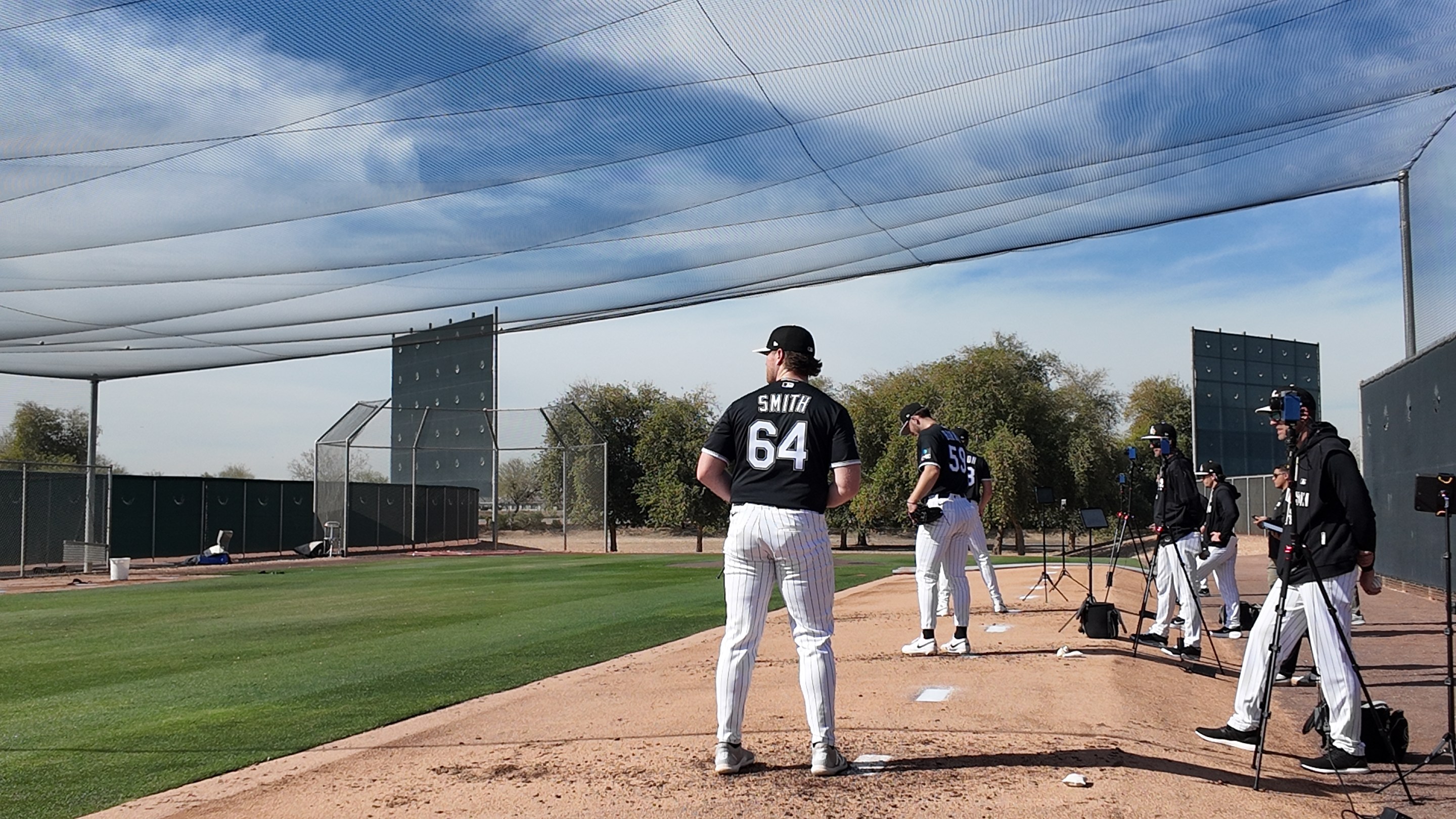
Shane Smith knows what this story is about.
"If I could figure it out, I think I'd do it," Smith said of his wayward fastball command. "It's magnified because it's the beginning of the year. I had some starts last year where I went 2⅓ [innings] and that sucks. Having the spring training I did that wasn't that clean, and then starting the year not that clean is frustrating for me personally."
Smith summed up the focus of his side session on Saturday as "just strike one," and it really could not be more clear in his body language that his 19.29 ERA in 4⅔ innings is frustrating for him. But after getting the nod for the Opening Day start, tasked with becoming a vocal leader of the pitching staff, and really just being -- with apologies to Erick Fedde's KBO exploits -- the most accomplished starting pitcher on the current roster, no one is really inclined to downplay the focus on his performance.
Asked about the scuffling starting pitching ahead of the White Sox's current homestand, general manager Chris Getz made it clear that the central issue was getting Smith right.
"You have to look under the hood to figure out why this is happening, and Shane being a primary example of not being able to use the four-seam fastball right now or get a better version of it. That’s led to some of the bleeding considering he’s made two starts for us," Getz said. "That can tax the bullpen, and offensively you are playing catchup."
As revelatory as Smith's changeup development was last spring, or how his slider shape might be a whole separate discussion at this juncture, the struggles with his four-seam really leave him with few routes to mitigation other than attacking the problem head-on. He's a fastball pitcher with the same 94-98 mph velocity he used to bully hitters last year, and doesn't see his sinker as a real alternative to take more weight off the four-seamer than it's already doing, neither long-term nor in its current state.
"I had a higher strike percentage with my four-seam than I did with my two[-seam] in Miami, so it wasn't great in Milwaukee but we've got to keep using it, and I think it's on the right path," Smith said. "I'm a fastball pitcher and I'm going to throw a ton of fastballs. But if it's not working, how do we still get to the same results of getting ahead of guys? Do we mix a little bit more? Or is it a mechanical cue of if we miss one, how do we get back into the zone with one? I think it's a mix of everything. Don't bang your head against the wall trying to make sure I need to throw four-seam fastballs, but also realize I have three good pitches other than my four-seam fastball and I still have to use them."
Maybe some pitch mix adjustments could alleviate the troubles and enable longer outings than the 4⅔ innings Smith has managed so far, but the best version of his game is led by dominant four-seam performance. So rather than tackle some sort of impossible choice, the White Sox have been trying to identify a root cause.
As nice as it was to finally get to ask Smith at SoxFest about his unique and up-tempo start to his delivery, breaking down the video afterward really drove home how much he had begin to tamp it down over the course of last season. That process appears to have only continued through the winter.
It's subtle enough that playing these clips at full speed, side-by-side, feels necessary to communicate the difference in timing, but the less intuitive pacing of Smith's 2025 delivery is something the White Sox feel aided his deception.
"He lost some of the qualities that made him unique. Pitchers often do that in an effort to actually become better pitchers or build upon the previous year, but in reality sometimes it forces them to take a step back," said Brian Bannister. "He had this unique little step forward that threw hitters off on their timing and then he would speed up right after that to go slow, fast. He would get his front side up and back a lot. You get some visual deception in a way that Tarik Skubal does.
"He came into camp with a more simplified delivery this year. He had a huge workload spike last year. And I think his goal was to throw more strikes. But what it has proven is just throwing him off a little bit. He hasn’t been confident in his fastball command. Eliminating some of those elements also eliminates some of those things that are hard to quantify. We call them residuals -- the timing deception, the visual deceptions."
As Sean Burke and Jonathan Cannon can attest, and Colson Montgomery's sojourn to the ACL last April can be lumped in, the White Sox under Getz have not let preseason expectations get in the way of making necessary demotions. Smith is no longer a Rule 5 pick, and can be optioned this year if his struggles make it necessary, even if the last status update made it sound like the Sox aren't there yet.
"We are doing everything we can to get him back on track," Getz said. "We certainly don’t need to get ahead of ourselves and start doing significant interventions, so to speak. It’s more, tweak this, tweak that."
If it's not an intervention, the effort to re-complicate Smith's simplified delivery sounds like a significant in-season tweak, even in the age of Hawk-Eye data and the sight of the White Sox staff biomechanist roaming the halls of the clubhouse being as familiar as seeing the strength and conditioning coach.
"What’s good, and I’ve had a lot of success with it, is when you are doing a thing the pitcher has done before, you are not asking him to do something new," Bannister said. "Just get him in the same position his body has moved in before, and his body knows how to get into and build off that."
If failure, specifically aggravation about failure, is the mother of innovation, Smith seems as ready as Bannister characterized him being in embracing a return to some of his old delivery's quirks. But as much as his struggles have never quite held such a central place in the fate of a major league team before, the guy who went undrafted out of Wake Forest due to years of injuries, or even just ran an 11.95 ERA in his last five starts before last year's All-Star Game, does not feel view his current plight as insurmountable.
"I'm not new to failure or adversity; it sucks but the staff has been great with me," Smith said. "You don't want to put an extra emphasis on the next start like this has to be good, or this has to be perfect, or this has to right the ship. That would be nice, but I just want to make sure I'm getting ahead in the count, putting guys away and making good pitches. If I give up some contact again, OK, we're just going to have to live with it. But if you're in the zone, that's really all I can do.
"I haven't done a great job with it. I did a better job in Miami, but didn't do a great job by any means. So, just continue that uphill climb of doing things the right way."