After the White Sox signed Munetaka Murakami for two years and $34 million and the projection systems could get to work applying his skills to a specific depth chart and hitting environment, they all saw a player who would be eminently useful were he able to demonstrate the tightrope-walking skills required to successfully live the Three True Outcomes Lifestyle.
One month into his season, it's been a smashing success in all senses of the word. All the algorithms understood the general shape of his output, but maybe not the scale of his production.
| System | BA | OBP | SLG | BB% | K% |
|---|---|---|---|---|---|
| ZiPS | .238 | .354 | .440 | 14.4 | 34.4 |
| OOPSY | .221 | .346 | .446 | 15.1 | 34.1 |
| PECOTA | .233 | .348 | .487 | 14.0 | 33.7 |
| April | .236 | .375 | .564 | 18.4 | 33.8 |
For a player like Murakami, he's operating at the sort of extremes to where it doesn't take much for one minor change to skew his production, and in either direction. As Mike Petriello wrote for MLB.com, he's been able to tilt his balance in his favor despite the contact issues by using his plate discipline to conserve the amount of swinging he does.
He’s doing something that seems backwards, given how massive his homers can be. When he doesn’t swing, he’s been worth +9 in Statcast Run Value, tied for sixth-best, meaning he’s collecting value by working counts in his favor or drawing walks. When he does swing, he’s been worth +1 run, because the value gained by the homers is about the same as the value lost by all the whiffs.
To put it another way, Murakami might be making some loud sounds at the plate, but his game is just as much defined by the notes he's not playing.
It's not necessarily the surest recipe for success, but given the terms for which the Sox signed him, they don't need a lock. They need entertainment value, and it's pretty critical that he's providing it immediately. On an individual level, it'd be understandable and reasonable if Murakami struggled out of the gate and didn't start getting a handle on MLB pitching until midsummer. It also would've muted a lot of the potential impact he could have on franchise fortunes, whether judged by the standings, attendance, ratings or other indications of interest.
As it stands, Jon Greenberg checked in with Brooks Boyer, and while Murakami isn't quite the pope in terms of worldwide significance, he has the benefit of being directly involved in the product.
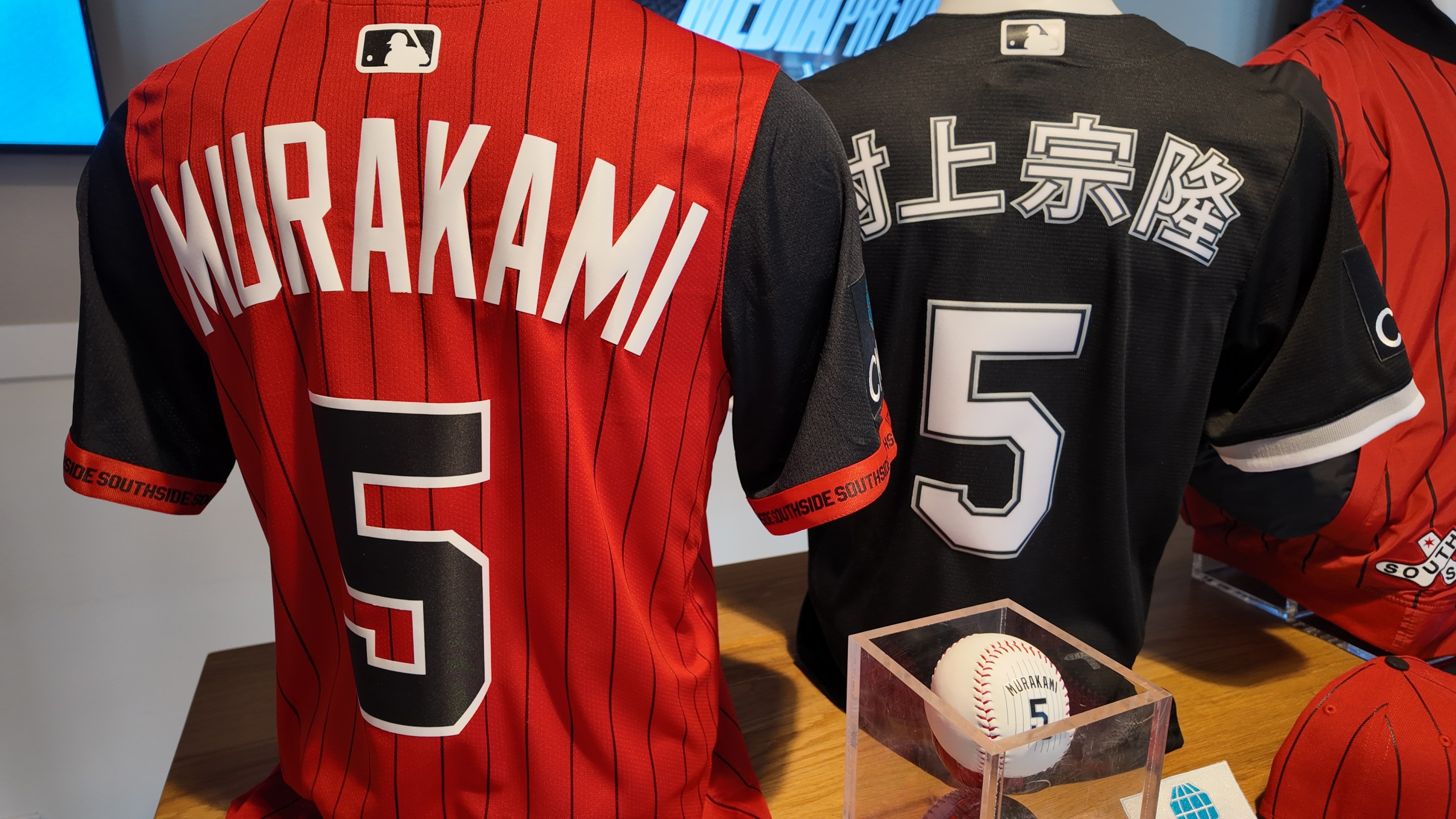
I stood around the team store during two recent games and saw fans flock to the shelves of Murakami shirts, which spell his name in English and Kanji. White Sox chief revenue and marketing officer Brooks Boyer said there’s been about a 60/40 split in fans buying his jersey in English and Japanese. The important thing is they’re buying them.
“This has been kind of unprecedented territory,” Boyer said. “His jersey is outselling the rest of the team combined, kind of as you’d expect.” [...]
Boyer is working on some deals with Japanese companies, and a Murakami bobblehead night should be announced soon. The Sox’s marketing department has been hustling in recent years, churning out milkshakes and Pope hats. Now they not only have a player to market, but also a team that isn’t bad.
“Murakami has made us more relevant,” Boyer said. “It’s really fun. We’re sitting here at the end of April, and we’re not out of it.”
"It's not how you start, it's how you finish" operates under the faulty assumption that the person will be allowed to finish regardless of the start. Sometimes it's absolutely about how you start.
Spare Parts
One of the most intriguing parts about the White Sox's maneuverings for new land, be it The 78 or Justin Ishbia's pending purchases across the Chicago River, is that both are pretty tight parcels, which can be pretty beneficial for ballpark construction, unless you're hung up on the idea that a retractable roof is necessary.
The Mets slow-rolled Robert's spring training with the hopes of preserving some unnecessary wear and tear, and those around the Mets -- or at least SNY analyst Jim Duquette -- was feeling pretty smart about it:
"I like what the Mets are doing. The White Sox have not been a forward-thinking organization. They’ve been old-school, where the Mets have become very forward-thinking with this stuff. I wouldn’t be surprised if they get a good result from what they’re doing. It’s smart because Robert has incredible skill when he’s right. He just hasn’t been able to stay healthy."
Anyway, Robert is hitting .224/.327/.329 and just went on the injured list due to a back problem that required an epidural.
George Springer's IL stint is the reason why the Blue Jays called him Jiménez, and Springer's return from the IL is the reason why they DFA'd him. He went 9-for-31 over 12 games with Toronto, but with zero extra-base hits.
Garrett Crochet expressed confidence that his shoulder inflammation should only require the minimum injured list stint. He threw six scoreless innings before that to lower his ERA to 6.30, but his velocity dropped into the low-90s by the end of his start.
- Paul DePodesta's Rockies move: 'Moneyball' at a midlife crisis or Colorado's best bet? -- The Athletic
- The Rockies' pitching staff is adapting right in front of us -- MLB.com
Like the White Sox, the Rockies are benefiting from the soft bigotry of low expectations. They're 14-18 in April, but they're not in last place in the NL West, and they're irritating the team at the top, which is good enough for now.
Also like the White Sox, the Rockies are benefiting from a new baseball operations leader who may or may not be a good idea in the long run because ownership doesn't deserve benefit of the doubt, but can make plenty of short-term progress simply by modernizing operations and picking low-hanging fruit.