No piece of baseball writing has ever connected with me like a 387-word meditation on a Wilbur Wood Topps card by Josh Wilker on his "Cardboard Gods" blog, as he traced an identical sense of bafflement to nearly the exact same source.
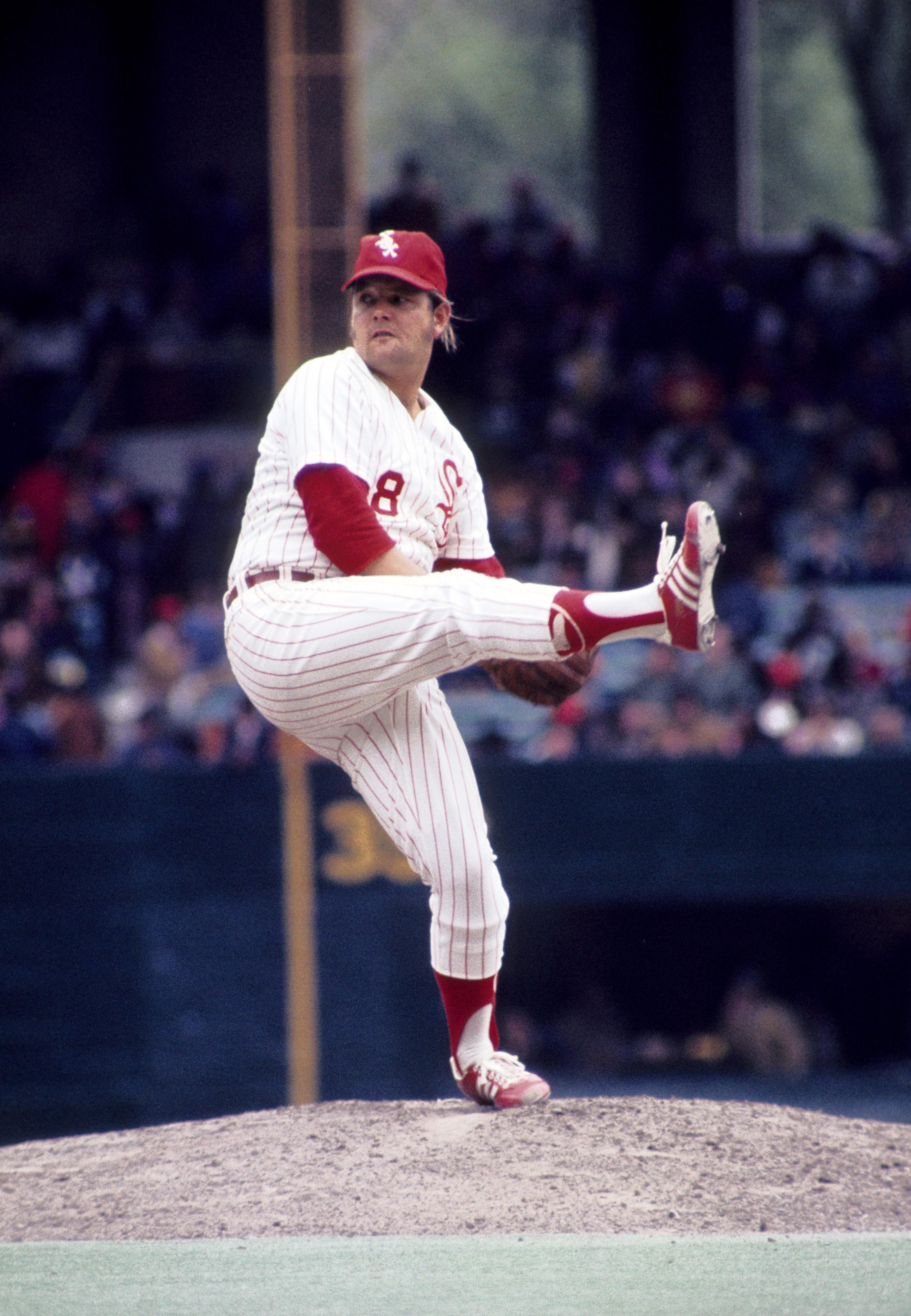
Wilker used Wood's 1978 card as his springboard, showing the knuckleballing lefty pretending to look into the catcher for signs while wearing the white White Sox jersey with the wide navy collar, even though he's not even on a mound and long stopped needing a catcher to tell him what to throw. My card was Wood's 1974 Topps, with a recumbent pose that made him look like a manager in my original estimation, although the red curtain behind him now gives it an unlikely boudoir vibe.
I can't pinpoint the year I came across the card, but I'd guess it was somewhere around age 9, because Dave Stewart was on his run of four consecutive 20-win seasons. That was treated as a highly significant indicator of consistent excellence and excellent consistency, and so multiple 20-win seasons instantly indicated quality as I inspected the backs of cards for players with whom I wasn't familiar.
Wood caught my attention because he won 20 games in three consecutive seasons, but he also confused me with the most recent season on that card, when he also lost 20 games. It inadvertently served as a cliffhanger; I didn't know that kind of performance was possible, at least for a pitcher whose card was recent and common enough to be left in a garage sale Monster Box, and I needed to know the rest of the story.
Wilker's post was published in 2006, 15 years or so after I'd attained Wood's card, but just like a Daniel Stern narration in "The Wonder Years," it immediately evoked the sense of astonishment I felt, but with words that were superior to my own.
These seemingly mutually exclusive starting pitcher landmarks were well-known to me by the time I started inspecting the baffling statistics on the back of Wilbur Wood’s card. In a five-year span, the aging knuckleballer with the 19th century name won 20 games four times, but he also lost 20 games twice, 19 games once, and 17 games once. The most confusing year of all was 1973, when Wilbur Wood achieved both plateaus in the same year, racking up 24 wins while also suffering 20 losses.
I couldn’t figure out right away if Wilbur Wood was bad or good, but eventually I came to see him as being in both name and deed some kind of a throwback to the rugged spike-gashing dawn of major league baseball, when hurlers started both ends of a doubleheader and then came on in relief despite massive corn liquor hangovers the next day at dusk to strand the go-ahead and winning runs in scoring position. Wilbur Wood was beyond Old School. He was Old Testament. He was the last vestige of a time when men named Rube and Mordecai and Smokey Joe and Grover strode as giants upon the land, their won-loss records both gleaming and gory, good and bad entangled.
When Wilbur Wood hung it up, it left no one to stop the meek 5-inning starters and 4-pitch bullpen specialists from inheriting the earth.
Wood has now truly shuffled off this mortal coil, as he died on Saturday at the age of 84, but that won't stop baseball fans of a certain interest level of embarking on their own Wilbur Wood Journey™️. It's as inevitable as death itself.
White Sox fans can't avoid it simply because he looms so large in franchise recordbooks and the story of the 1970s, when his rubber arm allowed him to shoulder an unholy burden to prop up underfunded Sox squads that punched above their weight. If I didn't learn about him from his 1974 card or the history section of team yearbooks, I probably would've seen his name when Jack McDowell won 20 games in 1992, and I definitely would've heard about him when Kelly Wunsch made an unsuccessful run at Wood's games pitched record in 2000. Wunsch finished with 83, well short of Wood's 88 games in 1968, the year that put him on the map.
But even baseball fans with no affiliation or affinity to the White Sox will accidentally find their way to him. Maybe it's the numbers on the back of the card, or maybe just the rustic, literary alliteration on the front of it. Maybe it's a random piece of trivia about starting both ends of a doubleheader, or a more impressive accomplishment like throwing the most innings in a single season since the Dead Ball Era. Any one of those will open your eyes, and then you'll spend the next 20 minutes wondering how somebody could be so accomplished, yet so anonymous.
Wood's peak is absurd, and can be immediately grasped, even if it can never be quite comprehended, by traditional and analytical fans alike. From 1971-74, he won 90 games and pitched 1,390 innings, peaking with the modern-day record of 376⅔ innings in 1972. He also set the record with 49 starts, and then nearly matched it the following year with 48, which is also a total nobody else has touched.
Over that time, he accrued a staggering 35.5 WAR. His 11.7 WAR in 1971 stands as the fifth-most valuable pitching season since the Dead Ball Era, and then he followed it up with 10.7 WAR in 1972. Since 1920, only eight pitchers have posted multiple 10-WAR seasons. Seven are in the Hall of Fame or would've been under normal circumstances. The other is Wilbur Wood.
On one hand, it's a shame that Wood is a player who must be happened upon, rather than somebody who is appreciated by default. It's less because he toiled for largely unsuccessful White Sox teams, and more because a Ron LeFlore line drive shattered his kneecap in 1976 and left him gun-shy about hard contact afterward. He was only 34 at the time, and a knuckleballer like him could've thrived through 40, if not beyond. Instead, he had an unheralded departure from the game after his age-36 season and worked as an account manager for a pharmaceutical company following his retirement from baseball.
Yet a career like Wood's fills a niche of baseball history in a very satisfying way. The status of "a comic's comic" might not be as lucrative as being America's favorite comedian, but it reflects a certain level of mastery on their part, and a certain level of connoisseurship for those who appreciate them. To learn about Wilbur Wood is to unlock a certain level of ball-knowing, no matter how you first found out about him, and with league-leading workloads winnowing down to half the total he threw in 1972, he's not at risk of being overshadowed anytime soon.