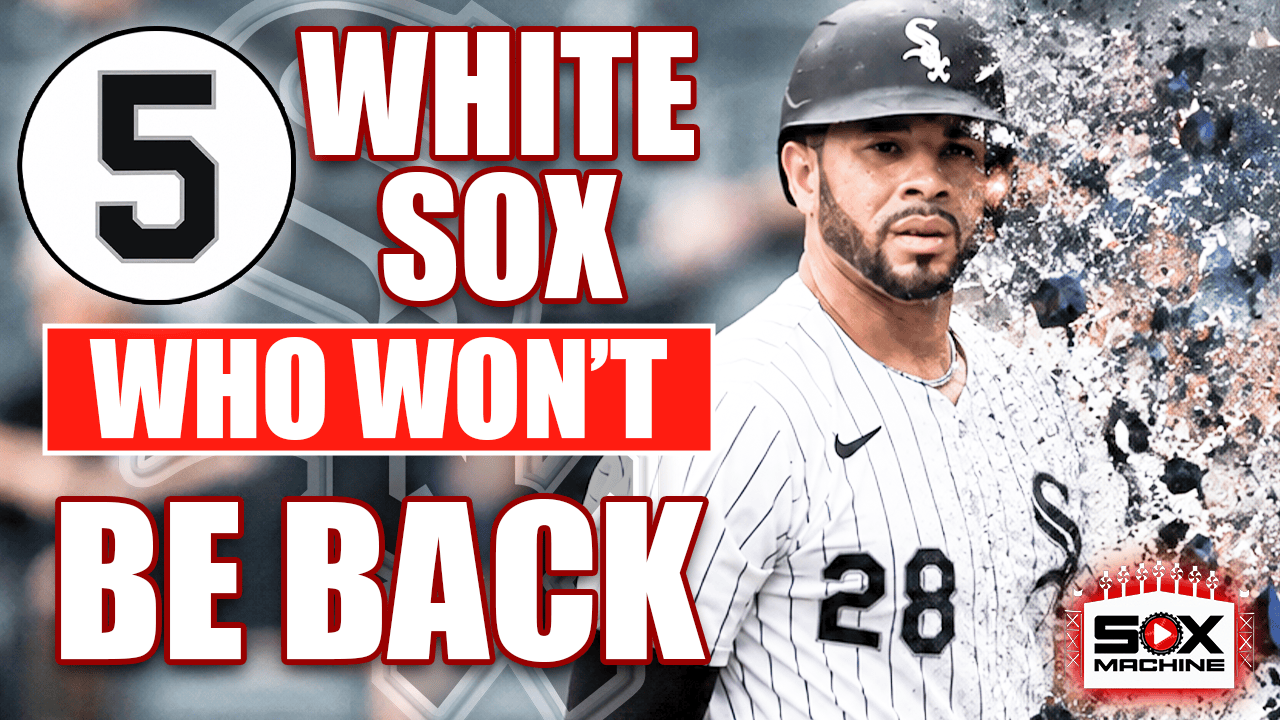
By various measures, there wasn't a worse right-handed hitter against left-handed pitching in Major League Baseball during the 2026 season than Braden Montgomery.
He hit just .129/.204/.226 with eight walks against 31 strikeouts versus lefties, which results in the lowest wRC+ for any hitter with at least 100 plate appearances in such situations:
- Braden Montgomery, 19 wRC+ over 103 PA
- Ian Happ, 36 wRC+ over 144 PA
- Leody Taveras, 41 wRC+ over 162 PA
But when he came to the plate with runners on second and third with two outs in the sixth inning of a game the White Sox trailed 2-1, he was armed with a very valuable piece of information gleaned from Game 1: Erik Sabrowski really likes to give up demoralizing two-out doubles on first-pitch low-and-away fastballs to White Sox hitters named "Montgomery."
On Saturday, Colson Montgomery shanked such a pitch inside third base and down the left field line for a key insurance run that kept the Guardians at arm's length, and on Monday, Braden Montgomery followed suit. Sabrowski tried to start him with 94 mph on the lower corner of the zone away, and Montgomery hit a more convincing two-bagger just inside the right field line that turned a 2-1 deficit into a 3-2 lead.
Or at least that's what I could detect. Montgomery wasn't as specific about any scouting after the game, saying, "I was just ready for something to attack. I wasn't playing the guessing game, just ready for his hardest stuff and ready for something over the plate."
But it still seemed like a mistake on Sabrowski's part. Montgomery had 14 hits against left-handed pitching in 2026, and only two of them were on breaking balls. Meanwhile, in his recap of the game at FanGraphs, Matthew Roberson noted that Sabrowski hadn't allowed a hit off his slider to righties all season.
It was in Montgomery's interest to not allow the plate appearance to get to a breaking ball count, and he didn't. Perhaps every count should've been a breaking ball count, but that's not Montgomery's call. He just hit what he was pitched, in the direction he was pitched, and got to scream at his teammates from second base afterward.
That last component is what he said separated this double from his walk-off homer in his major league debut.
First game up, it's -- I was welcomed in and enjoyed every moment of it, but it still didn't feel like -- I feel like it's impossible to feel like you're a part of the team at that point, because I mean, I'm coming up two months into the season, this is the first game, I've been playing my own game six days a week, so I don't know what's been going on in the clubhouse or how they've been doing. So that felt more personal that night, but tonight it tops it tenfold to have those emotions going into it, to have been down the road with this team and being in these games and to be playing the most important baseball of the year, it's unlike any other.
Cleveland's starting pitching edge neutralized
During the last of his seven decades in baseball, Hawk Harrelson loved to say that a team's offense is only as good as its bullpen, but through the first two games of the ALDS, it seems that a team's rotation is only as good as its offense.
As good as Gavin Williams pitched for Cleveland on Monday -- and his stuff was incredibly impressive -- it didn't yield commensurate returns. He suffocated the White Sox lineup for five-plus innings, yet when Stephen Vogt decided to go to the bullpen, it was only good for a one-run lead that promptly disappeared on Sabrowski's watch.
What's more: Through two games, Williams and Parker Messick have thrown exactly as many innings as the White Sox pitchers who went the longest, Grant Taylor in Game 1 and Sean Burke in Game 2.
| Pitcher | IP | H | R | ER | BB | K |
|---|---|---|---|---|---|---|
| Messick/Williams | 9.1 | 8 | 4 | 4 | 5 | 17 |
| Taylor/Burke | 9.1 | 2 | 1 | 1 | 2 | 12 |
Does it matter that Messick and Williams started the game, while Taylor entered in the sixth on Saturday and Burke in the third Monday? It probably should have, especially when the White Sox's opener strategy failed from the jump in Game 2.
Now, Will Venable's interview with TBS sideline reporter Lauren Jbarra in the top of the third inning suggested that using Anthony Kay and Sean Newcomb in the first didn't reflect calamity.
- Jbara: Will, you went to your bullpen early. How does that change how you deploy arms the rest of this game?
- Venable: Yeah, you know really the plan coming in as we evaluated their lineup was going to be Kay plus Newk to get through DeLauter the second time, so we're still in a good spot.
Apple Watches are prohibited in MLB dugouts, so there's probably no way of knowing whether Venable's stress level matched his outward demeanor, but that's indeed how it played out. True to that plan, Newcomb faced Chase DeLauter the second time in the bottom of the third. After that, Venable called for Burke, who went to work. Perhaps the White Sox choose a different course if Kay doesn't start the game with a single and a walk, but Venable and his staff essentially designed a three-ply approach the game, meaning two layers could tear, but there'd still be one layer remaining before the Sox truly had a mess on their hands.
Not only did Burke hold up, but he ended up retiring one more batter than Williams, and the Guardians couldn't score often enough early to create a margin that made the order of pitchers matter. That's why I'm thinking a team's rotation is only as good as its offense. But if that's the case, then the transitive property says a team's bullpen is only as good as its rotation, so maybe all of these elements matter? We haven't even gotten to defense yet, and the Yankees wish you wouldn't.
Sam Antonacci survives
But let's get to defense, because perhaps Burke goes the distance if Venable were allowed to have his preferred late-game defensive outfield alignment in place.
The Sox had been able to close out first three games of the postseason with Tristan Peters in left, Brenton Doyle in center and Braden Montgomery in right because they'd never trailed at any point.
But because the Sox had the unmitigated gall to spend the first five innings of Game 2 behind, Venable ended up pinch-hitting for Tristan Peters against Sabrowksi during the sixth, meaning that Sam Antonacci had to finish the game in left field. The game almost finished him instead.
In a classic instance of the game sussing out the weak link, the Guardians launched three flies at him over the last two innings. Antonacci took a poor route on the first one, as he broke in on a Steven Kwan liner that nearly sailed over his head. He was able to snag it with a late lunge, but seeing a triple flash before his eyes might have made him less aggressive on DeLauter's similar line drive two batters later, which Antonacci sat back on for a single.
That allowed Jo Adell to come to the plate representing the tying run with two outs in the eighth, rather than leading off the ninth, and that's when Venable opted for Taylor. Whether that was the right move is a post that requires another 1,000 words, but keeping the conversation focused on defense, this sequence illustrated a couple things.
One is what we talked about on Monday, where every lead and left-on-left success better enables the Sox to have their desired late-game options on hand. It doesn't always work out that way, so appreciate when it does.
The other involves the other team that's leading an American League Division Series 2-0. Over at MLB.com, Mike Petriello explained that superior outfield defense is one big reason why the Tampa Bay Rays improved by 20-something wins themselves.
It was a point of emphasis for the team last winter, hiring former outfielder Corey Dickerson as first base coach and outfield instructor, as well as bringing in defensive legend (and former long-time Ray) Kevin Kiermaier to help with instruction during camp. The roster changed too, as they moved on from Christoper Morel (minus-6 Fielding Runs last year) and Josh Lowe (minus-5) in offseason moves, while bringing in veteran Cedric Mullins, a once-excellent defender at his peak who had seen his performance slip in recent years.
Throw in the expected return of the defensively talented Jonny DeLuca, who had gotten into only 20 games last season due to injury, and there was plenty of reason to expect that last year’s unremarkable defensive group might improve. You could see it in Spring Training, or so they said, with manager Kevin Cash saying as early as March 16 that the outfield defense had been “probably the brightest spot of camp.”
How, then, did that work out? May we interest you in “the best outfield in Statcast history at turning batted balls into outs?”
The Rays have only scored six runs over two games, but they've been able to limit the Yankees to one run over those two games thanks in large part to superior defense. Should the Sox face Tampa Bay next week, this is something they'll have to contend with.
For the time being, there are three items of good news. The first is that Antonacci was tested one more time in the ninth inning, and he made an easier play of it:
The second is that some aspects of outfield defense can be taught, and we'll see whether it makes a difference for Antonacci to get an entire offseason and spring training to work at it. The third is that the White Sox have put themselves in a position to start considering ALCS opponents. They just have to win one of the next three games to make that happen.