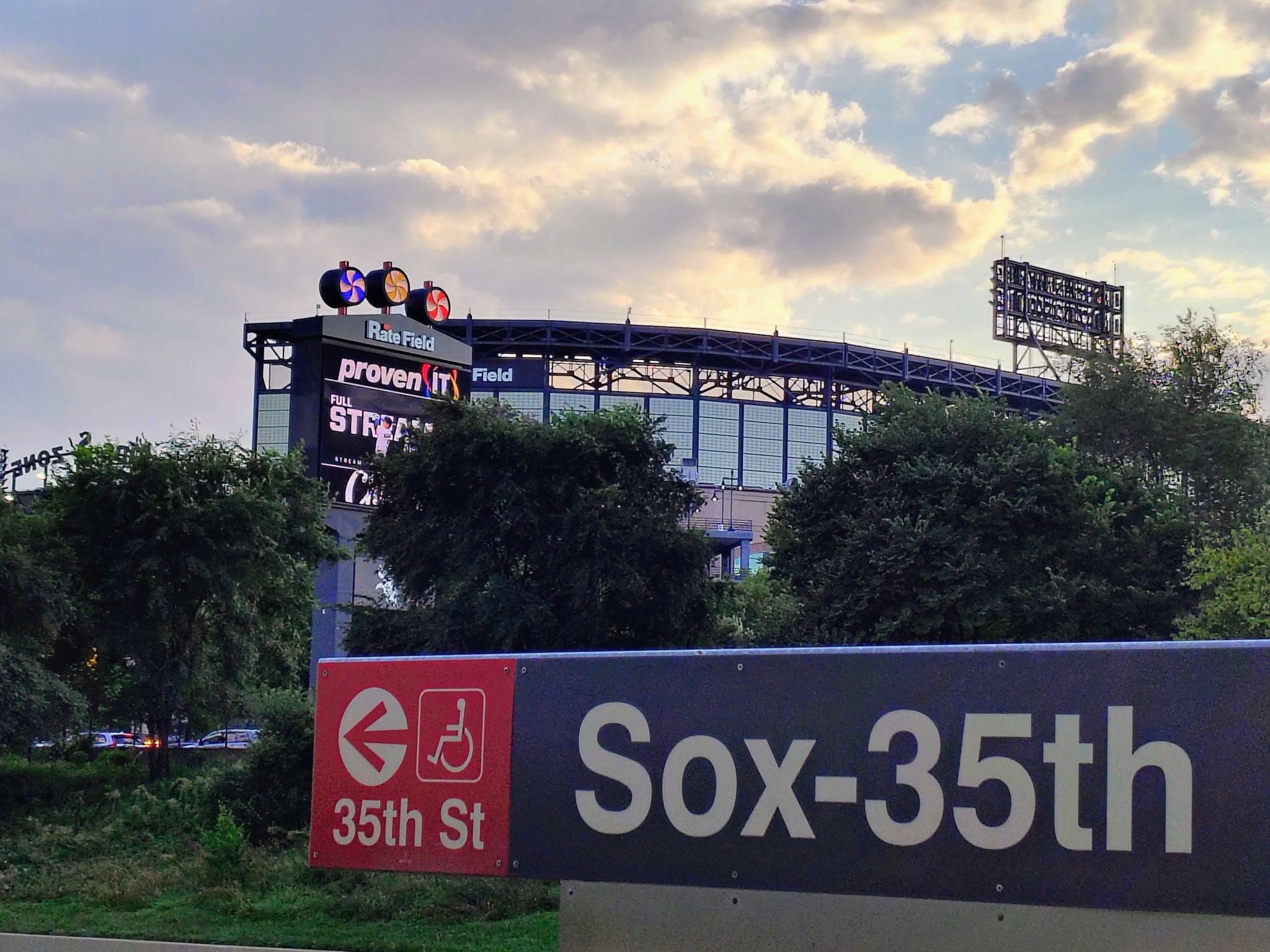
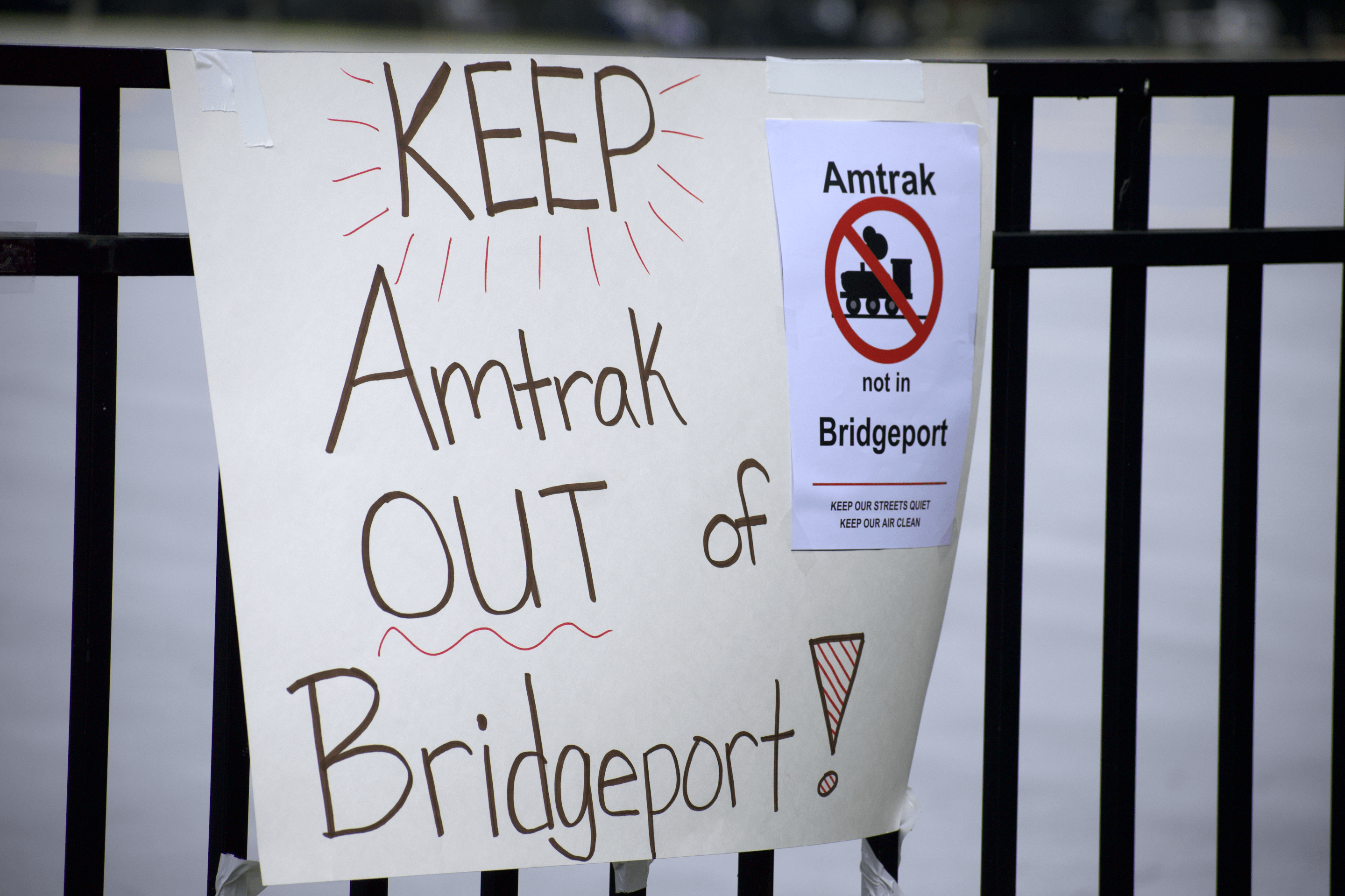
BRIDGEPORT – On a rainy Sunday afternoon, Bridgeport residents held a rally outside of Rate Field’s Lot G at the intersection of 33rd and Canal, urging opposition to Amtrak’s plans for its new maintenance facility.
Maria LaGiglio lives in the Armour Square neighborhood in the 11th Ward and is just a few hundred feet from the proposed maintenance site. After attending Amtrak’s first community meeting on Aug. 20, she felt the presentation wasn’t sufficient.
“We did not get any of our questions answered,” said LaGiglio. “We did not get much information from our Alderman. So where did we all turn? Facebook.”
LaGiglio spent the next week investigating all the public resources available about this project. She shared Sox Machine’s original report back in May, reporting from Crain’s Chicago, and other real estate blogs with Bridgeport and Chinatown Facebook groups. Shortly after, a petition formed and gathered 500 signatures within the first few hours. Local news showed up to report stories about how angry Bridgeport residents were about Amtrak’s project, and how they were left in the dark.
“People were looking for answers, they had questions, they wanted to talk to other neighbors, and we really all wanted to talk to Nicole Lee,” said LaGiglio.
Lee, the 11th Ward alderman, did show up, and spoke for 30 minutes in the light rain, answering questions from residents about what she knew of this project, when she knew, and what her plans were to help stop it.
“It feels great that the community has solidly been in opposition to this project,” said Lee. “We need everyone to come together to make our voices heard.”
Toward the end of the rally, one concerned resident grabbed the microphone and said the project is happening only because the White Sox want a new stadium. Lee reiterated her stance that she believes the White Sox should stay at 35th and Shields. She told the crowd that her next step was to work with fellow city officials to investigate how a major industrial project like this could include plans for a residential neighborhood in Chicago.
What has surfaced is that Amtrak had plans for Bridgeport long before Justin Ishbia got involved, or even considered becoming the next Chicago White Sox owner.
Why Amtrak targeted Canal Street rail yard in Bridgeport
In response to inquiries from Sox Machine, Amtrak replied with a Frequently Asked Questions document, in which it stated that three locations were considered for the maintenance facility:
- Redevelopment of the existing 14th Street Yard
- Union Pacific Global 1 site at 1535 S. Western Ave.
- Canal Street Yard, outside of Rate Field in Bridgeport
From its perspective, Amtrak didn’t believe redeveloping the 14th Street Yard was feasible because it would mean rebuilding the space around active train operations. Union Pacific’s Global 1 site, rumored to be BNSF's new home after it moves out of the 14th Street Yard, had problems with availability, dispatching, routing, and constructability.
Amtrak deemed the Canal Street Yard the best fit. In his April presentation at the UIC forum, Amtrak Director of Program Management Joe Shacter said the key catalyst in selecting Canal Street Yard was its ability to provide six tracks with drop tables and continuous maintenance. Currently, Amtrak has only two drop tables at 14th Street Yard, and each is located at a different facility.
By leveraging the Canal Street Yard, Amtrak could greatly enhance its maintenance capabilities without constantly moving equipment and locomotives. Its original plan was to build the maintenance facility directly east of Rate Field between 33rd and 39th streets, making it a neighbor of the Chicago White Sox, while also creating an opportunity to modernize the maintenance buildings at the 14th Street Yard.
What changed when Amtrak met with Justin Ishbia in August 2025 was moving the maintenance buildings that were to remain at 14th Street, along with a train wash, to the northern branch of Canal Street Yard in the Chinatown neighborhood. This clears the 47 acres both parties agreed Ishbia would purchase in March.
When asked for comment, the team sent a statement to Sox Machine: “The Chicago White Sox have not had any specific discussions with Amtrak about its proposed footprint for a new maintenance facility.”
Lack of details about environmental testing is concerning for city officials and residents
Alicia Ferro is a lifelong Bridgeport resident and mother of three kids. She’s become more active in spreading the word on social media, informing neighbors about what Amtrak is planning for their neighborhood.
“The fact that we weren’t told, consulted, or even included in the decision-making process isn’t great. I’ve lived here my entire life, and I don’t want something like this to happen,” said Ferro.
Many residents are concerned about the pollution level Amtrak’s maintenance facility will bring. During a community meeting on Aug. 26, Amtrak Senior Director of Real Estate Steven Segerlin said the project received categorical exclusion from the National Environmental Policy Act. That fact has not sat well with Lee or her constituents.
On Aug. 27, U.S. Sens. Dick Durbin and Tammy Duckworth sent a letter to Federal Railroad Administrator David Fink and Amtrak Interim President Byl Hermann, requesting both parties to “provide both residents and local officials with greater detail and insight into Amtrak’s plans to relocate the maintenance yard.”
Chicago city commissioners and representatives from the Planning and Development, Transportation, Law, and Water Management departments met with Amtrak on Tuesday. On the official 11th Ward Facebook page, Lee shared details of that meeting.
According to Lee, Amtrak conducted an environmental study for the Canal Street Yard but did not share the findings during its meeting with city officials. Amtrak also could not provide details of its plans for the maintenance facility. Alderman Lee wrote, “I left this meeting more frustrated than when I arrived.”
Amtrak's response to health and environmental concerns
In the Frequently Asked Questions document, Amtrak provided the following responses concerning emissions, vibration, and noise pollution.
In its statement, Amtrak said, “Amtrak locomotives assigned to Midwest services comply with EPA Tier 4 locomotive emissions standards, the most stringent federal emissions requirements currently applicable to new locomotives and railcar maintenance will be performed indoors.”
Amtrak also added, “Amtrak trains are lighter, shorter, and quieter than the freight trains previously handled here. Amtrak trains, when stationary, do not idle like freight trains, but are plugged into on-site power to conserve fuel.”
There are no plans to drop cars in the rail yard, as Amtrak ensures this will be a maintenance and servicing facility.
Concerning the environmental review, Amtrak said that its assessments “are standard due-diligence investigations for an historic rail and industrial property. Conditions were found that are consistent with that history.”
In its final remark, Amtrak said: “Over the longer term, we expect air quality at this site to improve relative to its freight era, when yard operations involved multiple diesel switching units running daily pushing heavier and longer freight trains.”
As for final maintenance facility renderings, Amtrak plans to share them with Bridgeport residents in upcoming community meetings this fall. They expect an 18-month buildout with about 3,000 workers and hope to start construction in 2027, which would mean the buildout will be ongoing during both the 2027 and 2028 Major League Baseball seasons next to Rate Field.
“They will never convince me this will be a good project for Bridgeport”
Maria LaGiglio works in communications and public relations. She knows what it takes not only to get the word out, but also to reach the right people for help. Every day, she calls and leaves voicemails for Durbin and Duckworth’s offices, hoping to speak with someone. She still hasn’t received acknowledgment.
“This is going to make me sound nuts, but I’ve left a voicemail for them every single day since this meeting,” said LaGiglio.
“Just saying this is day X that you haven’t returned my call. I’m your constituent. This is what I’m calling about, and I want somebody to respond to me either by email or phone call. Nothing. So I called the governor’s office. Nothing. I called the mayor’s office. Nothing. Just silence on the political front.”
This feeling of being in the dark about Amtrak’s plans is common in Bridgeport.
“I heard about this project a week before the community meeting on Aug. 20. I saw a flyer at my parents' home,” said Ferro.
“I started posting about it on Facebook to reach out to my neighbors to say, ‘Hey, do you guys know about this?” said LaGiglio. “Just going to be that lady who’s like doing this because, I don’t know, maybe I’m wrong? I was hoping I was wrong. But turns out nobody really knew the magnitude.”
“You catch people who are like, ‘You should have spoken up about this five months ago,’ because they read Crain’s every day. I don’t, and most of our neighbors don’t. They didn’t know,” said LaGiglio.
Now residents LaGiglio and Ferro are trying to spread the word. Help from Coalition for a Better Chinese American Community (CBCAC) and the Bridgeport Alliance is coming. Attorneys in Bridgeport are lending their support to connect with the right people who can help residents push back against Amtrak.
LaGiglio has contacted Northwestern University’s Environmental Advocacy Center to gather facts about health risks for residents living near a railyard that could help stop Amtrak’s plans. But beyond health, many in Bridgeport are concerned about what this maintenance facility will mean for their home values.
“They want to create an industrial corridor in the middle of a very residential pocket of this neighborhood,” said LaGiglio.
“It’s ridiculous to me that’s even being discussed or mapped out while we’re sitting here. Just waiting for people to make those decisions.”
“They will never convince me this will be a good project for Bridgeport,” said Ferro. “If this project happens, I would have to move because I couldn’t have my children growing up near this facility. I’ve lived in Bridgeport my entire life. This is where I work, where I want to stay, and where I want to raise my kids. Amtrak will never convince me this is a good idea.”
LaGiglio shares the same sentiment about leaving Bridgeport, “I have a 9-year-old daughter. I don’t want to be living next door to something like that.
"I think it will forever change the map and footprint of this neighborhood. Not only are there the health and environmental effects that we have to worry about, but also ‘What’s going to go there?’ What’s it going to look like?
“It’s just going to kill this neighborhood.”
New political ally emerges for Bridgeport residents
Ald. Nicole Lee has carried almost all of the political load in an attempt to get City Hall’s attention to Amtrak’s project, but during Sunday’s rally, an unexpected political ally emerged to speak with the crowd: Illinois Comptroller and Chicago Mayoral Candidate Susana Mendoza.
Mendoza was in southern Illinois days before the rally when she first heard about Amtrak’s maintenance facility project. She made a point of calling out Amtrak on Twitter, asking where the City’s Department of Planning and Development team stood on the issue. Before she became a State Representative, Mendoza worked in said department. When she learned the full scale of Amtrak’s project, she was shocked that a project of this scope and magnitude could take place in Chicago without city or local alderman involvement.
I spent time with Bridgeport residents as our listening tour reached the 11th Ward. I couldn’t agree with them more. They deserve more dialogue, transparency and RESPECT.
— Susana A. Mendoza ☮️ (@susanamendoza10) September 1, 2026
I will be coming back often and following this very closely.#chicago pic.twitter.com/Q6CMPOtzBx
“I’m super concerned about the lack of transparency,” said Mendoza. “The fact that the community was really shown no respect in this process at all, and that the alderman who they voted for was shown zero respect in the process.”
A self-described YIMBY, Mendoza is building her mayoral campaign on the idea of encouraging development in Chicago. She urges developers to share ideas and how City Hall under her administration can help streamline efforts to generate more revenue for Chicago and Illinois. Amtrak and Justin Ishbia’s plans for a land swap seem like the kind of economic development Mendoza's campaign would support, but she doesn’t think it is a smart plan.
“For anybody who says you can’t be YIMBY and be against this project, I would counter by saying, what if we created a landfill next to your home? One that will bring dollars in. Would you be OK with that?”
“I’m for very smart, well-thought-out development and then fast-tracking it to make it happen as quickly as possible. That does not appear to be the case in this scenario with Amtrak,” said Mendoza.
From Mendoza’s perspective, Planning and Development must get involved and stop being kept in the dark about Amtrak’s plans.
“I just don’t think there’s logic in moving it to Bridgeport. The city should be actively sitting down with the potential developers and Amtrak, and saying, ’Here’s a whole list of other properties that we can help facilitate to make this happen as quickly and safely as possible.’ That there will be buy-in from the city and areas that will benefit from this type of development, versus starting on completely the wrong foot -- which, by the way, will only further delay any type of development of this nature from happening.”
Chicago's first mayoral election will be held on Feb. 23, 2027, and if no candidate wins a majority of votes, the runoff will be held on April 6. Amtrak hopes construction will be underway by then, but Bridgeport could be a key issue in the election. Mendoza, who considers herself a die-hard White Sox fan, was asked about Ishbia’s plans to build a new stadium in the South Loop and believes it will have a major impact on the community.
“It would really be super sad to see the White Sox leave that area if you were a resident of Bridgeport. They’re an economic engine for the area, and there’s a massive Chicago loyalty component to that.
"I’m more concerned with the fact that, let’s say, the Sox park wasn’t there because that is going to be a private-investor type of decision. The community really doesn’t get to say, ‘You have to stay here.’ But I think the community should absolutely voice their concerns about a 24/7 maintenance facility or train yard that will be dropped into their very residential area,” said Mendoza.
Mendoza plans to reach out to the federal delegation for more transparency about Amtrak's plans, and she's not alone. Lee will press City Hall to act on this matter, and Bridgeport and Chinatown residents will continue to rally against the project. What first seemed like a creative solution promoted as a unique and beneficial public-private partnership between Justin Ishbia and Amtrak is becoming more contentious as the affected parties strive to be heard.