
Over 110,000 people will converge on Armour Park and Bridgeport this weekend for the Crosstown Classic, which is suddenly charged by the fact that both teams have winning records for the first time since 2008, shortened seasons notwithstanding. The Chicago Cubs have started strong in their quest for a National League pennant, but as their fans ride the Red Line from Addison to the Sox/35th Street stop, they’ll be greeted by a surprising amount of jovial White Sox fans.
The aroma of charcoal from Weber and Blackstone grills, with various sausages, burgers, and carne asada, will permeate the vast parking lots surrounding Rate Field. It’ll feel more like tailgating for a Bears game than watching America's pastime. Baseball being a zero-sum game, someone is bound to have a bad weekend, but it should be festive on the South Side.
While this has been a familiar scene since interleague play was introduced in 1997, this unique experience could be nearing an end. Five years from now, this inner-city rivalry could be moving north with a new White Sox stadium butting up to the Chicago River, across from the Chicago Fire’s new home, McDonald’s Park, replacing a fan-generated pregame party with the feel of a corporate soireé.
Justin Ishbia’s plan for a new White Sox home
Building a new baseball stadium near an urban center is hard. You don’t see 30+ acre lots just lying around for development in many MLB markets. That’s led owners to come up with more creative, destructive ways to find space for a new ballpark.
In Las Vegas, Bally’s Corporation tore down the Tropicana resort to make room for a new Athletics stadium. Recently, the Kansas City Royals and Hallmark will begin redeveloping 85 acres in Crown Center on the south side of downtown. Hallmark is giving the Royals their current corporate headquarters space to start breaking ground on a Kauffman Stadium replacement in 2027.
While other teams are tearing down old casinos and corporate headquarters, Justin Ishbia is targeting a rail yard.
During a webinar presentation by the University of Illinois-Chicago Urban Transportation Center, Amtrak Director of Program Management Joe Shacter spoke out of school about plans Amtrak was preparing for the coming years. The thrust of the presentation was to highlight and draw excitement about the Chicago Hub Improvement Program (CHIP) progress in modernizing rail infrastructure. Instead, Shacter gave away Ishbia’s planned course in moving the Chicago White Sox to the South Loop.
This webinar, which has since been deleted from public records, caught the attention of everyone in Chicagoland, including key political figures like 11th Ward Alderman Nicole Lee, who represents Armour Park and Bridgeport, where the White Sox have played for the entirety of their 126-year existence. She’s trying to get everyone’s attention, including City Hall, to come up with a plan to keep the White Sox where they are, before Ishbia’s new stadium plans leave the station.
Amtrak’s plans for Bridgeport
With an increase in rail activity, both commercial and passenger, Amtrak was at a crossroads. They needed significant investments to enhance regional rail infrastructure. With the federal government passing the All Board Act, which would fund $200 billion in rail improvement projects, Amtrak found an opportunity to capitalize. Along with several federal, state and local agencies, Amtrak created CHIP.
There are seven projects listed that require funding assistance, with one currently in progress at Union Station. Platforms 30 to 38 are being transitioned to passenger use for the first time at Union Station. That’s part of the CHIP initiative.
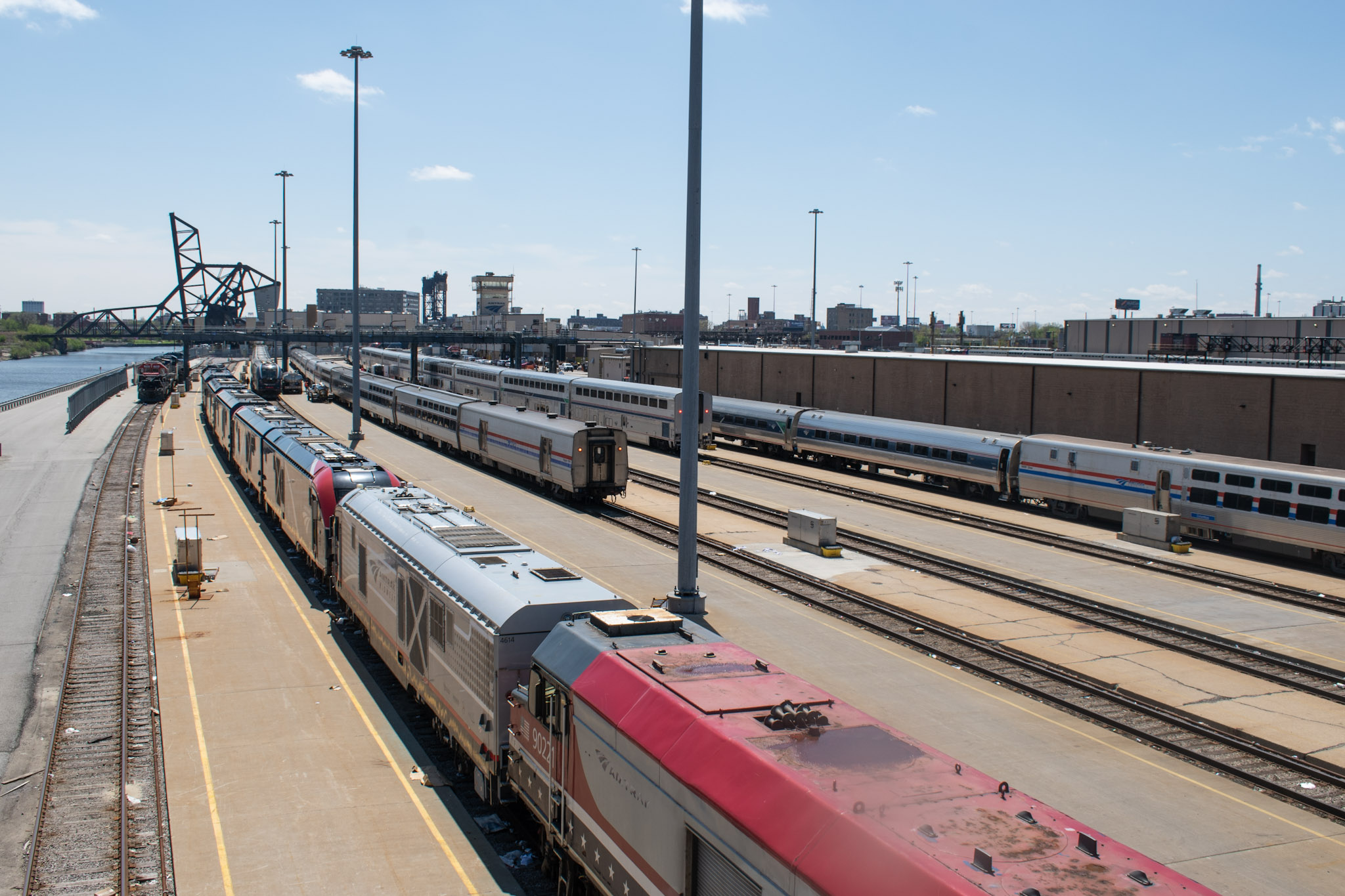
One project currently in the planning phase is the Midwest Maintenance Campus Build-Outs. Amtrak’s existing maintenance yard, located along the Chicago River between 14th and 16th streets, presents operational challenges due to constrained corridors that limit both current maintenance activities and future upgrades. To give itself more space to work, Amtrak is currently negotiating with Union Pacific Railroad to buy rail yards along Canal Street, located directly west of Rate Field in Bridgeport.
Purchasing this yard would allow Amtrak to stage upgrades at the 14th Street rail yard by moving equipment south to Canal, serving as a sort of storage area. Eventually, after applying for and receiving federal grants, Amtrak’s original plan was to update the 14th Street rail yard for continued use.
Then, Ishbia entered the picture.
Last August, Ishbia’s firm, Shore Capital Partners, met with Amtrak to discuss the future of the 14th Street rail yard. After hearing about the need to significantly enhance maintenance capabilities, both parties agreed to construct a modern facility at the current Union Pacific rail yard near Rate Field. By doing so, Amtrak would have a state-of-the-art facility and more maneuverable space to work. Moving out of 14th Street would open that lot to commercial development, which is of great interest to Ishbia.
During the webinar with the University of Illinois-Chicago, Shacter stated in his presentation that he learned only “a few weeks ago” that the proposed commercial development is intended for a new White Sox stadium.
Ishbia creates Canal Edge To lead the project
To get this project started, Shore Capital Partners spun off a new company called Canal Edge. Since last summer, Canal Edge has been very busy behind the scenes, laying the groundwork to help Amtrak vacate 14th Street.
Over the past nine months, Canal Edge has engaged WSP, a global leader in engineering and transportation consulting, which previously assisted the St. Louis Cardinals with the construction of the current Busch Stadium. During this time, Canal Edge retained three federal lobbying firms: Accelerate Strategies, Harbinger Strategies, and Penn Avenue Partners. Quickly, Canal Edge found partners who could help secure key funding and develop design plans for the 14th Street lot.
On Nov. 21, 2025, Canal Edge submitted a letter of interest to the Build America Bureau. Managed by the Department of Transportation, the Build America Bureau maintains a record of projects that request federal financing through TIFIA or RRIF loans. In their application, Canal Edge is seeking $383 million in financial support for the project titled “Chicago Keeps America Moving” through a RIFF (Railroad Rehabilitation and Improvement Financing) loan. These loans are attractive because they offer low, fixed interest rates and repayment terms of up to 35 years.
In March 2026, Crain’s Business reported that Shore Capital Partners had reached an agreement with Amtrak to purchase 47 acres of the 14th Street rail yard. By the time the public was trying to wrap their heads around what Ishbia had planned for this lot, his efforts were well underway.
Next steps
Before any of Ishbia’s machinations gets closer to becoming reality, this grand plan is contingent on Amtrak first purchasing the Canal Street rail yard from Union Pacific.
Once that’s completed, the next step is on Canal Edge to receive its $383 million federal loan.
“I should point out that if the Canal Edge project proceeds, the most likely path for it would be that Canal Edge would take out a loan to fund the construction of the new buildings on Canal,” said Joe Shacter during his webinar.
“The grant we would receive from the FRA would be to buy the finished yard.”
- Amtrak buys the Canal Street rail yard from Union Pacific.
- Canal Edge builds a new maintenance facility for Amtrak using a federal loan.
- Upon completion, Amtrak purchases the facility from Canal Edge using federal grants.
- Once the new facility is purchased, Amtrak and Shore Capital Partners can complete the purchase of 47 acres at the 14th Street rail yard. Amtrak will begin vacating that lot to prepare for commercial development.
This plan will be championed as a great example of how private partnerships can aid the public; a huge boost to CHIP efforts in modernizing rail infrastructure that not only benefits Chicago but also the entire Midwest. All of these activities won’t happen overnight, but if everything goes according to plan, the 14th Street rail yard could be ready for commercial development as early as 2029.
Before shovels can enter the ground, there is a key step in CHIP’s process requiring community engagement. This stage of the project timeline is when Amtrak and Canal Edge will inform Bridgeport residents that a new rail maintenance facility is coming to the neighborhood, while also trying to dodge questions about whether this means the White Sox are leaving Bridgeport.
The evolution of Chicago’s 11th Ward
Regarding the White Sox's current neighborhood, most baseball fans only know what they see getting off the Red Line. They are immediately standing over a major highway before walking towards Rate Field. The large, empty parking lots and the 35th Street viaduct serve as a gateway to Bridgeport. Most know about the local bars, Cork & Kerry and Turtles. Some walk through the viaduct past the murals to grab a hot dog at 35th Street Red Hots. But for the large majority, that’s where they stop venturing into Bridgeport.
What outsiders are missing out on are the many changes to the neighborhood, especially in the last 10 years.
“It's a super diverse, really vibrant neighborhood that's continuing to evolve. With the redevelopment of the Ramova Theater, I think it's been a great anchor to help revitalize the Halsted Street Corridor,” said Ald. Lee.
“We've got a lot of economic development work going on currently. You can eat your way through many countries coming to Bridgeport. Some of the best food and best people, I say, in the city of Chicago are right here in Bridgeport.”
The Duck Inn, owned by executive chef Kevin Hickey, was just named by the New York Times as one of the 25 Best Restaurants in Chicago. Electric Funeral was named by Chicago Magazine as one of the Best New Bars in 2025 and frequently has a waiting line on the weekends. Speaking of waiting, you’ll usually see a crowd of people standing along Archer Avenue waiting for Fat Peach Bakery to open.
Stussy’s Diner has been drawing large crowds by posting photos of its pretty food on social media. Korean-Polish mashup Kimski is celebrating its 10th anniversary this summer, drawing in guest chefs from the best restaurants in Chicago. In early October, the entire neighborhood meets up at Antique Taco for Bridgeport Taco Night. Old standbys like Maria’s Packaged Goods and Franco’s are still packed on the weekends.
If you love coffee, Bridgeport has become a mini-Seattle featuring numerous cafes like Jackalope, Bridgeport Coffee, Bad Owl Coffee Roasters, The Stockyard Coffeehouse, and Base Community Cafe. Halsted between 31st and 35th has become an extension of Chinatown, featuring a variety of Asian cuisines. During Father's Day weekend in June, Bridgeport is hosting street festival Motoblot.
The old Bridgeport is finding new life.
Yet there has always been some hesitancy from the White Sox to create more connective tissue between Rate Field and the neighborhood. Oftentimes, it’s up to local restaurants and bars to build that connection, like Connie’s Pizza and Wings and Rings, which offer local bus transportation to games. The White Sox built a bar that’s rarely open, and their team store, now run by Fanatics, has limited hours and competes directly with Grandstand, a 37-year-old sports apparel store two blocks away. It gives off the impression that when the White Sox are not playing, the neighborhood is closed for business for those coming off the Red Line.
Some within the White Sox organization have tried to build a stronger connection with the ward. SoxFest Live has been held at the Ramova Theater for the last two years, and through White Sox Charities, large donations have been made to the Louis L. Valentine Boys & Girls Club.
But instead of adding more to the neighborhood and helping continue the 11th Ward’s evolution, the parking lots sit empty, with no plans from either Jerry Reinsdorf or Justin Ishbia to develop them. That hasn’t stopped Lee from making her pitch to the upcoming owner.
“I think one of the challenges has always been that the stadium feels so far away from everything else. I think that these big, vast parking lots don't help,” said Lee.
“We've talked a couple of times. I've met with him [Ishbia] just to have, like, an introduction. And I made very clear right from the get-go, I want you to stay. He hasn't ever directly told me that he wants to move the Sox out, but clearly he's made public statements about it.”
Nicole Lee trying to get City Hall's -- and White Sox's -- attention
Three professional sports teams are seeking new homes in Chicago. The Fire are already building their privately financed new home at Project 78. For the Bears and White Sox, both their situations are still up in the air, but one team clearly takes precedence based on Mayor Brandon Johnson's actions.
Despite Bears president Kevin Warren publicly stating that the team is no longer considering any plans of staying in the city, Mayor Johnson is pleading with Illinois state officials to find a way to build a new publicly owned stadium in downtown Chicago. Currently, the only plan Illinois lawmakers are working on is making the Arlington Heights location palatable for all parties, which would prevent the Bears from considering a move to Indiana. This level of grandstanding from Chicago’s mayor is akin to a football team trying to establish the running game down by 21 points.
Mayor Brandon Johnson is still making a push for the #Bears to stay in downtown Chicago.@leilarahimi, @mharrisonair & @grotesports listen and react to Johnson's recent comments.
— 104.3 The Score (@thescorechicago) May 13, 2026
🎧https://t.co/8am8qI0UKV
💻https://t.co/vwfNUP4Dui pic.twitter.com/nV98wTr1WL
What irks Lee is that the Soldier Field lease expires in 2033, and the Bears have already bought the land in Arlington Heights. It seems like a foregone conclusion that they are leaving Soldier Field. Meanwhile, the White Sox's lease expires after the 2029 season. When Lee tries to raise this as a more pressing matter, it’s crickets from City Hall.
“To be honest with you, it's been difficult to get attention from the city on this,” said Lee.
“I've been in office for four years now, and I still haven't been able to get attention from the city on this. I've been asking anyone in the mayor's office for a time to talk about what development looks like. This lease is up in 2029. The Bears' lease isn't up until after that. We've only talked about the Bears.
"We've got a lot of teams that are looking for homes right now. I mean, I think it behooves us to really look at this from a more macro level.”
The Illinois Sports Facility Authority is still responsible for Rate Field and the parking lots surrounding it, but no one from the government agency has publicly stated that they oppose any development plans. The total area is more than 80 acres, significantly more than the rail yard Justin Ishbia plans to develop.
“I think that development on the 78, with the Fire stadium, I'm excited because there's something that's actually moving there," Lee said. "As I've listened to my colleague, Ald. Pat Dowell, [she] said very publicly she doesn't think that there should be two stadiums on the 78,” said Lee. I'd like to appeal to [Ishbia] to think about what we have already built, infrastructure that is already there, and what's possible to build up around it.
"As the 11th Ward alderman, if they were to take the White Sox out of where it is currently, and leave the community with a big gaping hole of 80 acres of undeveloped property, and move it to the ward just north of me, I'm going to have a headache on both sides.”
Upcoming pushback on Amtrak’s plans
Union Pacific’s intermodal facility on Canal has been dormant for many years. For someone who grew up in the neighborhood, Lee has grown accustomed to the relative peace and quiet of trains just passing through, rather than loading into a maintenance facility that could see work around the clock.
“For many, many years, growing up in the neighborhood, and many people who've lived along this rail track, if you lived along Canal Street or around Stewart, I would have never seen a house shake whenever they were loading these trains,” said Lee.
The disturbance of neighborhood peace will be a focus in upcoming community meetings between Amtrak and the 11th Ward.
“When I have had conversations with Amtrak, there was agreement that there would need to be community engagement prior to their breaking ground on anything. Again, I haven't seen any plans. I have nothing to react to other than the description of here's what's going to be here. We think we can keep it relatively quiet because it'll be enclosed. But again, lots of other questions about idling trains,” said Lee.
Noise concerns from Chicago neighborhoods are nothing new, especially those communities that live near O’Hare and Midway airports. Frequently, White Sox fans can watch Southwest Airlines planes fly over the stadium on the descent to the airport. A certain amount of noise pollution is nothing new and often serves as white noise for those who live in Chicago long enough. However, this new project from Amtrak is expected to draw heavy criticism from 11th Ward residents whose backyards are pressed up against the elevated rail tracks.
Despite local pushback, that might not be enough strength to stop Amtrak from moving forward with this project.
“I've been very honest with constituents whom I've talked to about this. You know, it's not city-owned land. We don't have control of it in that way. It's privately owned. And if it is sold, then that's between private parties at the end of the day,” said Lee.
To help her constituents, Lee has turned to City Hall for clarity.
“That's why my questions to the city are, like, where are the pressure points? Where can the city exert some leverage in order to ensure that the concerns of the community are heard, and actions are being taken to address those concerns?” said Lee.
“This ends up kind of being sort of like a community zoning issue, but on a much larger scale. Things that happen between two private landowners are one thing. So, what can be done to mitigate all of the things that people are really worried about? Noise, traffic, and the like.”
The dominos are set, but will they fall?
This level of behind-the-scenes activity from Ishbia indicates that moving the White Sox from Bridgeport to the South Loop is more than a hypothetical. It’s the intended target. Building a stadium similar to Pittsburgh's PNC Park will earn rave reviews both locally and nationally. If this plan with Amtrak comes together, it's feasible that the White Sox will have a new stadium with Willis Tower in the background, hosting the 100th MLB All-Star Game. Never mind that the first All-Star Game was played at 35th and Shields, which would be commemorated with a home plate plaque in a parking lot next to an empty stadium.
It's an uneasy juxtaposition for White Sox fans, many of whom live outside of Chicago and, ever since Project 78 was a possibility, have been dreaming of what could be with a new stadium. But for the 11th Ward residents, losing the team that’s been playing baseball for more than a century would leave a gaping hole in the neighborhood’s heart.
The ward's alderman has stated that there are no current conversations between her office and the Chicago White Sox. She’s made it clear that the team should stay. In March, during the Media Preview Day, Chief Revenue Officer Brooks Boyer stated to Sox Machine that the plan is still to build a new stadium at Project 78.
Even though the dominos are set in Justin Ishbia's Rube Goldberg machine for building a new White Sox stadium, what’s unknown is whether everything will fall into place as designed. If the Amtrak purchase with Union Pacific delays or stalls, how does that impact the timeline? If that purchase doesn’t happen, does Shore Capital Partners bail out of their agreement to buy the 14th Street rail yard? If Canal Edge doesn’t receive its $383 million federally backed loan, does this machine fall apart? If Brandon Johnson doesn't win re-election in February 2027, does a new city hall administration have different ideas about this project?
Mayor Johnson plans to give Pope Leo, the world’s most famous White Sox fan, a Cubs hat. https://t.co/n4WECZ7VWJ pic.twitter.com/mesPuXRor3
— Block Club Chicago (@BlockClubCHI) May 14, 2026
But if the first couple of dominos fall, the chain reaction is in place to close one era in Bridgeport, while welcoming in a new one under Ishbia in the South Loop. The 11th Ward would be trading a professional baseball team for a rail yard, and that notion is unacceptable for Lee.
“I think that it would be a travesty if that is what happens, if we're trading a ballpark for a rail yard and nothing else. That is unacceptable. And it's unacceptable to me, that I will be working to make sure that that is not what is going to happen.”