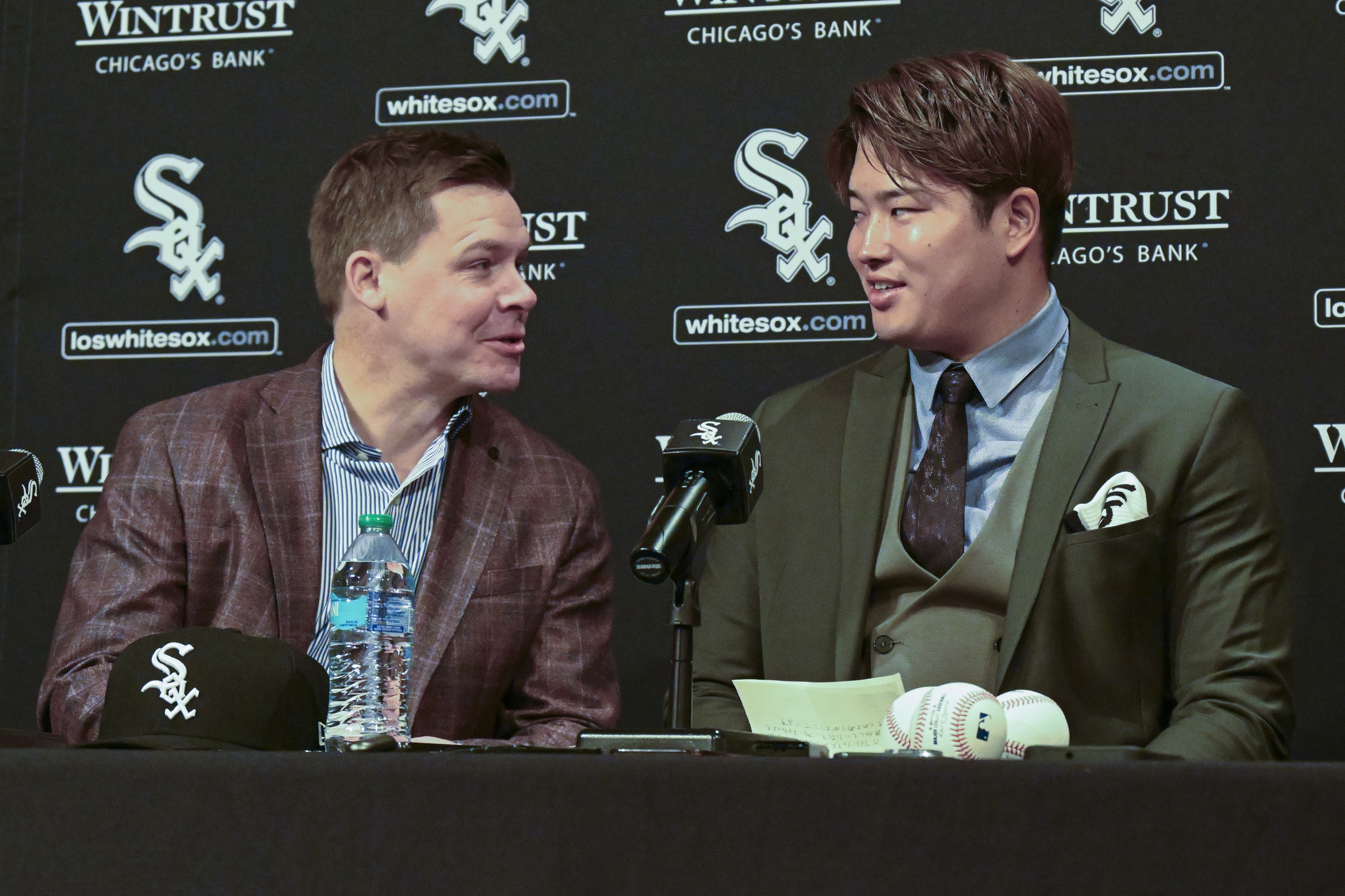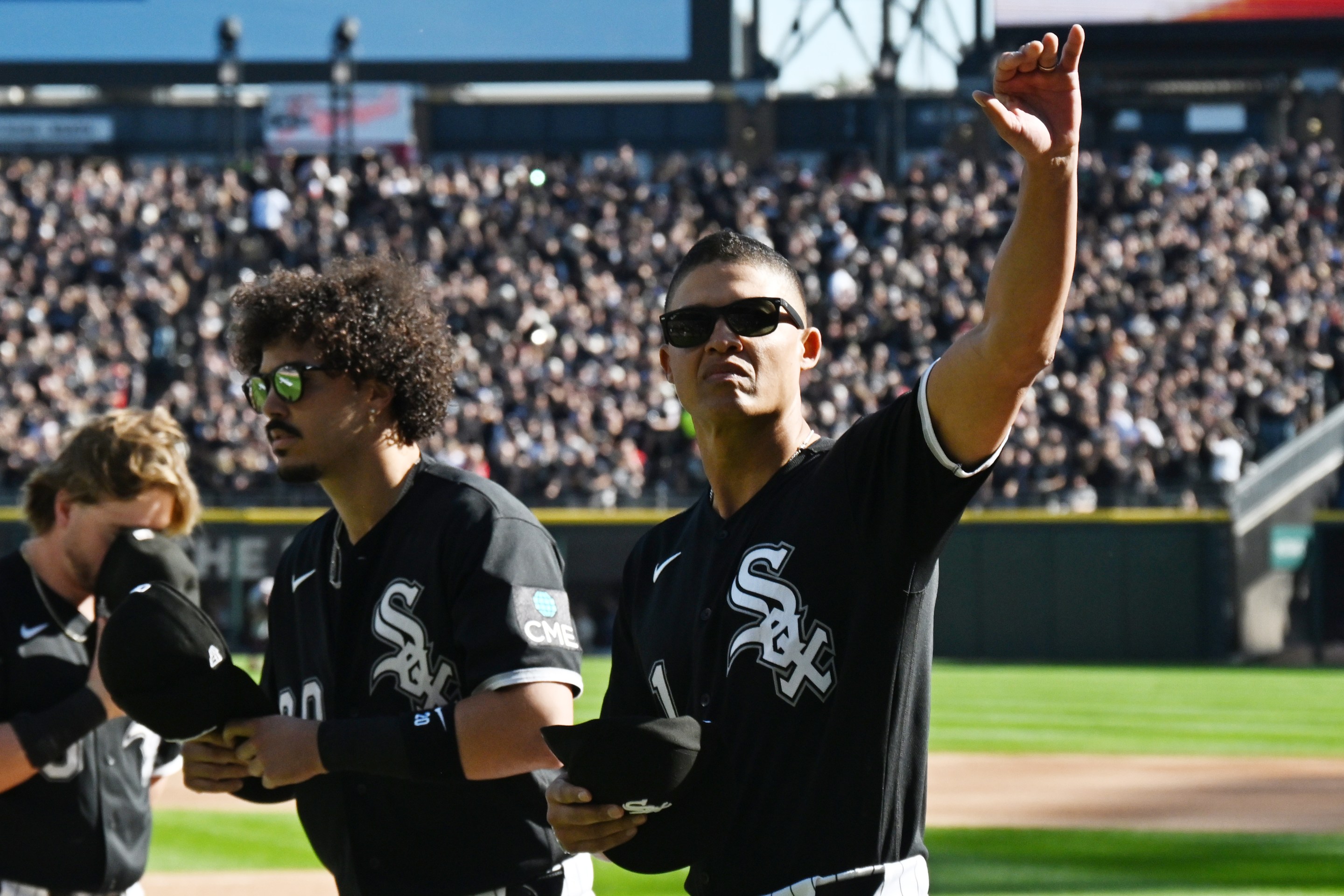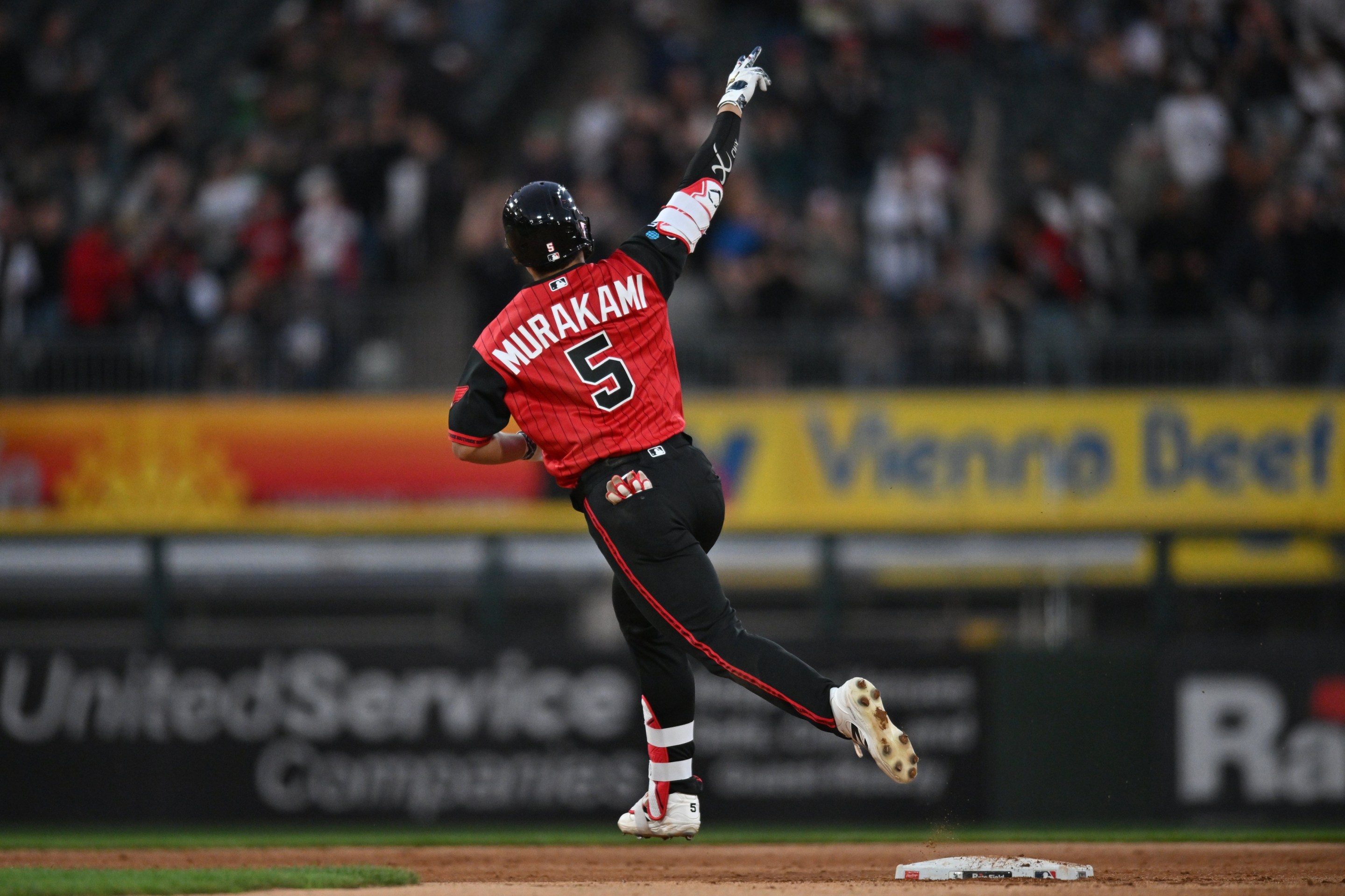
If you determine the White Sox's record during Munetaka Murakami's absence by the games where he was unable to participate at all, they went 17-18 during his 35-game absence for a strained hamstring.
If you approach it like the Major League Baseball rulebook determines a pitcher's record, then you could say the White Sox went .500. The Sox trailed 2-1 when Murakami left the May 29 game against the Tigers, and didn't lead until Miguel Vargas walked it off with the final swing of the game. For that matter, Luisangel Acuña pinch-ran for Murakami after he reached on the fielder's choice and scored from first base on a Vargas double, which is something Murakami wouldn't have been able to do, so he really didn't factor into the decision.
Either way, the White Sox were two (or three) games out of first place when Murakami went down, and now they're tied at the top of the AL Central even with a losing record over that stretch, so they ultimately came out ahead, even if the three-game sweep by the Red Sox suggested they were pushing their luck.
The players who were called upon to replace Murakami's production as a left-handed bat at first base or DH did so, more or less. Jacob Gonzalez's surface-level stats don't stand out -- .244/.323/.360 over 97 plate appearances -- but he wasn't really that kind of hitter at any given time due to an 0-for-28 slump in the middle of it all. He hit .333/.429/.458 in the eight games before that, and then .351/.400/.541 in the 12 games afterward.
As for his defense at first base, Outs Above Average (2) and Defensive Runs Saved (2) both had him at above average, so the times he looked overqualified outnumbered the occasions he appeared inexperienced. The White Sox optioned him back to Charlotte to open the spot for Murakami, but it's not because of anything he did.
Andrew Benintendi also helped by hitting .261/.333/.533 over 102 plate appearances, both of which propped up the overall White Sox performance so that they basically matched their line with Murakami:
- Through May 29: .237/.325/.403, 1.33 HR/G, 4.67 R/G
- Since: .242/.306/.418, 1.4 HR/G, 4.69 R/G
The first line doesn't quite capture the strength of the offense the last time Murakami was a part of it, because it bottomed out in mid-April, then hit .253/.342/.439 over the last 42 games of that sample. That said, if nothing changes on the whole by Murakami's return -- we're talking about the 4.7 runs per game, not the two runs and no extra-base hits over three games against Boston -- that'd be fine, because that's a top-three offense in the American League.
The White Sox were able to validate the confidence they expressed in the wake of Murakami's injury and Gonzalez's ability to hit major-league pitching, so perhaps they'll come away from it richer from the experience. Now with Murakami back in the fold, the hope is that there are two additional knock-on effects that round out the offense into a more stable form.
The first is similar to what we talked about with Braden Montgomery, in that Murakami gives Will Venable one more player he doesn't have to sub out due to simple platoon concerns, which frees up his better bench bats for more vulnerable hitters or the highest-leverage opportunities, and not just the first opportunity, although those situations can overlap.
Meanwhile, the reference to Montgomery reminds that he wasn't part of the roster when Murakami was last active. Neither was Kyle Teel, for that matter, so the White Sox are finally able to roll out their Plan A lineup for the first time all season.
Mune returns 🔜 pic.twitter.com/TCG2HYtg0i
— Chicago White Sox (@whitesox) July 10, 2026
They still don't have their best possible roster, because even if teams are usually shorthanded to some degree by injury, Junior Pérez isn't a major leaguer in his current state and Drew Romo went 3-for-43 during Murakami's absence. There's also the matter of the rotation, with Davis Martin wheezing into the break, Sean Burke is the only starter who appears capable of completing six innings with any regularity.
Murakami can't really affect that last part, but they're worth lumping together in the same paragraph as clear shortcomings that can be addressed, whether by returning players like Edgar Quero, Austin Hays and/or Everson Pereira, or external solutions at the trade deadline. The goal under Murakami's purview is reinforcing an offense that makes the roster worth investing in before Aug. 3, one way or another.