Behind the White Sox's back-to-back extra-inning walk-off victories against the Yankees this week was a herculean effort from their bullpen, which didn't allow an earned run over 11 innings of work, all conducted within the same physically taxing 24-hour span.
Pitching a scoreless eighth on Wednesday made it five innings in five days for Trevor Richards, before Grant Taylor took the game from the ninth into the 11th with a season-high seven outs recorded, and Jordan Hicks worked for the third time in four days for a scoreless 12th. Thursday saw Sean Newcomb work two innings as has become typical, Bryan Hudson pitch for the third time in four days, and Chris Murphy make his fifth appearance of a seven-day homestand.
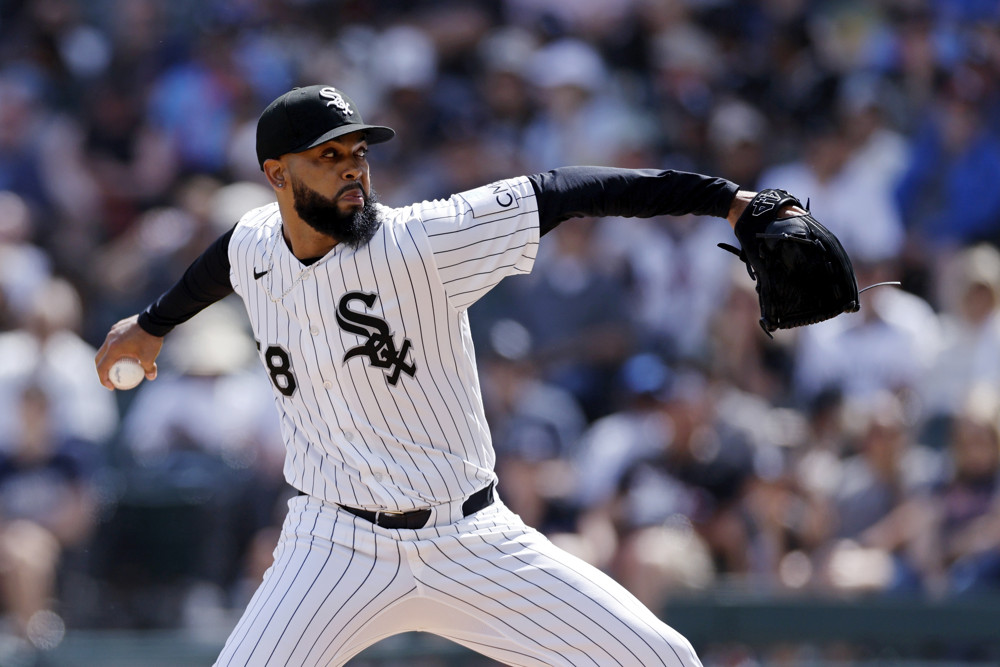
Only after all that, Seranthony Domínguez, signed to be the White Sox closer in the winter, entered in the 12th inning Thursday to throw his first genuinely high-leverage assignment since blowing back-to-back saves last month. He got through it scoreless, earned the victory and dropped his ERA to 4.21, even if the statement on where he sits in the Sox leverage hierarchy was already made.
"They're doing what they're supposed to do," Domínguez said earlier in the week about being sidelined from high-leverage work. "If I'm not doing my job right now, I understand that I can't be in the biggest situation. Thank God we have really good guys here, like Grant Taylor and Sean Newcomb doing an excellent job during the year. They're taking care of it for now and I'm happy for my teammates."
While his walk rate for the season season remains an elevated 14.1 percent -- very similar to the career-high figure he posted last year -- Domínguez does feel like he's making progress toward getting his delivery where he wants it to be. The issue he and White Sox pitching coaches have identified is a common pitcher gripe; he feels his shoulder was flying open early in his motion and causing him to yank balls off target.
The good news is that Domínguez says he has navigated this issue before, has come out the other side multiples times throughout his eight-year big league career, and feels his last few outings have been an example of the type of work he'd like to repeat. He's sat 97 mph and missed a credible amount of bats (27.8 percent strikeout rate) all season, and a solo shot in Texas is now the only run he's yielded over his last nine appearances.
Sure, they've mostly lower leverage appearances, and six home runs in 37 1/3 innings this year is part of the larger issue, but Domínguez can only pass the assignments he's been given.
"Low-leverage situations, if you don't do your job, then you're not going to get good results," Domínguez said. "I've been struggling. Everybody knows. It's not a secret. But I think if I feel good and I feel comfortable, I can come back and do my thing."
"We're seeing the fastball in the zone, attacking right away," Will Venable said. "Got ambushed by [Jake] Burger there with the home run, but outside of that, he's been really good limiting the walks and just being aggressive in the zone with a fastball, good sweeper. So I think he's getting getting closer and closer."
The bad news is that Domínguez dealing with delivery inconsistency lines up with both internal and external assessments that the same long and loose arm action that makes his stuff play up with plus extension also can be difficult to repeat. That generates stretches where he struggles badly with command, and doesn't look worthy of being trusted with the tightest spots of the game.
In turn, Venable was generous with his praise postgame Thursday, and expressed his hope that it would be a confidence-boosting outing for Domínguez. But the Sox manager also had spoken earlier in the week like a man who was content to not bestow a closer title upon anyone going forward, let alone on someone who's just fighting to get back into the late-inning mix.
"[We have] a bunch of guys in some really good spots," Venable said of the Sox's late-inning bullpen roles. "So outside of where Seranthony is, we have a lot of coverage in these leverage spots. He's certainly getting closer to his best version. I don't know if that necessarily means he's gonna, you know, be closing a game in two days, but he's getting closer and doing a great job."
Domínguez's two-year, $20 million deal came with the understanding that he would close, and he expressed surprise earlier in the year when his usage made a hard pivot toward sharing the load with the likes of Taylor, Newcomb and Hudson, who often matched up more favorably against lefties. Maybe that tension emerges again if Domínguez returns to pitching like someone who should be closing for a division leader, to find that his manager believes the division lead was built via a flexible approach to late-inning matchups.
Certainly for now, there's no clearer case of 'cross that bridge when we get there' on the Sox roster, and after a difficult first half in a new city, Domínguez would just like to get there.
"Sometimes you just feel disappointment, feel bad for yourself, and a lot of frustrations, tough times," Domínguez said. "But you've gotta be able to keep your head up and come back next day and do your best to help the team win today."
⚙️⚙️⚙️
The average age of the White Sox position player group is 25.7 years old, third-youngest in the sport, serving to partly explain why a popular clubhouse t-shirt proclaims 34-year-old outfielder Randal Grichuk as the "World's Greatest Dad."
The pitching group (28.5) is a shade older, but still below league average, such that Richards' thick-framed glasses and full head of white-gray hair still stands out. That he's actually only 33 would also surprise because it's been a couple years since he was a regular member of a major league bullpen, and 45 2/3 innings of 3.55 ERA this season represents arguably his best results since 2021.
Richards' rebound, and journey from almost exclusively low-leverage work at the outset of his White Sox tenure, has relied on the restoration of his changeup. The 48.4 percent miss rate he has on it is the fourth-highest among changeups thrown 200 times or more; Phillies All-Star Cristopher Sánchez is in fifth.
Trevor Richards, Disgusting 2747 RPM Changeup. 🤮 pic.twitter.com/ogHqBoGFE8
— Rob Friedman (@PitchingNinja) July 28, 2026
The issue for Richards' changeup over his past two nomadic seasons might have been that he's too good at killing velocity and turning his wrist over to throw it.
"It happens naturally, sometimes I feel like I have to try to throw it straight," Richards said. "In '24, it started getting slower and bigger. It was moving more, which on paper looks good. But it wasn't getting the chase I got my whole career. So going into the offseason I was looking into what changed and trying to figure it out. I got it back to being a little harder and not so depthy. Just being a little bit harder and being on a better plane with my fastball gets hitters to offer."
Richards sits 92 mph and opponents have slugged .509 against his fastball this season, but in turn he just has to think about throwing his changeup straight down the middle and harder than seems necessary, and that gives him one of the nastier offspeed pitches in the game as a means of working around it.
⚙️⚙️⚙️
Colson Montgomery didn't have the prettiest K-BB picture in June, but hit six home runs. July has been more unambiguous struggle, and seen the White Sox shortstop hit .202/.253/.333 with six walks to 28 strikeouts.
"July's been a little bit of a tough month You look at his metrics underneath, and he'll be the first one to tell you, like, not where we want it to be," said hitting director Ryan Fuller. "But he's working at addressing it."
Montgomery has a big uphill swing, and the other side of his elite power production is a bottom-of-the-scale squared-up rate (16.2 percent), so the waits between outbursts of loud contact will always feel long at times. But his average launch angle (23.5 degrees) is way up from even last year's power binge (18) and more so recently, and Fuller feels they're in a period of reining Montgomery's swing plane back to his norms.
"He'll be the first one to tell you, regardless of who's on the mound, 'I'm trying to hit a short line drive over the shortstop's head,'" Fuller said. "Each guy has a miss in their swing. There's a part of the zone that you're not going to be able to cover. All these guys go with [Derek Shomon] and Joel [McKeithan] after the game, go through their at-bats the previous night. What was my miss?'
We see with Colson most of the time, he's going to miss under fastballs. So now it's 'How do I make that swing adjustment where it's not a foul ball?' where when he's really rolling, his bat path's in a good spot, it's a hard line-drive or a home run. So it's those small tweaks, where Colson will be the first one to tell you, 'I'm one swing away, I'm one adjustment away.'"