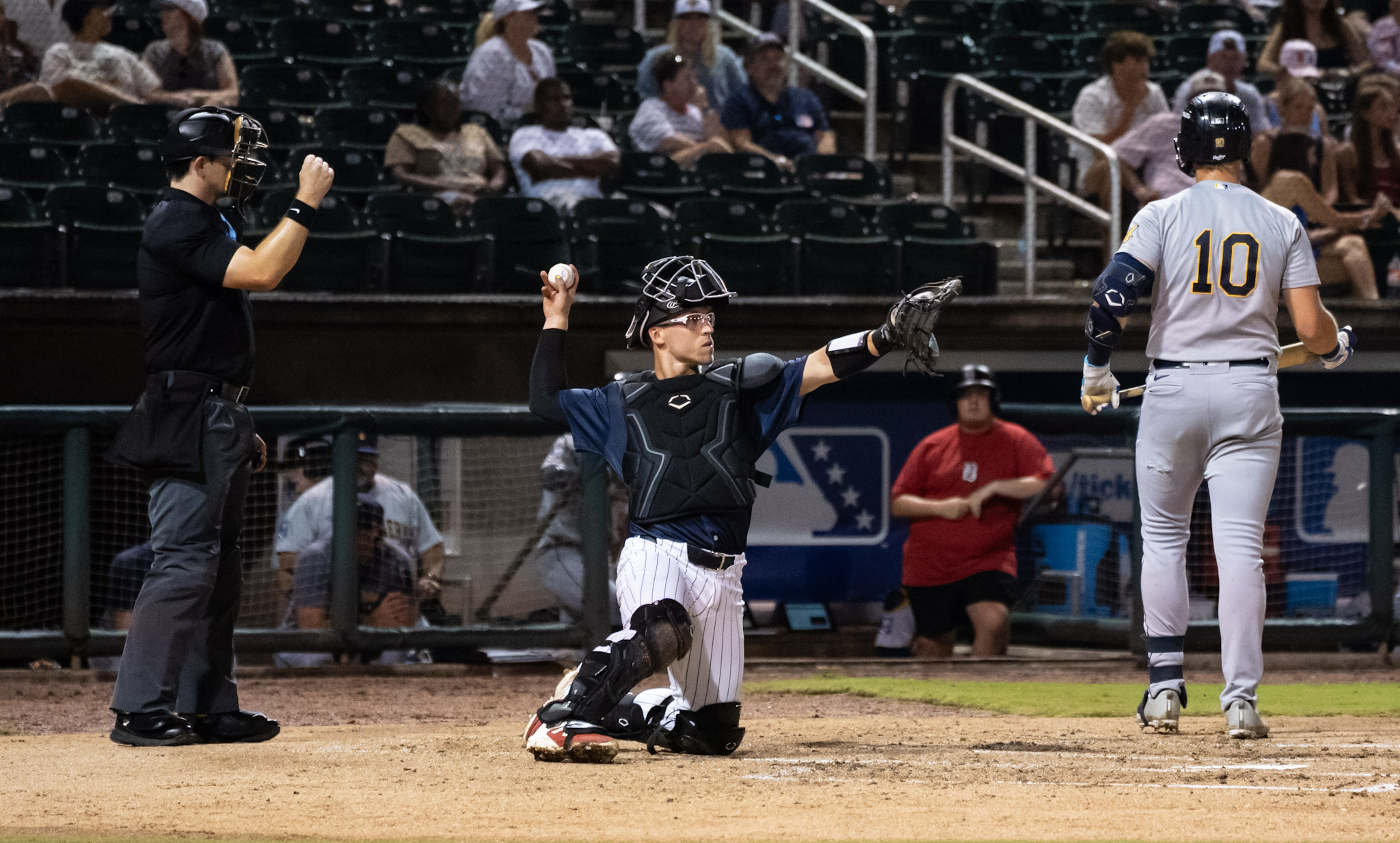
BIRMINGHAM, Ala. -- In order to start making a name for himself, Boston Smith first considered the name for himself.
His actual first name is Noah, but as he explored playing baseball beyond high school, the White Sox catching prospect chose to go by his middle name, which is also his mother's maiden name, figuring it might help him make an impression.
"I was from a small farm town in Ohio, wasn't sure if I was good enough to play college baseball, even professionally, and I didn't know if my name would get out there," he told Sox Machine at Regions Field on Saturday. "So Boston was more of a memorable name to try for like college coaches to be like, 'Oh, I remember him because his name was Boston.' And then, you know, the name kind of just stuck. It's unique and I like it."
While the uncommon moniker is currently helpful in distinguishing him from the other Smiths in the organization who might first come to mind -- Shane and Hagen -- his bat is what stands out most in his first year with the White Sox. He was named the team's Minor League Player of the Month for June after hitting .293/.481/.603 with more walks (20) than strikeouts (17) over 17 games with the Winston-Salem Dash. It also earned him a promotion to Double-A, as he opened July in the middle of the Birmingham lineup.
Given that more homers were hit in the South Atlantic League through June than there were all last season, it was fair to wonder whether Smith's Winston-Salem success was at least in part a product of a particularly charged environment, but he's embarked on answering that question with two homers in his first four games with the Barons.
Smith, 23, is now hitting .288/.438/.576 over his first 60 professional games, and inspiring a more general curiosity about how he got here.
Addressing it in the technical sense, Smith came to the White Sox from the Nationals in the trade for Curtis Mead back on March 28. The Sox had DFA'd the out-of-options Mead when he didn't crack the Opening Day roster, and two days later struck a deal for Smith, who was Washington's sixth-round pick in the previous draft.
Smith put himself on draft radars during his senior season at Wright State by hitting .330/.498/.770 and sharing the NCAA lead in homers with 26, the last of which helped the Raiders make college baseball history by eliminating the No. 1 overall seed Vandy on their home field in Nashville before the regional final. The Nationals ended up signing him for $50,000, but Smith told FutureSox two weeks ago that Ryan Fuller said the White Sox had him on their boards, which is how they came about acquiring him before Smith appeared in a professional game.
As for how he's posting a four-digit OPS across three levels in the nascent stage of his pro career, it's less immediately apparent. At 5'10" and 180 pounds, Smith is built, but he doesn't possess long levers, and his left-handed swing is a fairly quiet affair. He stands upright in the box with his hands near his head, and strides to the plate without a pronounced leg kick or other strenuous loading mechanism.
Nevertheless, it's a swing that optimized for putting the ball over the fence.
"I have sort of an upward bat path, and so when I do hit a flush barrel, I'm typically hitting it at your ideal 25 to 30 degrees," Smith said. "So far this year, I haven't really hit a whole lot of, like, line-drive doubles. Most of them have been like kind of out front, like over the first basement's head.
"I try to stay quiet and really under control in the box, because that's just the way I operate. If I think more, I get way too far out of my comfort zone, so I try to be as loose and under control as I can in the box, just try to hit mistakes hard, and let that kind of take care of itself."
"He's got some strong legs," said Birmingham hitting coach Aaron Hill, sharing his first impressions of Smith one week into his Double-A career. "He's got good, powerful legs, and it's simple, efficient."
There are trade-offs with this kind of approach. Smith is running a contact rate of 67.6 percent, which White Sox fans can easily envision by calling it the Colson Zone. He said he doesn't yet try to manipulate his swing, and he's noticed Double-A pitchers trying to get above his bat path with high fastballs.
At the same time, that contact rate has risen while Smith has climbed ...
- Kannapolis: 60 percent over 34 PA
- Winston-Salem: 68.6 percent over 216 PA
- Birmingham: 73.3 percent over 11 PA
... and eliminating chase has been a part of that equation.
- April: 12.8 BB%, 33.3 K%
- May: 23.1 BB%, 28.6 K%
- June: 24.7 BB%, 21.0 K%
"I've learned so much in three months," Smith said. "Going into it, I kind of trusted my abilities, but also was kind of getting out of myself a little bit, the strikeouts were high.
"[I was] just kind of making adjustments, realizing a lot of these pitchers are trying to work towards getting chase, then as a catcher, realizing that our pitchers are doing that. I just tried to shrink my strike zone a little bit. All of a sudden I start taking fastballs, sliders, changeups out of the zone, I start getting better leverage counts, and now they've got to work towards me."
That balance is tougher to strike against better pitching, but he provided a proof of concept on Friday. In his first plate appearance, Smith swung through a fastball to lose a seven-pitch battle against Montgomery's TJ Nichols. In his second time up, Nichols started Smith with a pair of breaking balls -- one taken for a strike, one taken for a ball below the zone. Nichols then returned to a fastball up and away in the zone, but this time Smith sent it over the Barons bullpen for his first Double-A homer.
"It was the situation where I was telling myself, don't be late," Smith said on Saturday. "He had a really quick arm with good ride. I just told myself to stay above it, and don't be late. I got a pitch to hit. It wasn't, you know, the most perfect pitch in the world, but I just stuck to my plan and had a good result."
Boston Smith goes yard for the first time in AA to give the #Barons a 1-0 lead. (I apologize for the video quality, but I'm just happy the stream is up and running. We lost the last half of the game yesterday.) pic.twitter.com/vqTPHgMiUn
— FutureSox (@FutureSox) July 4, 2026
It's the kind of production that works behind the plate, and Smith considers himself a natural catcher, even if he's often found himself at other positions due to decent speed. It wasn't until his senior season at Wright State where he was the Raiders' primary catcher. Up until that point, he'd played more left field and infield, including 10 games at shortstop in 2024, in order to get his bat in the lineup while accommodating catchers who couldn't play elsewhere ("It wasn't the prettiest thing in the world," Smith said of his middle infield work).
The White Sox have thus far narrowed the demands on Smith's athleticism. He's made 36 of 60 starts at catcher, rotating only between left field and DH otherwise to keep the plate appearances coming. He said game-calling is the most challenging part of pro catching, because even if he had more reps behind the plate in college, the pitch calls were still coming from the dugout.
"He doesn't have a ton of experience behind the plate, but in talking with him, it's something that he wants to work at, he's going to dive into," said Birmingham manager Pat Leyland. "Our coaches here -- [Daniel] Millwee with the catchers, John Kovalik with the pitchers -- they game-plan extremely hard and well. They can definitely help him out, and he's willing to be helped, and he wants to be helped."
Smith has only made one start at catcher with Birmingham thus far, but in another example of quickly showing how it could work, he caught a seven-inning shutout on Friday with Dylan Cumming throwing the first six zeroes.
That said, in a season where Sam Antonacci and Jacob Gonzalez have experienced major league success at positions that weren't part of the plan, Smith said he's happy to keep all avenues open.
"One thing I've been a very big fan of the White Sox with is they're exploring, they're very optimistic in terms of my athletic ability," Smith said. "They're not just saying, 'Hey, you're only a catcher.' It's, 'You can catch and we want you to develop as a catcher, but we also want to develop you potentially as an infielder, as an outfielder and just explore different ideas.'
"Because when it comes down to it, if I do make a big league debut and somebody goes down, now it helps a team find success if they know their catcher can play four different other positions. And at the end of the day I just want to win."