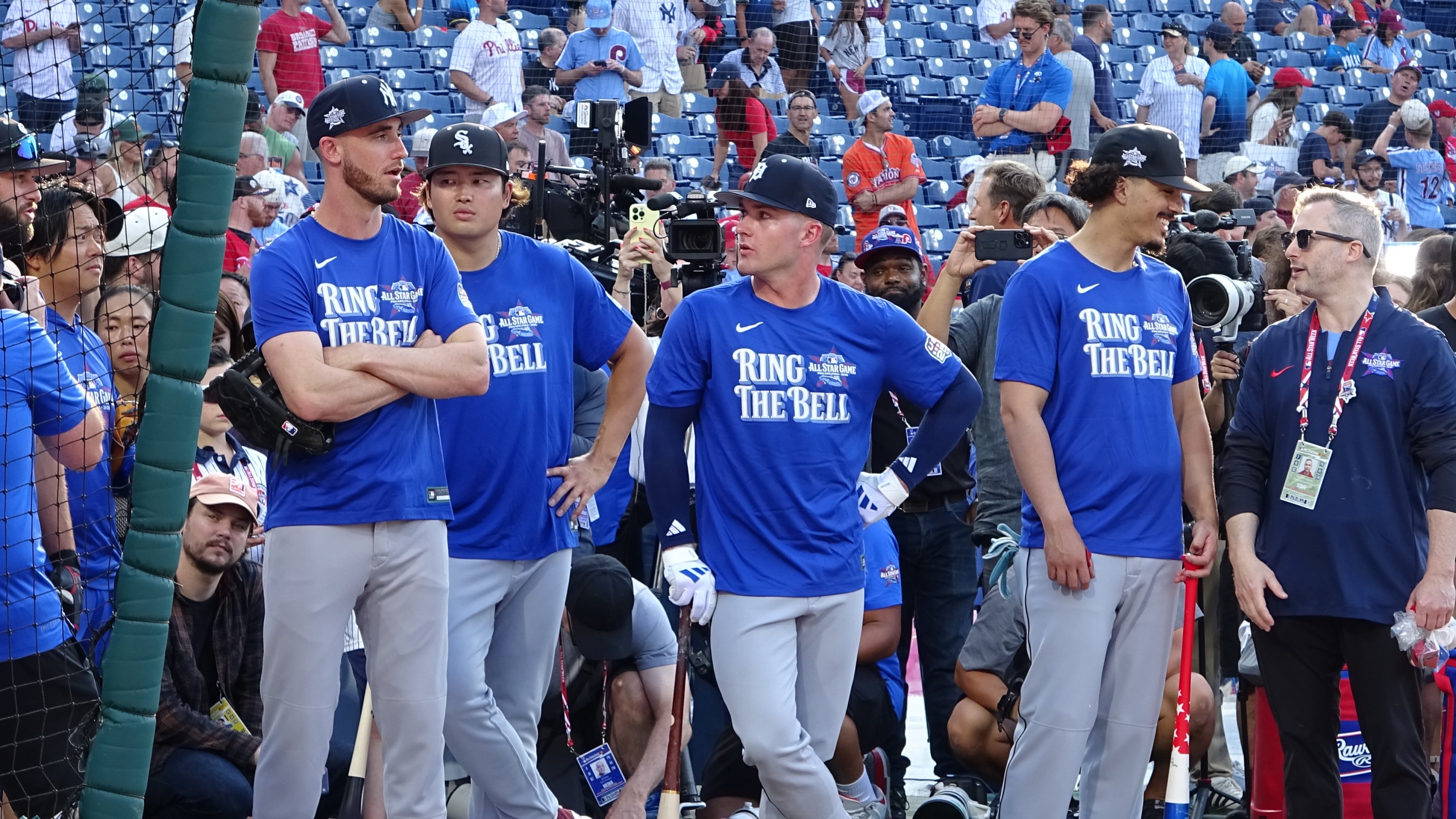
PHILADELPHIA -- A warm smile creeps across the face of any Dodgers veteran at the mere mention of White Sox All-Star third baseman Miguel Vargas.
"We're always in contact, we talk all the time," said his good friend Andy Pages via interpreter. "I know how much work he put into this. I know how much went into it."
"He worked hard, he didn't complain about anything," said Max Muncy. "He had the broken finger, broken thumb, something else, and not once did he ever complain about it, and we all knew it was bothering him. For him to go out there every single day and work, and try to be the best player he could be while dealing with all that, and not complaining about it once to anybody, that earns a lot of respect in our clubhouse."
"So happy for him, what a great kid," said Freddie Freeman. "He's always happy. He's fun. He works hard. He just loves the game of baseball. Baseball has been his whole life, with his dad too. So you can just see the joy he has in it."
This matches the reputation Vargas had in the Dodgers organization when the trade that brought him to the White Sox first went down, but upon arrival in Chicago two years ago, it wasn't as easy to see the joy as it was for Freeman. For much of last season, even with improvements that saw him capture AL Player of the Week in mid-May, Vargas simply wouldn't discuss the depths of 2024. Sometimes it came with a customary athlete cliche about focusing on the present, sometimes with a playful "I don't remember" befitting of the humor style that saw him doing his chihuahua barking after a satisfactory batting practice round at Citizens Bank Park on Monday. But neither 121 losses nor a .387 OPS seemed like topics he wanted to revisit.
The dam has broken a bit in the last week with Vargas' selection to the All-Star team certifying his full-circle journey to an ebullient leader of a young and hungry first place Sox team. Only now that it's been fully restored, he's admitted to, for a time, losing faith in his ability to enjoy baseball. But as relatable as that sentiment would be for anyone who has observed the White Sox's lows and only recent highs over the course of Vargas' tenure, there's a sheepishness from him about letting it reach that point.
"You were there in that clubhouse a couple years ago, so I think it's more of a reward for me, because I never expected to be here as soon as I did," Vargas said. "I don't know, I think I was young. I was 24 at the time and I went to a new team. I was young and I guess I was immature at that moment. I think I understand now the purpose I have in this organization."
"His dad was a great player," Pages said via interpreter. "So for him to put a little bit more pressure on himself to get to the big leagues, it's kind of something that he puts upon himself."
As Freeman held court with media on Monday, he stipulated that everyone in the majors works hard, but the players who are able sustain their performance and/or rebound from down seasons are the ones who are courageous enough to work differently and explore uncomfortable solutions to extend their careers. Similarly, the defining element of Vargas' story is that when he says he was struggling to find joy in baseball, that's exactly when he submitted himself to rigorous physical and mechanical transformations. He bulked up after a '24 season where Sox officials said they wanted him to be unrecognizable by the time he arrived at spring. He altered his setup at the plate early in '25 in a manner he admitted was uncomfortable until it became his new normal.
There's a Rate Field scoreboard segment where Vargas describes his father Lazaro as "the most famous person in my phone," and boasts of his two Olympic medals from playing for the Cuban national team. At the same time, Vargas views himself as living an opportunity to play Major League Baseball that his dad never got to receive. And what looks like an extra helping of pressure he's heaped upon himself, now looks like a source of enduring resolve.
"That's the reason why I'm wearing his number and his last name on my back," Vargas said. "For me, this opportunity, once we're here [at the All-Star Game], I feel like we both did it. I'm him, in my body. That's all we're trying to reach. I'm just trying to represent him and my whole family. It means a lot."
Of course, if you give him the opportunity to, Vargas will just start doling out credit to his entire support system. Follow-up questions about where he found the strength to keep pushing just give him leeway to expand the plaudits.
"Will Venable, our manager, he has been a great human being in the clubhouse," Vargas said. "He's a guy who played in the big leagues, too, and we've got a really young group of guys, and he understands that. He's got great communication with every single person there. He just want us to go out there and have fun every single night. The clubhouse has been unbelievable. The vibes, the spirit of every single guy out there, every single day is unbelievable. It's a group of guys. They they want to show up and work and win every single day. And for me, I just want to be part of that group."
Few players better represent the White Sox's newfound ability to find solutions than Vargas, who has turned substandard power into exceptional impact, enhancing the impressive contact ability and quality swing decisions he always offered. And Vargas seems to be a beneficiary of the opportunity they were uniquely in position to offer.
"What a great team; they beat us in a series there too, so we know firsthand how good they are, and happy for Miguel," Freeman said. "All sometimes you need is runway, and to get everyday at-bats, and for him to be able to go over there and get those at-bats, you can now you can see the player he is, and we all thought he was going to be. Sometimes it's not with the team you come up with, but it's with another team, and you couldn't be more thrilled for him."
The insight that former Dodgers teammates offer is that the particulars of Vargas' turnaround is mostly ephemera. The player they knew was simply always going to work to figure it out and become a star, no matter what his path entailed. He always good enough, even if sometimes he needed a reminder.
"I was kind of keeping him motivated," Pages said via interpreter. "Telling him what a great player he is, knowing he's a great player, and being able to not only make the adjustments, but push himself to complete those feats and make himself a better player every day."
"He looked like the guy we knew coming up," Muncy said of playing against Vargas in June. "Some guys can just flat-out hit, and he can hit. Ultimately, it's just in his blood to hit. You look at what his dad did in Cuba, and you know he's just he's ultimately born to hit. That's what he's going to do."