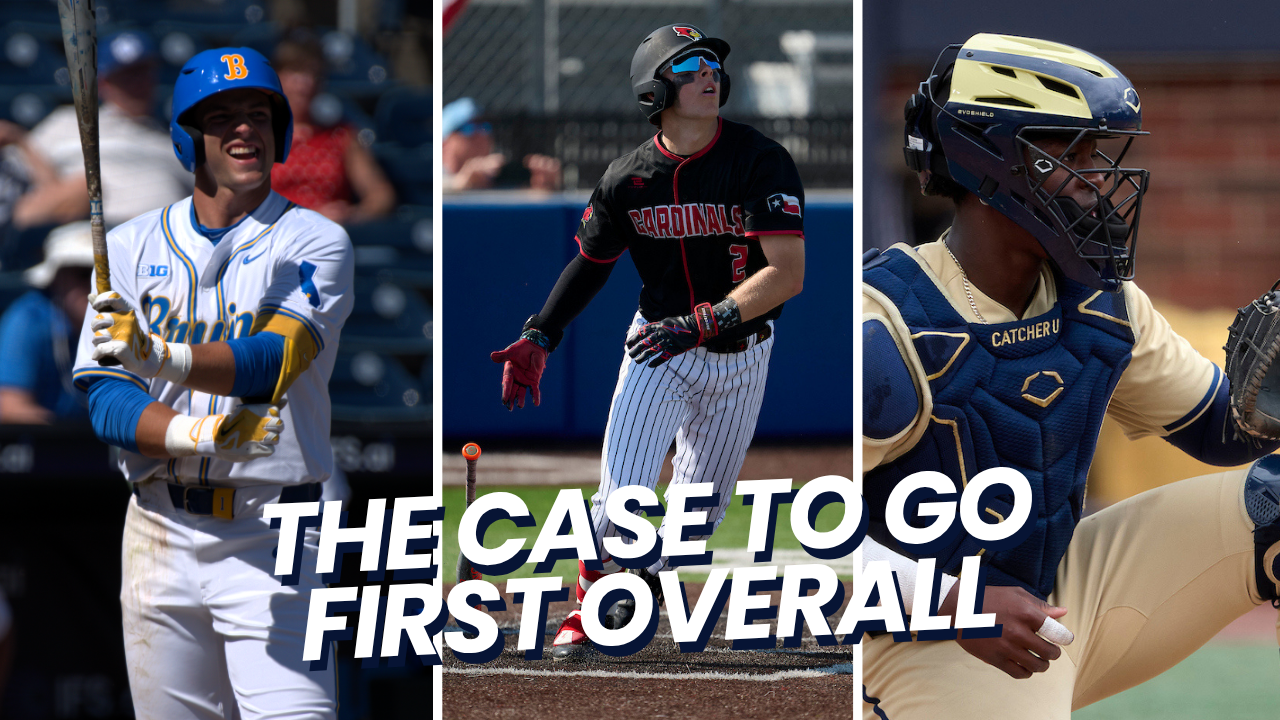
No matter which direction general manager Chris Getz takes, I think the Chicago White Sox are in a winning situation. After re-watching numerous college baseball games, our own film, and heeding advice from trusted sources, adding anyone from the trio of Grady Emerson, Roch Cholowsky, and Vahn Lackey will only lift the White Sox farm system.
In our current world of constant comparison, the 2026 MLB draft could become the most contentious. Chances are very high that whoever the White Sox won’t take first overall could end up in Minnesota, so this debate will continue for several more years.
No matter how promising a prospect can be, or what great first impressions they make, a lasting impact in the majors is never guaranteed. Injuries, lack of adjustments, or maybe not nailing the scouting report all play a factor several years down the road. We won’t really know if the White Sox made a mistake with this draft pick until 2030 or even later.
So let’s push those butterflies out of our stomachs, and take one last look at the case for and against for first overall worthiness out of Grady Emerson, Roch Cholowsky, and Vahn Lackey.
Case for taking Grady Emerson 1-1
Grady Emerson’s showcase metrics are very impressive, and when watching him play, they do translate into game action. I believe it’s easier to teach a contact-oriented hitter to swing for more power than a power hitter to try to develop better contact skills. Emerson’s fluidity in his wrists gives him plus-barrel control in the strike zone, which should give him a chance against pitches high or low in the zone.
Defensively, Emerson should be given every opportunity to continue developing as a shortstop. He has impressive lateral range and a strong throwing arm. If somehow Emerson was on the same roster as Billy Carlson, he could easily move to either third or second base.
If everything clicks for Emerson, his development path could be very similar to Detroit’s Kevin McGonigle, with more contact (and a higher average and OBP) at age 19, while slugging numbers are limited. But after that first year in the minors, and under an MLB weight training program, where could Emerson be in his power development? We’ve seen top White Sox prospect Caleb Bonemer make a huge leap in his second season. Could Emerson do the same? And if he does, would that put Emerson within reach of the majors before his 22nd birthday?
This type of projection is what every MLB is betting on when drafting prep players. It’s just that Emerson has a level of contact skills that puts him ahead of the curve.
Case against taking Grady Emerson 1-1
Setting aside the money game, which is always a factor in decision-making when choosing between prospects in the MLB draft, the only case I can imagine against Emerson going first overall is having doubts about his future ability to hit home runs.
Slugging can come in different forms as a heavy doubles hitter, or a speedster that racks up double-digit triples, but as long as the White Sox play at Rate Field, they need home runs. If Emerson can even reach 20 homers, that would be great. But if Emerson’s power ability is closer to Chase Meidroth than Colson Montgomery, that would lower his potential ceiling.
The case for taking Roch Cholowsky 1-1
Roch Cholowsky is like a Marvel movie. During his time at UCLA, you can cut together an impressive trailer of his highlights to get every baseball fan hyped about his potential.
Cholowsky’s best part of his game heading into draft day is his defense. Re-watching the game in late February against Texas A&M was a masterclass in how to play shortstop. He can throw from multiple angles and does a terrific job of charging in on slow rollers. More impressively, Cholowsky has made many web gems running down shallow fly balls into the outfield. There’s very little doubt about Cholowsky’s defensive ability, whether that is at shortstop or anywhere else in the dirt.
Offensively, Cholowsky made a significant adjustment from his freshman to sophomore year at UCLA to focus on firing from his back hip and developing an “A” swing. When Cholowsky barrels up pitches, it’s a beautiful thing to watch. There’s quite a bit of power potential in his offensive ability, which one can dream of him being a consistent 30-homer hitter.
The case against taking Roch Cholowsky 1-1
Roch Cholowsky is not as polished a hitter as we thought back in December. His Eloy Jimenez-like load has too many moving parts and needs to be quicker when facing faster velocities. Because Cholowsky liked hunting pitches on the outside corner, he would frequently jam himself on inside pitches as his hands don’t pull quick enough through. Finally, Cholowsky lowers his hands during his load and gets locked into his swing. It’s better suited for pitches lower in the strike zone, so it’ll be interesting to see how he fares when attacked with high velocity.
But every college hitter has to make some sort of adjustments to be better suited against professional pitching. Just look at the film of Jacob Gonzalez swinging today with the White Sox compared to how he swung at Ole Miss. It’s vastly different, and the way Cholowsky looked at UCLA in the highlight reels will probably look a lot different in the majors. So there’s a lot of unknowns with this hitting profile.
Knowing that swing adjustments are coming, how long will it require to take hold? Cholowsky is often compared to Dansby Swanson. In 5,600 plate appearances, Swanson is a career 97 wRC+ hitter, but he has racked up over 30 WAR according to FanGraphs thanks to his outstanding defense and occasional hot streaks of hitting homers in bunches. Swanson didn’t become a 3 WAR player until age 27 (thanks to the COVID-shortened 2020 season), so there was a bit of a learning curve.
Maybe that’s the future for Cholowsky. He can rise up the farm system because of his defense, but the hitting development may take more time than originally thought.
The case for taking Vahn Lackey 1-1
On March 10 against West Georgia, Vahn Lackey played eight different positions in a seven-inning blowout. He fell a single short of hitting for the cycle, too. This rare performance, first by an ACC player since Buster Posey did it in 2008, was also in the midst of Lackey hitting a home run in five straight games. His hot March catapulted him into the spotlight.
Lackey is a plus defender at catcher thanks to his athleticism and strong throwing arm. He moves well laterally behind home plate, blocking pitches in the dirt, does a great job of getting up out of his crouch and fielding bunts in front of home plate, and has flashed 1.75 second pop times on potential base stealers. In his three-year college career, Lackey threw out base stealers at a 32.9 percent clip. Also impressive is his ability to back-pick baserunners, doing a great job of moving his feet into position quickly to catch runners off guard.
In 2026, Lackey made noticeable swing mechanic adjustments. His lower half got quieter as it’s a small leg kick that helps him fire off his hips through the zone. With more focus on generating loft, Lackey went from hitting six home runs in his sophomore season to bashing 20 in 2026. Also helping was being more patient and waiting to attack pitches located in the middle of the strike zone. That allowed Lackey to improve his walk rate and saw his slugging percentage increase by 272 points (.500 to .772).
His future defensive home should be catcher, and that raises his floor as a prospect. If the swing adjustments he made in 2026 hold, Lackey could be one of the better power-hitting catchers in major league baseball. With his athleticism, Lackey could also be flexed to play some third and first base, if needed.
The case against taking Vahn Lackey going 1-1
Out of the three prospects considered to go first overall, Vahn Lackey has the largest gap between ceiling and floor.
Lackey’s ceiling is a defense-and-power catcher, perhaps similar to a profile of Athletics catcher Shea Langeliers, who has already hit more than 100 home runs in five seasons and posted a 4.0 WAR season in 2025.
If that hitting ability doesn’t continue to progress, Lackey could be more like Joey Bart, a fellow former Georgia Tech backstop who was taken second overall in the 2018 draft. His defense is good enough to play in the majors, but the bat isn’t strong enough to merit full-time starting duties.
Taking Lackey over Roch Cholowsky is a bet that the tools will continue to develop, putting them on the same level offensively despite their track records. If that were to be true, then Lackey could be one of the best catchers in MLB. But that’s a risky bet to make based on a small sample size.
Who will the White Sox draft?
My brain says it’s going to be Roch Cholowsky.
Cholowsky has tantalizing tools, and UCLA coach John Savage has raved about his character and makeup. I do think he’ll be a quality major leaguer, and if that is truly the direction the White Sox will go, they will need to be steadfast in being patient with his hitting development. There’s a high risk of another Andrew Vaughn situation of promoting a talented college player before they are truly ready.
If the decision were up to me, I’d take Grady Emerson.
He’s better than Cholowsky was at age 18, and if the White Sox have any faith in their player development staff, they can turn Emerson into a better player ready for the majors than the University of Texas can.
Of course, I do need to openly admit my new bias regarding the MLB draft. I’ve been covering this beat since 2018 at Sox Machine, and have watched a lot of college baseball over the years. I love the sport. It’s fun with plenty of intensity.
But after sitting in a camera well for four days in Omaha watching the Big Ten Tournament, I’ve come to realize that college baseball is not all that close to High-A. While I do think colleges do a good job of helping develop pitchers because of the amount of money they’ve invested in labs and technology, it feels like hitting development is lagging behind.
Which is why I firmly believe that MLB teams today do a far better job of preparing high school position-player prospects for the major leagues than college baseball does. With the overhaul in approach, personnel, and technology in player development, the White Sox have earned confidence in their ability to develop hitters, be it Colson Montgomery at the major league level, Caleb Bonemer in his second pro season, and even George Wolkow is starting to figure it out.
Cholowsky is older than Bonemer. At all levels of baseball post-high school, Cholowsky has amassed only 941 plate appearances (including Team USA), and only a fraction of those were against minor league-quality pitching. That’s not a lot of quality reps over three seasons.
By the time Bonemer turns 21 in October, he’ll surpass Cholowsky’s plate appearance total across three levels of the minor leagues in just two years. Bonemer is far more prepared and closer to the majors than Cholowsky. As Jim wrote from his recent visit with the Birmingham Barons, Bonemer is grateful that the White Sox were able to make a good deal and has no second thoughts of missing out on college baseball.
If I were Chris Getz, and I had to give a block of clay to the player development staff to mold the next great White Sox hitter, I’d give them the best high school hitter in this class.