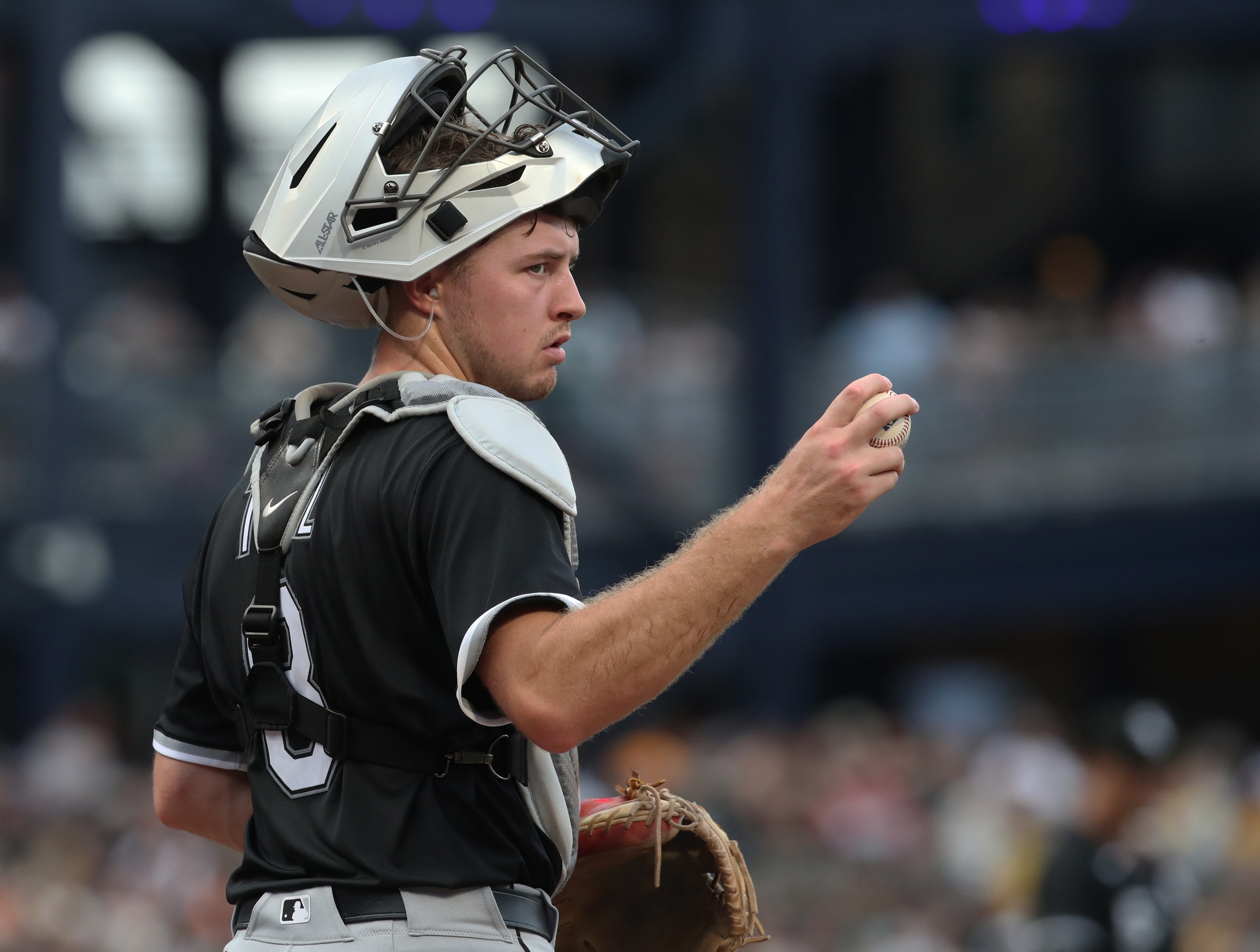
After a pair of sprains teamed up to put him on the shelf for the first 76 games of the season, Kyle Teel is back, and just when the White Sox could use him the most.
The White Sox activated Teel from the injured list this morning, and optioned Edgar Quero to Charlotte to make room. While the White Sox might ease Teel into action due to the time he missed from the Grade 2 hamstring strain he suffered during the World Baseball Classic, or the sprained right knee LCL he incurred during his rehab stint, he'll ultimately be tasked with rescuing a catching situation that statistically grades out as the worst in Major League Baseball.
The position has been a mess without him. Offensively, White Sox catchers hit .171/.249/.268 during Teel's absence. That's good for a 45 wRC+, and only Philadelphia's 43 wRC+ saves them from the cellar on that side of the ball. But the JT Realmuto-led Phillies group offers the second-best catching defense according to both FanGraphs and Statcast, whereas the White Sox's -5 Fielding Run Value is the fifth-worst in baseball thanks to subpar receiving and blocking, so there's little going for them either at the plate or behind it.
Worse yet, there have been no recent signs of traction. After a mildly encouraging May, Quero is hitting an empty 6-for-38 in June, with no walks or extra-base hits. As bad as that sounds, and although he was the catcher who was shuttled to Triple-A, he was the superior option during a time when Romo hit 2-for-28. Combined, White Sox catchers are hitting .121/.132/.136 with a -35 wRC+ in June. The White Sox are dead last in fWAR at -0.8, and the last month is responsible for virtually all of that deficit.
ABS challenges are the only area where White Sox catchers have graded out positively, and even then, it feels like there's a catch. Quero leads the league in runs gained from challenges, but because he's a volume shooter, he also leads the leagues in runs lost. By all indications, Quero was doing what he's been told to do.
"We expect our aptitude on player accuracy and decision-making to get better as we go, and we're giving feedback on that, but in general, from a high level, we've wanted to be aggressive, we are aggressive, and that has paid dividends being aggressive," Bench coach Walker McKinven told James in Detroit. "The surface line of success rate on challenges is really, really misleading in my opinion. Like the ones you should have challenged that you didn't; no one talks about that, really."
MLB Senior Data Architect Tom Tango put it this way:
Edgar Quero (Whitesox) is first among catchers in getting overturns runs on ABS Challenges: +9.6 runs
— Tangotiger 🍁 (@tangotiger) June 19, 2026
However, hes 2nd worst in lost challenges
Combined, hes worst catcher at challenging
BUT, at team level, lost challenges are irrelevant making Whitesox catchers among the best
I'm not quite sure "irrelevant" is the most appropriate word, or maybe it's application is more narrow than universal. Lost challenges are irrelevant in the sense that won challenges make calls better while lost challenges don't make calls worse, and McKinven went on to tell James that the White Sox have an in-house statistical score on the value of each challenge, factoring in things like the opposing batter/pitcher and game situation. And I'm sure there are some bird-in-hand arguments about knowing which challenges succeeded over which pitches could have been challenged later in games.
Yet over the past two series against the Yankees and Tigers, White Sox catchers lost challenges in the first three innings of three different games, and that seemed to leave the team at a disadvantage. White Sox hitters challenged only one pitch total in those three games, and at the end of the week, Statcast said they were tied with the Royals for the most balls called strikes against them with 23. Here are those offenders:
Whether Quero was successful at challenging is a valid philosophical debate, but his brand of success is messy enough that the White Sox should feel comfortable going without it and seeing how it plays out.
Between the team's struggles at the position and their bottom-third performance against right-handed pitching, there's a hole in the roster that's pretty much Teel-shaped, so he should slot in neatly, especially if his hitting performance -- .387/.441/.613 during his rehab stints in Charlotte -- continues to show no signs of rust.
Everybody involved just has to make sure not to get overzealous, at least until Teel proves his lower body is structurally sound. It's similar to the discussion about the White Sox's dearth of upper-minors pitching depth, in the sense that the team somehow weathered a supposed strength morphing into a liability, but are running the risk of seeing how far they can drive on empty.
If you told me the White Sox would go 39-37 without Teel, I'd have assumed that Quero looked like a capable starting catcher in his own right, and upon his return the Sox would be back to figuring out how to successfully leverage both players. Instead, Quero, Romo and Reese McGuire basically put forth the worst-case scenario, and the Sox were extremely fortunate that it didn't sink them.