Grant Taylor has been great.
The White Sox right-hander is fourth among relief pitchers in wins above replacement per FanGraphs, with the fourth-highest strikeout rate (38.8 percent). It wouldn't be a waste of time to just have people talk about how good he's been. And it would be easy to, since even after allowing the first home run of his major league career last month to Rafael Devers in San Francisco, Taylor has thrown seven scoreless innings and struck out half of the 24 batters he's faced.
"As impressive as he is on the field, the mindset, the ability to bounce back is great," said pitching coach Zach Bove. "It’s going to happen, it happens to everybody, learn from it. Is there any change? It hasn’t affected him. He’s very strong in that area for sure."
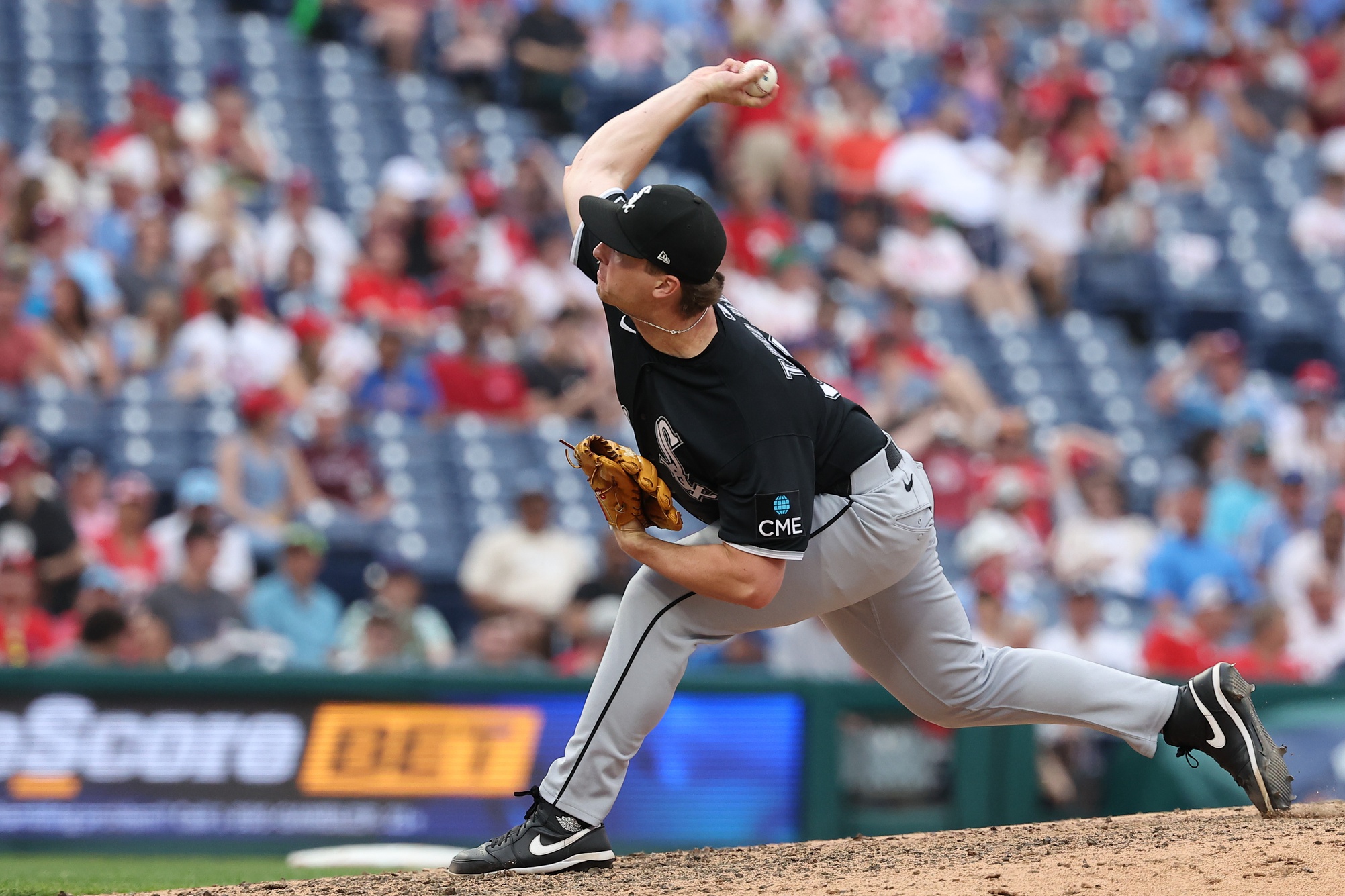
Maybe the struggle with the topic is that Taylor being great doesn't feel like a new development. His four-seamer clips 100 mph with above-average carry. He's built like he should opening up holes for Walter Payton as a lead blocker, but is still so freaky flexible that his delivery produces the elite extension that men half a foot taller than him struggle to replicate. It combines to produce a fastball so overwhelming in the strike zone that he often only needs -- and often only uses -- his hard 12-to-6 curveball as a change of pace.
Unless you're some sort of Philistine who uses superficial stats from the 1980s, nothing really has changed since he debuted last June.
| Year | IP | K% | BB% | BABIP | xERA | FIP | ERA |
|---|---|---|---|---|---|---|---|
| 2025 | 36.2 | 34.4 | 9.6 | .420 | 2.91 | 1.42 | 4.91 |
| 2026 | 32.2 | 37.9 | 6.8 | .333 | 2.09 | 1.27 | 1.93 |
Taylor's stuff was clearly awesome last season, certainly missed ton of bats, and whenever he didn't miss a bat, it fell in for a hit at a truly stupid rate against a defense considerably worse than his current one. So now that his batted ball luck is mostly normal, has he really stepped forward, or is he just getting the great results his execution level has always deserved?
"I've definitely taken a step forward," Taylor said, "Last year, all my expected numbers were supposed to be really good, and my actual ERA was a lot higher than what that said. That can sometimes be just process stuff; in-between counts, pitches that I throw, execution of pitches, where maybe they're able to get to different pitches and hit them to certain parts of the field where we're in a shift and they beat the shift. This year and toward the end of the year last year, I learned myself a little bit better on when to execute pitches and when to throw what to get more swing and miss, more strikeouts, more soft contact, and I've carried that into this year."
Beyond Taylor's self-critique of not lining up his attack plans to the current defensive shifting as well as he's doing now, Will Venable echoed his sentiments with the added note that the reputation of his stuff preceded his arrival to the majors. Rather than taking the league by surprise, opposing hitters were looking to avoid deep counts against the fire-breathing reliever immediately, and Taylor has had to show the ability to pitch backwards.
"Last year you remember a lot of early contact, guys ambushing him a little bit," Venable said. "He's solved for that, throwing breaking balls early in the count, keeping guys off balance. Continuing to do a really good job of using his full arsenal to find different ways to get guys out in different parts of the count."
The funny part about Taylor using his full arsenal is the marriage between doing things that allow him to operate like a starter -- working multiple innings, developing comfort with a four-pitch mix -- and being the most trusted leverage reliever for a team with increasingly real playoff ambitions, has taken on a defined platoon split.
Against left-handers, which are often the last vestige of an opposing manager desperate for offense, Taylor has become "super simple" by his own description. He's almost exclusively four-seamer/curveball and has once more put his cutter and kick change on the shelf for now. It's against righties where he gets to play around with his slider more, break out the sinker he developed in spring training, and work through more complex sequencing.
"I've kind of used everything, which has been really helpful this year for getting righties out, because last year I didn't feel like I threw my slider for a strike very often," Taylor said. "I've gotten that in the zone and the two-seam kind of opens it up a little bit more."
A four-pitch version of Taylor who can work both north-south and east-west at elite velocity sounds monstrous, especially if you catch his tone that he feels like he's only just starting to get the feel for it. But such is the dichotomy of Taylor's immediate awesomeness as a reliever and long-term potential as a starter is that his work against right-handers better resembles his 2025 form.
| Split | K% | BB% | BABIP | AVG | OBP | SLG |
|---|---|---|---|---|---|---|
| vs. RHP | 33.8 | 7.7 | .368 | .237 | .292 | .305 |
| vs. LHP | 41.8 | 6.0 | .294 | .175 | .224 | .270 |
As they should be, given both his injury history and value, the Sox have been judicious with Taylor.
They don't really do three days in a row for any leverage reliever, but Taylor always gets at least a day off -- and usually two -- between any multi-inning appearance and his next outing. That has him tracking closer to an 80-inning season than the notions of a 100-inning campaign that were floated during the winter.
Every time the Sox seem to be trending toward using Taylor as a multi-inning reliever like Sean Newcomb, who seems just a step away from being ready to start next year, the easy security of days like Saturday, where he looks like someone who could be a top-three closer in the sport, rears its head once more. The White Sox don't really have to make a choice on that front right now, and don't seem like they're rushing to do it either, so Taylor is just choosing to embrace his multitudes.
The commonality with his various roles is that he's pretty good at all of them.
"I've kind of learned to appreciate all of them," Taylor said. "Pitching in the ninth is a lot of fun, but also coming into the game in a one-run ball game with the top of the lineup coming up in the seventh is a lot of fun. Opening games is fun, and there's a different joy that comes from like starting and relief. The start is more a slow burn of excitement as you get deeper and deeper in the game, where relieving it's like, it's here, it's now, go get after them.
"They're two different types of fun. I like both."