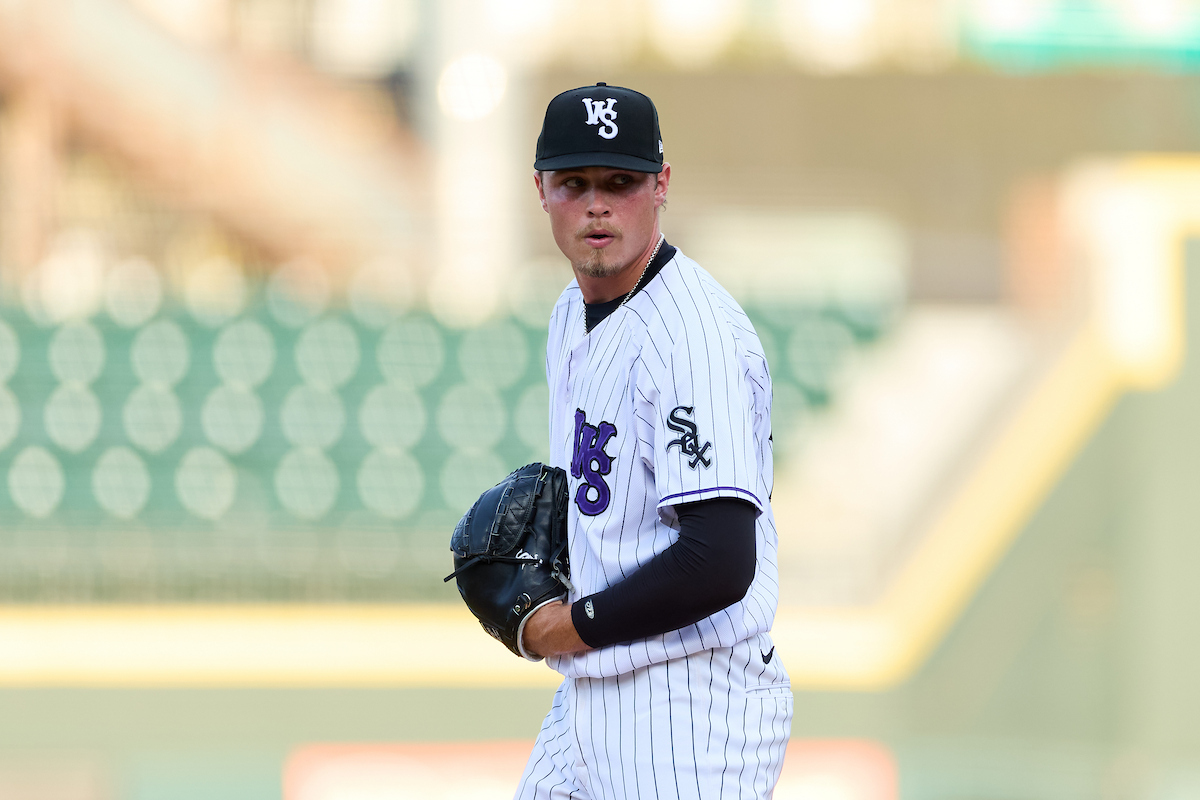
Standing 6-foot-9 with a 95-97 mph fastball that's touched triple digits, White Sox prospect Gabe Davis has burst onto the scene in his professional debut season, striking out 33 compared to just seven walks over 27 1/3 innings with a 2.63 ERA at High-A. Because of that, Davis will make his next start Saturday at Double-A Birmingham.
When it's all working, Davis looks the part of someone who was a dominant Friday night starter in college, and that's what Oklahoma State tabbed him to be last year.
Instead, he finished his collegiate career in the bullpen, logging just 24 1/3 innings in his final season with OSU while dealing with shoulder issues and compiling a 5.92 ERA. So when the White Sox took him in the fifth round with the intent to still develop him as a starter, the word that came to mind for Davis was "relief."
"Just to know that the last three years at Oklahoma State didn't go to waste, and my dream is coming to fruition," Davis said. "I didn't really get the chance to prove myself at Oklahoma State, to show everybody, my coaches there, that I could be a dominant starter for them. Some injuries kind of got in the way, and along with that just not getting very many opportunities."
With the Sox not putting Davis out to an affiliate after the draft last summer, he wanted to focus on developing a professional routine that could keep him healthy and consistent, and his new team had similar ideas.
"A whole lot of the stuff that Gabe needed to work on could really be worked on at every level," said pitching coordinator Matt Zaleski. "It was the the daily prep, the work. How are you going to go about your day from a time perspective? What time are you getting to the field on your start day? What are your workouts looking like, and what time are you getting in the gym on your non-start days or your sideline? Navigating the pitch clock, the step-offs, holding runners, getting faster to home plate. I don't want to call it the basic stuff of pitching in baseball, but that's his low-hanging fruit."
Even with that in mind, the turning point might have come this spring. Davis reported to camp two weeks before it normally started, but felt his shoulder flare up on him again in his first time facing live hitters. After telling the training staff, the Sox reworked an arm care program for Davis that has turned him into certainly one of the taller blood flow restriction therapy evangelists around. He's convinced that regularly flushing out lactic acid -- and also made special mention of his day-to-day work this season with Dash performance coach Logan Jones -- has been a big part of his shoulder feeling as strong as ever, despite already surpassing his junior year innings load.
The Sox have a rough target of 90 innings for Davis this season that they've been working toward gradually. He was limited to three-inning outings in April before getting bumped up to four, with the expectation of reaching five-inning outings in the second half, and small measures like 10 days off between his last start and his Double-A debut.
Cool look here from the 6’9 RHP for the @whitesox prospect @gabedavis07
— PitchingWRX (@PitchingWRX) December 19, 2025
Makes it look easy for someone with such long levers! pic.twitter.com/ZzbeDSKpgE
Progress with the other low-hanging fruit has arguably sped up Davis' progress to Birmingham. As a big body with long levers, Davis' delivery could creak to a start in the past, cautiously setting and re-setting his place on the rubber before slowly getting into motion. Such an operation looks like it would struggle to deal with the pitch clock -- and to be clear, it certainly was an adjustment -- but now Davis views it as a tool that's helped him stress less about every individual pitch, and adhere to the organization's effort to make him quicker to the plate. Through eight games, Davis has had just three bases stolen on him in five attempts.
"Not necessarily slide-step every pitch, but just speeding up the delivery, just so I'm able to get to the 1.3-1.4 [seconds to home plate] range to give my catcher a chance," said Davis, who likes multiple things about working faster. "Because there's some times last year and my previous outings to where I'll get out of that rhythm, or I'll throw two or three balls in a row and I need a reset. It's speeding up that process. Instead of dragging on and thinking about that last pitch, being upset about it, just moving on and getting my next sign, and executing that."
Instead, he's trying to focus on a smaller set of mechanical cues, with really one taking center stage. Despite his larger frame, Davis has a relatively short arm action, and strives to keep his front shoulder closed for as long as possible so that his lower half can stride down the mound. Because as it turns out, when Davis executes, his stuff is too much for A-ball hitters to deal with.
Along with David Sandlin and Davis Martin, Davis is another pitcher who spent his offseason training at Pitching WRX in Oklahoma City. After devolving into being mostly just fastball-slider out of the bullpen in college last year, Davis has restored his curveball and changeup to make his arsenal significantly better against left-handers so far (.244/.320/.333). Moreover, the process of finding out what makes his curveball work really served to explain a bit of what went wrong last year in Stillwater.
"My junior year I was throwing [my curveball] a little bit, but my arm slot was changing throwing the curveball, because I was fixated on trying to get the true 12-6 shape," Davis said. "I was really wanting to see the move north and south. With my arm angle being a little bit of a higher three-fourths arm slot, I'm not ever going to get that true 12-6 [movement]. I never really wrapped my head around that, never really trusted my true plane of rotation and it kind of jacked up my delivery a little bit.
"In my head I was like, 'I'm not throwing this pitch anymore.' Because it changed all my other pitches. It changed my changeup, it changed my slider. My slider became a little bigger than I felt like it needed to be, became a little slower. I feel like my slider plays the best when it's anywhere from 87-90 mph, like a bullet [spin] cutter, or a bullet slider. I call it a slutter because it's not really a true cutter, not really a true slider, but right in the middle. I feel like that's my bread-and-butter."
Davis says that because the slutter is the pitch he can land in the zone the best, and get ahead in count by means other than just his fastball, hard as it is. He developed a sweeper version of his slider when he wants to chase swing-and-miss later in the count, and suddenly looks more like a college arm throwing strikes with a five-pitch mix, rather than a long-term development project with substantial relief risk.
While the workload restrictions probably keep Davis from being in consideration to reach Chicago this year, he doesn't sound like someone resting on his laurels until then.
"I've always been kind of hard on myself my whole life," Davis said. "My family, we're surrounded by tough love and that's just how I was raised. I've always been someone that's never been one to settle or be satisfied, and so I always knew that I keep myself to high standards. So, I knew it was in me. Now it's just like, all right, I've got to do the little things right to keep myself on the field, to be able to go out there and prove it to everybody."