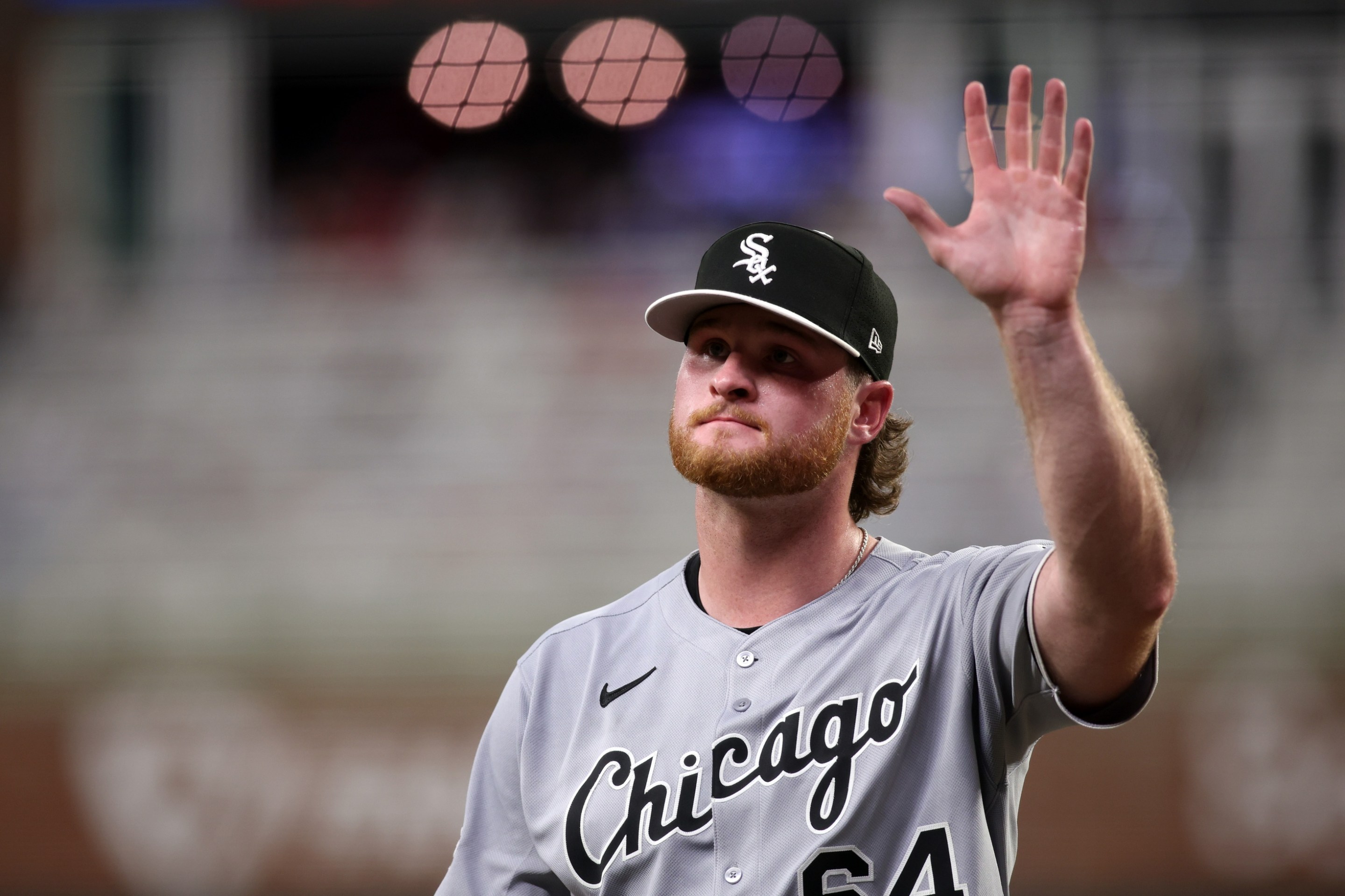
As a Rule 5 pick turned All-Star by way of insightful pro scouting and pitch development breakthroughs, Shane Smith is hopefully representative of a new era of White Sox baseball. Which makes it funny that he ended his 2025 season -- a no-hit bid he took into the sixth -- looking a lot like Lance Lynn.
Look at all these fastballs?
Even as someone who barely pitched at Wake Forest and went undrafted due to injury, and sat closer to average right-handed velocity before flashing more consistent upper-90s with the White Sox, Smith professed comfort with his new identity of challenging big leaguers relentlessly with ol' No. 1 (and No. 1A). It's just that he couched it more as a logical response to his observed experience, rather than a pursuit of catharsis.
"I've always thought my fastball was my best pitch, since I was a kid," Smith said at SoxFest. "I saw the results of what the four-seam was doing and I think I got hurt on some offspeed pitches early in the game where the guy wasn't on my fastball, so why am I pivoting? If I'm getting hurt third time around from too many fastballs, maybe that's where I can switch it up a little bit more."
Smith's sinker had some cameo appearances as early as April, but didn't take on a sizable role in any of his starts until July, after his four-start swoon heading into the All-Star break. As nasty as his new seam-effects changeup was, diving down and to the arm side with the movement of an offspeed pitch arriving at near fastball speed (89-92 mph), Smith explained that he had overplayed his hand to a degree. Since his four-seamer worked up in the zone, opposing hitters saw any pitch coming in below the belt and assumed it was bad news. A new two-seamer gave him something that would stay up and grab strikes, and in turn drew more swings back to his changeups for rollover grounders.
But how did someone who needed a new one-seam grip to execute a changeup when he never could before, adapt a two-seamer midseason?
"It's so similar to the changeup in terms of seam orientation that throwing it with [index and middle] fingers is so much easier than ring and middle, so then once I started throwing two-seamers it was an easy transition," Smith said. "It's a similar movement profile, it's still a seam-shifted pitch. When I started throwing the changeup in the winter last year, I was playing around with the two-seam."
At the outset of the season, Smith was already handling a lot of new elements in his game, and didn't really know when he'd use the sinker until the defense response that the league had to his changeup showed him where it was needed.
Smith's peripheral-defying success, his hard regression before the break, and his brief second half injured list stint for a rolled ankle that also served as a break in his workload, obscured a second half that probably deserved more excitement than his other work. In his final 11 starts, Smith ran a 3.17 ERA with 64 strikeouts in 59⅔ innings against 21 walks.
For someone taken in the Rule 5 draft, who has quite-good-but-not-insane average velocity (95.7 mph) and a below-average amount of carry on his four-seamer, it might be hard to buy Smith as someone who will head up the 2026 Sox rotation by bumping fastballs, and Smith certainly didn't embrace Josh's attempt to refer to him as the ace of the White Sox staff in this interview. But there's always been something curious in Smith's delivery that scouts have identified as making him hard to time up, that make his pitches, especially velocity, just get on guys. Its pacing is ... different.
Compare it to a more methodically paced right-hander like Sean Burke.
It's a slighter difference than it was earlier in the 2025 season, but whereas other pitchers tend to start their leg kick in a slow and measured fashion, Smith is more or less trying to move as fast as possible, as soon as possible.
So, like, why does Smith's delivery look the way it does?
"That started my first year in pro ball in '23, my first healthy year," Smith said. "I felt strong and my velo kind of wasn't where I wanted it to be. I thought back to some of the stuff I did in the weight room. If you want to go from standstill to jumping as high as you possibly can, are you going to do it slowly or fast? If I want my arm to move fast, everything else has to be at that same speed. I can't really go gather, gather, gather slow and let the arm kind of unwind. So I played around with that leg kick and what it did for me. Early on it was kind of messy and I was trying to figure that out. But I plan on keeping that similar thing, but cleaning up the rest of it."
What Smith thinks there still is to clean up after getting his walk rate down to 8.7 percent in the second half is worth parsing. But after it was his most heavily used secondary pitch in '24 in the Brewers organization, Smith's slider disappeared from his arsenal down the stretch last year, as he cited it becoming too much like a cutter in shape and opponents slugged .465 against it.
What will it take to get Smith's slider going again?
As it turns out, it's related to his efforts to rein in some of the elements of his delivery that can shift over time.
"My delivery evolved a lot last year," Smith said. "I was a little less cross-body as the year went on, changed my posture a little bit. For the slider, that's why it was a little harder for me to get around it, make it go left. Made a few grip adjustments, and it's something I worked on for a while. I wasn't just spamming sliders this offseason, but I think it's a pitch I have a good feel for."
"I think that's why the changeup suffered too. The changeup is such a seam-shifted pitch that when I would land cross-body, I would just kind of swipe it and I would get that dive. The slider is easy because I'm already cross-body and I could just come around it. I probably have a little bit cross-body, but not as much as the beginning of the year. So it's tweaking where the hand is with the evolved delivery."
Smith commanded his fastball and objectively pitched better in the second half than the first, so it's not like he wants to try to add more cross-body action to his increasingly stable delivery, but he has spent the offseason trying to figure out the right amount of funkiness to retain.
"The deception in my delivery is a benefit for me," Smith said. "You don't want to take away some of the intangibles you have naturally. I don't want to try to cross-body or try to straighten up too much. It's a lot of [syncing up] what my back leg is doing with my upper half and making sure I give myself enough time to land and have my arm in the right position. I think that's more what took away from the cross-body [action] than anything."
There should be plenty of runway to perfect it, because after bumping up from 94⅓ innings to a career-high 146⅓ last season, Smith should be free of the workload concerns that dogged him throughout 2025. A lot of innings full of pumping a lot of effective fastballs in the zone is a clear path for Smith to pace the White Sox rotation in returning value, whether he's fond of the label it might bring or not.
"It was the right concern at the time, because I ran out of gas in the middle of the year," Smith admitted. "It sucks. I think that happens to everybody at one point in time or another whether you hit inning 70, or inning 125 and you feel it. You're just trying to push off that feeling as long as you can. But in terms of being sore in between starts and what that feels like, nothing really scares me anymore as far as how bad I'll feel, or how good I'll feel. You just know that you'll be ready for Day 5."