NASHVILLE -- Although he homered more times over his first three games in Charlotte than he did over 49 games with Birmingham last year, Sam Antonacci looks largely the same. He's still working deep counts if there isn't anything to attack early. He's still rounding first with the intent of getting to second, and attempting to bait infielders into an extra throw if they stop his initial attempt. It took him five games -- an eternity in the Antonacciverse -- but he finally got hit by a pitch, to the loud appreciation of his teammates in the dugout.
The biggest difference is where he's standing. Antonacci has started the first five games in left field, with farm director Paul Janish explaining last week that the White Sox wanted the career infielder to get a concentrated dose of outfield exposure at the onset, because Antonacci has the capability of figuring it out, and that's where the playing time is. Watching the replacement-level play of the White Sox outfield during their 1-5 start has done nothing to dispel that notion.
With one full turn through the rotation in the books and a 1.000 fielding percentage still intact, perhaps the biggest challenge is keeping Antonacci occupied.
"It's a little boring out there sometimes, because you're by yourself and it feels like you get a little bit away from the game," Antonacci said before Tuesday's opener against the Sounds. "So I enjoy talking to some fans to keep me in check, and then I get a card to look at to see where I position, to keep up on that stuff. But it's been fun."
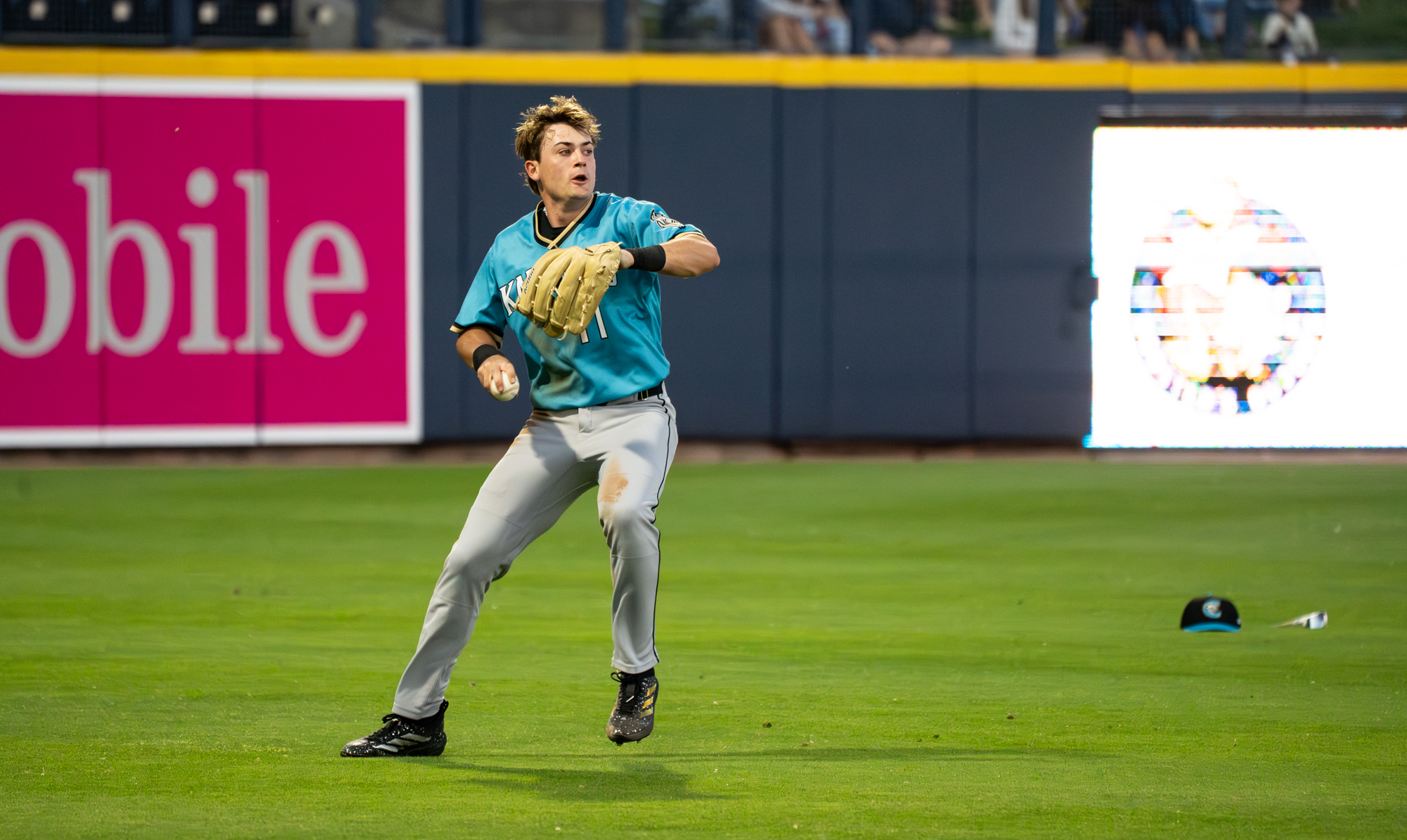
It's also been successful enough. Grading him on a simple pass/fail system based on whether plays are made, Antonacci is clearing the bar. He's converted every chance he could feasibly reach, most recently flagging down this Jett Williams liner in the eighth inning of Charlotte's 9-3 victory over Nashville Tuesday night.
In terms of refining a technique that will allow him to make the more challenging catches on a reliable basis? That's more of a work in progress.
Charlotte manager Chad Pinder, who played seven years in a superutility role with the Oakland A's, has been in Antonacci's position -- even in a geographical sense, as Nashville was the Athletics' Triple-A affiliate 10 years ago. He was drafted as a shortstop out of Virginia Tech in 2013, but an infield with Jed Lowrie, Marcus Semien and Matt Chapman forced him to learn the outfield in a hurry, and that's where he ended up spending the bulk of his major league career.
Pinder describes the current stage as pure rep-building, figuring out positioning and learning how to read swings. That includes batting practice, where Antonacci practices his first few steps, and occasionally completes a route. He lauded Antonacci's work thus far, because even the shakier moments have resulted in outs.
For instance, Antonacci didn't immediately read Greg Jones' sky-high fly in the second inning on Tuesday, but recovered and closed the distance -- almost too much distance.
"That got lost in the sky, and he took the time, found it and got to a spot," Pinder said. "He's a baseball player, he's figuring it out."
And then back in his second game of the season on Saturday, he flagged down a fly to the gap, but center fielder Dustin Harris had to slide on the warning track to avoid a collision.
Sam Antonacci showing some range in LF. Dustin Harris showing his range and escapability. #Knights pic.twitter.com/j8M54mjm1j
— FutureSox (@FutureSox) March 29, 2026
"It's a lot different," Antonacci said of this play. "You've got two people running as far as they can to get a ball. In the infield, you're running, but you're not running at full speed, because you're not running in a straight direction usually, and your eyes are kind of on the ball as well. It's a little different in that regard.
"The communication is more crucial, especially in an outfield with those types of things. It's definitely an eye-opener for the first series."
"There probably is a bit of communication error and those things will iron itself out," Pinder said. "They never have played together in the outfield, that's two guys going after the ball. Sam did an unbelievable job getting there and Dustin's trying to get there, too, and it's just these guys learning each other.
"Thankfully, nothing happened, so it was a good learning moment."
While Antonacci might have to practice negotiating moving targets, he's erring on the side of caution with regards to walls, whether cutting a route short to play a carom, or measuring steps on the warning track in pursuit of a homer that probably couldn't have been retrieved by a more experienced outfielder.
We might need to revisit that Luis Lara power grade @MLBPipeline pic.twitter.com/5OhRODapu0
— Nashville Sounds (@nashvillesounds) April 2, 2026
Antonacci isn't known for a self-preservation instinct, but it makes sense at a time when the other side of his game has transferred seamlessly to Triple-A. He reached base three more times against Nashville on Wednesday, raising his line to .350/.519/.650 over his first 27 plate appearances. He's drawn six walks and the aforementioned HBP against just one strikeout.
When informed that he'd already surpassed his one home run with the Barons, Antonacci simply responded with "I hope so." He said he notices some difference in the way the ball carries, but he's not shaping his approach for the ballpark. He said last August that he was "obsessed" with reaching base safely, and while the power he predicted is showing up early, he hasn't changed his aim.
"I would say I'm always trying to get the pitch that I want, and hit it as hard as I can at the specific launch angle that we want, which is 5 to 25 [degrees], 5 to 30," he said. "Hit it as hard as I can. The harder you hit it, the higher chance you have of getting on base."
The White Sox could use that skill, especially in the outfield. At the same time, the shaky start to the Luisangel Acuña era suggests Will Venable's staff wants outfielders who successfully demonstrate confidence in their actions, and therein lies the tension. The experience of three consecutive 100-loss seasons and an initial trajectory for No. 4 informs us that what the White Sox want and need are constantly at odds with what they have. The experience of watching Antonacci informs us that he'll force their hand.