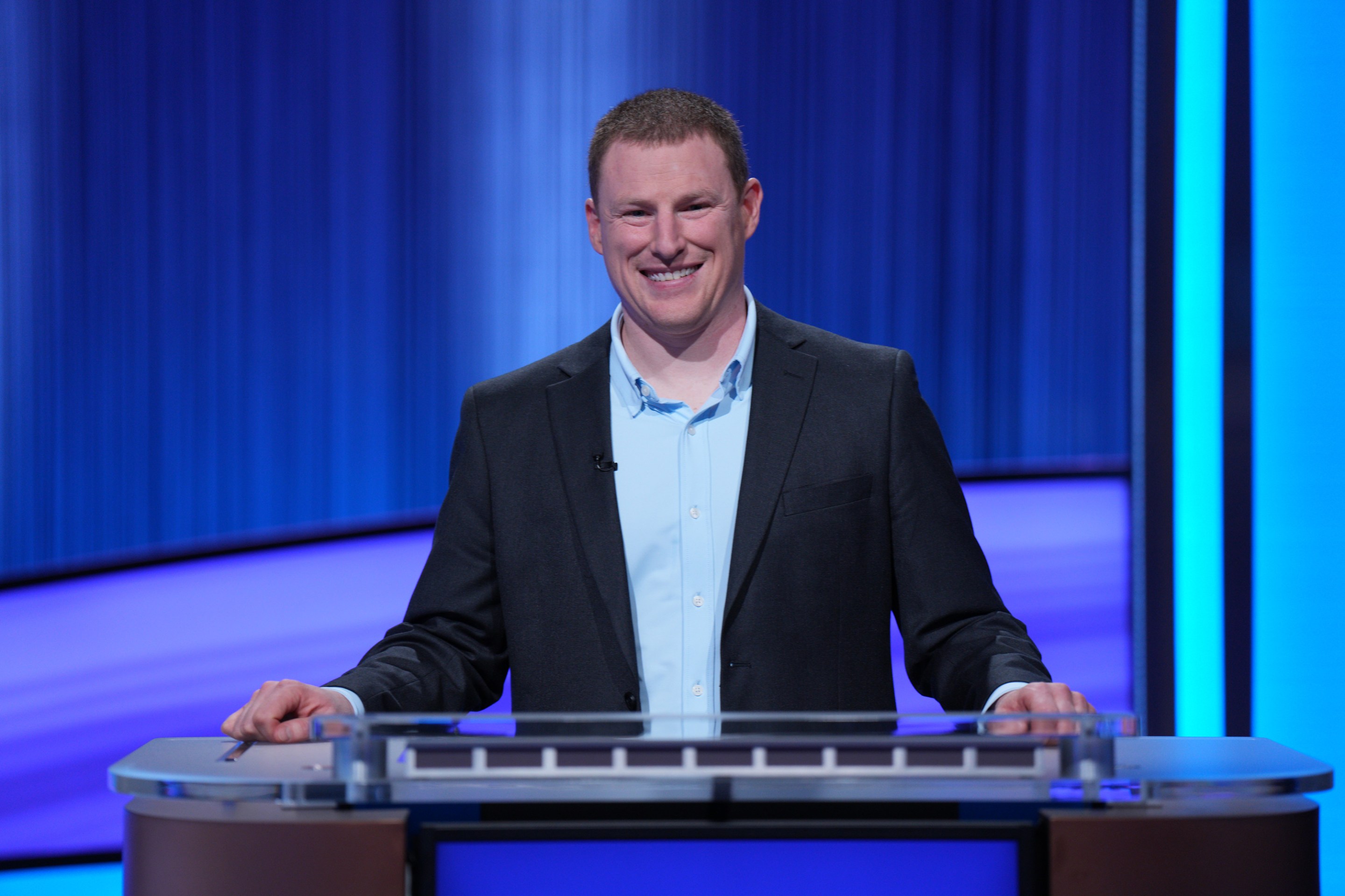
Longtime Sox Machine contributor and longer-time White Sox opinion-haver Patrick Nolan -- aka Pnoles -- competed on Jeopardy!, with his first appearance airing Thursday. This interview runs through his entire experience and includes a recap of moments to add context to questions, so if you haven't yet seen it and would like to check it out before knowing the outcome, then stop reading here. But leave the page open so ads will refresh.
[THE REST OF THIS POST CONTAINS SPOILERS.]
[YOU CAN'T SAY YOU WEREN'T WARNED.]
Sox Machine: How long has this been a dream for you?
Pnoles: Back in 2017, I was invited to join a trivia league, LearnedLeague, with a few friends from college. After playing a season of the league, it was clear that I was easily the worst player in the group, which made me really mad. My personality isn't wired to continue participating long-term in something I'm really bad at, so there were two roads: either 1) quit or 2) take it way too seriously and get better. The gym class hero in me won out, and I started studying history, memorizing geography, theater, Shakespeare, you name it. Eventually, Jeopardy! became part of my studying, as I realized there was often overlap between topics asked about on the show and questions I'd get in the trivia league. As I was watching the show basically every day, at some point my primary motivation shifted from "I care about LearnedLeague" to "I care about Jeopardy!" Looking back at my daily logged score sheets, I'd say this means it became a dream some time around 2018.
Sox Machine: Walk us through the process of getting on the show.
Pnoles: Jeopardy! has an "Anytime Test" online that you can take once per year, plus one gratuitous attempt on March 30 ("JeoparDAY"). The test is 50 questions and it's unknown how many you need to get correct to pass, though conventional wisdom online suggests it's around 35 out of 50. If you pass this test, you may get asked back to take a second 50-question test, but this time on Zoom (presumably to make sure no one is feeding you the answers).
If you pass the second test, you may get asked back for an audition. At the audition, they have you play a mock game of Jeopardy, clicking a pen or something in lieu of a real buzzer. I don't know how much they're grading you on performance at that point, but I do know that they're checking to make sure you can keep the game moving without disrupting the flow. You also have to answer personal anecdote questions along the lines of what Ken asks in the contestant interview portion of the show. By random chance, I got the dreaded "What would you do with the money?" question, which I scuffled my way through since I was never thinking about Jeopardy in terms of prize money.
In any event, I must have done OK enough, because I wound up in the contestant pool, meaning they could call me to come on the show any time in the next two years (though sometimes, the two years expire without getting the call and you have to repeat the whole process). On Jan. 16 of this year, I got the call and it rocked my world.
Sox Machine: What was the call like? Did you have to take a chance on picking up an unidentified number?
Pnoles: I actually missed the call when it originally came in. However, they left a voicemail and a text message, and when the Los Angeles number popped up on my phone, it said, “Maybe: [Name],” where [Name] I recognized as the name of the person who ran my audition. So there were plenty of indications it was the real deal.
They gave me a tentative tape date and just wanted to firm up that I would be available if we were to move forward. Then, a few days later when it was confirmed, they called again and sent me all the documents I needed to fill out, which included the list of personal anecdotes they might use on the show. I had all sorts of paranoid questions, like “What happens to my appearance if I get the flu or something.” They were nice and accommodated my neurotic energy!
Sox Machine: Jeopardy strategy, just like professional sports, has been revolutionized by a more analytical approach. I miss the old days of people selecting values from top to bottom because as a viewer, I liked gauging whether a $1,000 question seemed easier than a $600 question, but I understand the strategy behind hunting Daily Doubles as quickly as possible. Where do you stand on it, and what was your strategy going in?
Pnoles: I appreciate that the writers sometimes write the clues with the intent of them being played top-down. Sometimes, a fourth-row clue gets revealed early and goes triple-stumper because no one bothered to play the clues higher on the board in that category to get a feel for what the show was going for, and I can understand how that messes with the quality of watching the game. However, the Daily Doubles are too valuable in gameplay to mess around, and there's a full archive of statistics on where they're most likely to be, so a person choosing to simply select the clues starting from the top of the categories is doing themself a major disservice. You get once chance in your life to go on a Jeopardy streak, so hunting for the wager clues has to be the priority.
Sox Machine: What was the biggest difference between your perception of the show from watching on TV versus actually being on it?
Pnoles: One thing that suprised me was how quickly the buzzer gets armed. I assumed that because of the little delay between when the clue is finished being read and when we actually see someone's podium light up on TV that such a delay is also afforded to the contestants in real-time. However, it really does get activated right as Ken finishes the last syllable. I also thought that the clue board would have the selected clue enlarge until it encompasses the whole screen, similar to what we see on TV. In reality, the categories at the top of the screen stay visible and they have a separate screen below the categories where the contestants can read the clues. Also, on picture clues, the picture appears side-by-side with text, so you can actually read the clue on those as well, whereas on TV you just get the picture and listen to Ken read.
Oh, and I imagined that the "green room" would actually be green. It was not!
Sox Machine: Do you wish you made it on in time for Alex Trebek, or are you a Ken Jennings Guy now?
Pnoles: When Alex Trebek passed away, it was a tragedy to lose such an (Canadian-)American icon and a personality that had been a constant voice in our lives for many decades. For me personally, I was sad that it meant I would never get to meet him.
That all said, I love the energy that Ken brings to the show and am very glad they selected him to be the host. He's very personable and engaging with both the contestants and the audience and he's very quick-witted at putting an amusing button on a conversation. My dad was in the audience and got a chance to ask him a question -- "What was your most difficult category when you were on the show?" After some thought, his response was something along the lines of, "Hmmm....I wasn't great with country music, and I was typically lost whenever there was a hockey question. So, anything with mullets, really."
Sox Machine: I used to play bar trivia in Troy, N.Y., with a couple of people who appeared on Jeopardy!, and through them I learned about the pros and cons of the community and fandom around it. What's been your experience with being a contestant? Do you feel like you're part of a fellowship? Was it weird being viewed and judged?
Pnoles: The Jeopardy contestant community is very welcoming and it very much does feel like a tight-knit group strengthened by sharing a common significant life experience. It's great to be able to talk to other people that have been put through the ringer.
That being said, in recent weeks I have been hopping into various Facebook and Reddit threads about the show and have been exposed to some nastiness thrown at the various contestants. Some of the comments from fans are pretty ugly, and it seems like to avoid those types of criticisms, you have to satisfy a bunch of contradicting expectations. Don't show too much enthusiasm. Don't be an emotionless robot. Don't be excited about winning. Act like winning actually makes you happy. In the end, you're not going to please everyone, and the good news is that even within some of those disgusting threads, there's plenty of people who call out the bad behavior, which makes it easier to ignore.
I've been called everything under the sun on Twitter from my White Sox #HotTakes, so to some degree I've had a fair amount of training in letting stuff roll off my back, even if my success rate is ... shall we say ... less than 100 percent.
Sox Machine: On the date of the recording, how did your nerves compare to the other stages of the process -- Zoom call, audition, etc.?
Pnoles: My nerves were through the roof for most of the day! I was shaking in the green room during the other games they were taping. But there's a funny thing about coffee: If you drink enough of it in a short period of time, "nerves" turn into "jitters," which are different and better! I felt ready to go when I stepped out onto the stage, and although I seemed more tightly wound on TV than I thought I would, I definitely didn't feel that way.
For my audition, I wore a nice button-down shirt and after it was over, there was enough sweat on it to make someone think I had just overdressed for a basketball game.
Sox Machine: How much consideration did you put into your handwriting, or presenting your name on the board?
Pnoles: Very little! I have terrible penmanship and just told myself I was gonna write just bold capital letters. I even started running out of space; some people commented my "C" looked like it could have been an "L" because I was trying to cram the last couple letters in at the end. That bit of bad planning is emblematic of the lack of thought put into the whole process.
Sox Machine: And your buzzer technique?
Pnoles: I had been practicing with the "Fritz Holznagel" method from his "Secrets of the Buzzer" book that was popularized by James Holzhauer. I honestly don't know how much of a difference it makes, but I wasn't going to pivot to something unfamiliar in the moment, so I stuck with it. You'll see a lot of contestants do this as you watch the show -- they're holding the buzzer below the podium with one hand crossed over the other wrist. There's so little motion when it's done properly that you can barely tell when someone is attempting to ring in. I was of course too much of a spazz so it was definitely noticeable when I was buzzing.
Sox Machine: At the time of the airing, the viewer saw you and fellow challenger Leighanna Mixter from Fresno, Calif., going head-to-head with Jamie Ding, a 29-time superchampion. At the time of the recording, how much did you know about him? Did you feel like an underdog?
Pnoles: We were all introduced to Jamie at the beginning of the tape day as the reigning 26-game superchampion, and after watching him win the first three games of the day, it's safe to say I felt like a massive underdog. I arrived in Los Angeles with high hopes of winning, and after seeing Jamie dominate, I pivoted to "don't embarrass yourself." I didn't know much about Jamie at the time other than that he was relatively quiet and pretty nice. He was helpful in the green room and gave all of us buzzer tips.
For the first round, the categories were Big 12 Schools, Science, America 1750-1800, Recent Hitmakers, Hobbies & Pastimes, and Words for the Young.
For Double Jeopardy, the board showed American Lit, Celebrity Chefs, Art for Art's Sake, Word Origins, Teeny Tiny Countries, and I Have a Lot of Grey Friends.
Sox Machine: What was your reaction to the categories you were drawn?
Pnoles: Very favorable. I was hoping to avoid major land-mine categories for me. Fortunately, things like fashion, cars, and food had appeared earlier in the tape day, and I did alright on the couple off-beat categories that were included (Celebrity Chefs, Big 12 Schools). The only tough draw for me was that I sometimes struggle with wordplay and vocabulary, and there wound up being a vocab category in both rounds. I did pretty poorly on both accounts; I think I buzzed a total of two times across those ten clues and never got in. The good news is that I got mostly Jeopardy meat-and-potatoes categories that I was prepared for, so I feel pretty fortunate.
Sox Machine: Was it a relief when the first answer selected was the Daily Double? Strikes me as an OK result, because it's less likely the first-round score will get out of hand.
Pnoles: Definitely. If Jamie got that late in the round, it could have spelled disaster. I've watched him get to five figures plenty of times before the end of the Jeopardy round on the strength of a late Daily Double. A $1,000 head-start was far from disastrous, and it meant there was a good chance I'd be still in the mix heading into Double Jeopardy. Obviously the best result would be to find it myself, but if he's going to get it, that's when you want him finding it.
Sox Machine: One of the moments where a contestant might be judged the harshest is the interview portion. Ken Jennings made a gentle joke about actuaries, then asked you about your Christmas Jeopardy! games complete with a buzzer lockout system you'd received as a gift. I think you got in and out of it with success. Were you happy with the anecdote they selected? Was your voluminous history of White Sox commentary a possibility?
Pnoles: I was happy with the anecdote they selected because I knew my family would want me to talk about the Christmas Jeopardy games and it gave me a chance to mention my daughters. The White Sox stuff was definitely on my list of potential topics.
At the end of the first round, Jamie led with $7,600, with Patrick close behind at $6,400, and Leighanna at $200.
With the ninth answer in Double Jeopardy, Patrick selected American Lit for $1,200. The answer was, "A South Carolina literary festival is named for this late author of "The Great Santini." Patrick correctly answered fellow Pat "Conroy" to take a $400 lead over Jamie. He then selected "Teeny Tiny Countries" for $1,200 and hit on the first Daily Double.
Sox Machine: You took the lead for the first time in the second round at $11,600, and then you got the first Daily Double soon after. You bet it all. How fast did you calculate making it a true Daily Double?
Pnoles: There was pretty much no decision at all here. I could get into a bunch regarding game theory, being the underdog, the category, my personal performance on Daily Doubles in my training, but there's a much simpler and better explanation. The last thing Jamie Ding wanted to hear in that situation was an all-in bet, and that is why you do it. He's the better player, and the more control of the game you put in his hands, the happier he'll be. That was my opportunity to make headway while he could do nothing but spectate, and I wasn't going to pass it up.
The answer: "Borgo Maggiore & Serravalle are towns in this landlocked nation that bears the name of a 4th century holy man."
Patrick began, "What is...", and after a two-second pause, "... San Marino." The answer was correct, and Patrick led $23,200 to Jamie's $11,200.
Alas, Jamie retook control of the board with a correct response to a $2,000 clue, which left him in position to retake the lead when he hit upon the final Daily Double with his next selection.
Sox Machine: What was your reaction to Jamie retaking the lead on the final Daily Double?
Pnoles: Ugh. The worst part was that I almost picked that art clue where he uncovered it. I was 50/50 between picking the bottom row literature category and the bottom row art category, and I lost the coin flip. Worse still, I wasn't armed with the answer on the literature clue, so I was defenseless as he took back control of the board.
There was a little bit of a nuance here that someone on Reddit picked up on that I thought was interesting. In all of Jamie's games so far, he hasn't been aggressively hunting the Daily Doubles as much as making "knight moves" around the board, which is to say he hops to a clue that a knight could hop to from the previous clue if the Jeopardy grid were a chess board. Anyway, there was a "knight move" available from the literature clue he got -- Celebrity Chefs for $1,200. The serious tone in his voice as he answered the Damon Runyon question carried forward in his clue selection, as he correctly determined that the Celebrity Chefs clue was unlikely to hold the game's last Daily Double. He abandoned his convention -- no longer able to play with his food -- and went for the fateful art clue. If I found it first, I would have bet enough to lock him out before Final and won the game.
At the end of Double Jeopardy, Jamie led with $30,800, followed by Patrick at $28,000 and Leighanna at $5,400.
Sox Machine: You finished $2,800 behind Jamie entering Final Jeopardy, which is suboptimal in the sense that you don't control your own destiny. But it's not bad, in the sense that you're probably 99 percent likely to win if Jamie merely gets the answer wrong. Did that take the stress out of Final Jeopardy any?
Pnoles: It absolutely did and contributed to my lack of focus, but I'll be honest, it was a weird feeling standing up there through the end of the game knowing nothing I could do going forward would change my chances. I had to make sure I didn't make a ridiculous overbet, but beyond that, Jamie's answer was the only thing that mattered. I was in total shell shock from the first two rounds and all the prep and drama leading up to that moment. I was practically dissociating from it, so much so that coordinators kept asking me if everything was OK. I took forever to lock in my wager, not because I was unsure of it, but because I was having such a hard time functioning.
Sox Machine: How did Final Jeopardy compare to how you imagined it? Did you even hear the music?
Pnoles: I'm pretty sure the music was playing. The truth is I was so focused on my internal debate between answers that I wasn't aware of what was going on around me. I immediately thought of the polio vaccine (the correct answer) after reading the clue, but managed to talk myself off of it because I thought the clue's reference to a death in 1945 was referencing the inventor of whatever it is we were going for, and I knew Jonas Salk was still alive well past 1945. I didn't love the answer I wrote down, penicillin, but at the very least I had nothing concrete in my head telling me it was wrong. Anyway, 20 seconds in, it occurred to me that I had to put down SOMETHING, and I panic-wrote penicillin. Not my finest moment, and I'm just thankful it ultimately didn't matter at all.
In the end, Jamie finished with $56,001, with Patrick second at $18,000, and Leighanna at $10,400.
Sox Machine: When my friend in Troy competed on Jeopardy!, I didn't ask her about it until after the airing party, just because it was understood she wouldn't be able to divulge anything. How tough was it to keep the outcome to yourself?
Pnoles: It was very hard because there are so many innocuous questions that people can ask you where you can inadvertently give away the outcome. An example: "When was your tape day?" Well...how do I answer this in such a way that it's ambiguous how many tape days there were? I wasn't super tempted to actually tell people how I did in advance, but it was very challenging to talk about the experience without inadvertently giving away information.
Sox Machine: What did you think of your performance when watching it as a TV viewer? Who did you watch it with?
Pnoles: We had a watch party with family and friends and it was really fun because there was a lot of loud cheering for responses. I honestly didn't think I would look so serious and locked in the whole time and thought I smiled more. I also buzzed on more clues than I thought I did.
I had a moment when I was looking through my game on the Jeopardy archive after it was released on the 23rd and came across the Diego Velazquez art clue. I read it and was completely lost. Then I watched myself get it right on the show later that day. I must have been on a whole different level when I was taping.
Sox Machine: What's sticking with you now that you have some distance from it? Any future trivia plans?
Pnoles: For the time being, I'm in the mix for the Second Chance Tournament, so I've gotta try to stay sharp for that. After all that finishes up, I'll have to ask myself some tough questions about my relationship to trivia. It has taken a lot of time and mental energy over the last 8-9 years or so to upskill at this, and you have to continue to practice to even maintain your current level. I don't know that I'll have the same motivation for it once my Jeopardy journey is over. There's probably many more productive and beneficial ways to spend my time. If this is the end, we'll always have San Marino.
Sox Machine: I have to ask you the Cliff Clavin question -- Final Jeopardy, you're leading by more than double the runner-up, so you don't have to bet anything and you'd still win. The category is "21st Century White Sox." What would you have wagered?
Pnoles: Defensive keep-the-lead wager. Too risky, and I'm actually pretty bad at baseball trivia, even if that is easily the best possible sub-category of baseball trivia I could get. I had so many fears going on the show that there would be a baseball category and I'd flub something, so much so that I'm glad there wasn't one, even if that would likely have given me an advantage.
Sox Machine: And if the category was "Overrated Kansas City Catchers"...
Pnoles: All in, and thanks to Sal for the free money.