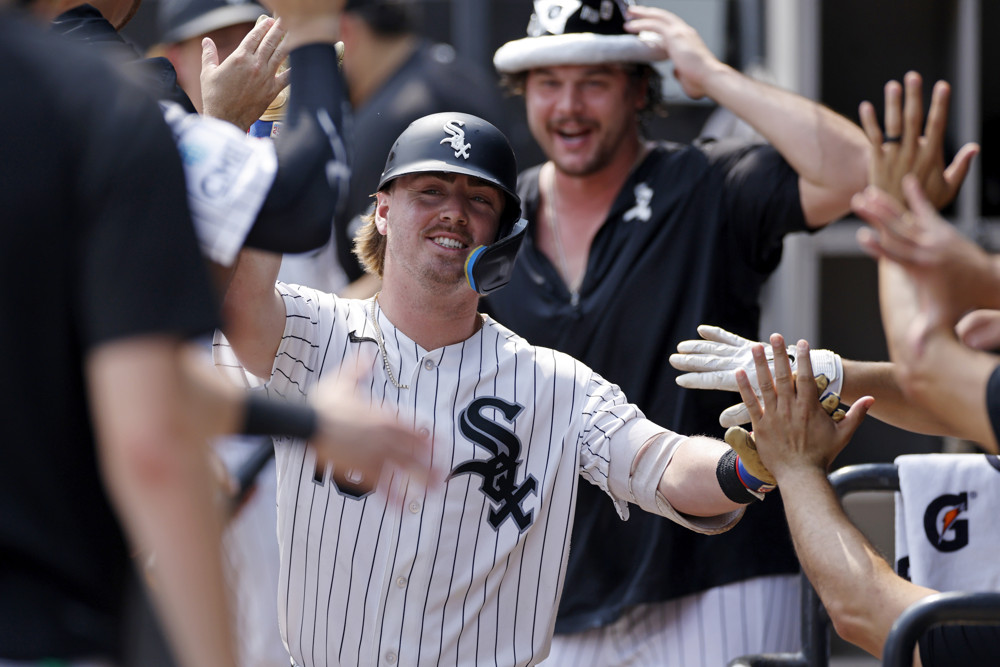

Sam Antonacci's father Bill was a baseball coach, after finishing up his collegiate playing career at the University of Illinois.
At times, this can feel like the most obvious fact in the world. Who else but a coach's son gets noticed in the World Baseball Classic for dirtball reads, and deking baserunners? Maybe the son of an all-conference collegiate softball player, but thanks to his mother Nicki, he qualifies as that too. Antonacci has had plenty of influential coaches, but his whole deal is more deeply ingrained.
"I've told multiple people after watching Team Italy, Sam taking the extra bases, and the dekes defensively in the hit by pitches, the stolen bases," said Nick Naumovich, Antonacci's coach at Sacred Heart-Griffin High School in Springfield, Ill.. "Sam played the identically same way from freshman year."
Similarly, Antonacci's gusto for hit-by-pitches certainly seems influenced by spending his junior year at Coastal Carolina, where coach Kevin Schnall says he targets players who will be "obsessed with getting on base," and asks, "If the pitch is coming at your knee, why are you getting out of the way of an opportunity to get the first base?" But even there, Antonacci had long already embraced the pain hard-nosed play can inflict, as if it was its own incentive.
"He got taken out [with a slide] his sophomore year at the [junior college D-II] World Series on a double play," said Chris Razo, who coached Antonacci for two years at Heartland Community College in Normal. "He jumps up, and the umpire goes in thinking there's going to be a fight. [Antonacci] is in the kid's face and he's telling him 'Great slide! That's how you play the game!' And the other kid is so confused because Sam is pumped up that he just got upended at short.
"That is who he is."
A romantic love for baseball is seemingly a prerequisite for enduring its costs, but it can be weird at first, and maybe even off-putting, to encounter someone so intense about it. Sox player development noted that Antonacci occasionally rubbed opposing players in the Arizona Fall League for playing too hard, which scans. It always has.
"Why's this guy playing so hard on a Tuesday afternoon with nobody there?" Naumovich said. "Taking charges, rebounding, taking away the other team's tops scorer; the dirtbag on the baseball field is the same guy on the basketball court."
"It is the epitome of: He only has one speed," Razo said.
No one likes eye wash, so the sincerity is what sells people on Antonacci's approach over time. But maybe it would take a lot of time if he were on the roster of an AL Central rival.
"I'm probably not gonna like playing against him a whole lot, but I love playing with him," said Vinnie Pasquantino, Royals first baseman and Team Italy captain. "It doesn't mean he's a bad guy. He's just playing the game hard all the time. There are situations where things like that don't fly at this level, like when a team is up or down a lot, but at least in my experience, we'd obviously have no issue with that. He's just playing the game hard. Him and I would have conversations all the time about what it looks like in the major leagues versus what it looked like in college. He'll adapt, the same way the league will adapt to him."
"It’s a learning moment," Antonacci said after getting thrown out on the first dirtball read of his major league career in his debut on Wednesday. "It’s the big leagues now. You may be able to get away with that in the lower minor league levels but here it’s a little different."
Antonacci's disarmingly quiet demeanor stands in contrast to his helter-skelter baserunning style. It sneaks by you when Antonacci matter-of-factly reveals his fantasy/very serious plan to one day score from third by timing up a slow lob from the catcher back to the mound, or is asked to verify a story that Razo -- quite unsuccessfully -- tried to ban him from diving after balls in practice at Heartland with a blasé "sounds right."
The calmness with which Antonacci invites White Sox fans to get on him if they see him taking a play off, or discusses what he admits is a probably unnecessary focus on tricking opposing defenses into getting dinged with baserunning obstruction calls, communicates something different than if they came with bursts of emotion. To him, this is all normal.
"He is a silent assassin competitor, not a rah-rah guy," said Kevin Burrell, the White Sox amateur scout who signed Antonacci as a fifth round pick out of Coastal Carolina.
"Anyone who knows him off the field, he's kind of reserved, keeps to himself," said Kyle Teel. "And then when the game starts, he's an animal, he's a savage on the field."
Or maybe he just prefers a lower profile, but his style of play and the results it produces messes things up for him. Standing in front of his new major league locker on Wednesday, discussing with media an achievement that seemed unthinkable when he had no Division I scholarship offers out of high school, Antonacci seemed to lose interest in focusing on admirers over the task at hand.
"This is a job," he said, saying his parents would probably take the lead in organizing his cheering section. "I'm not here to call everybody."
And up until Italy's run to the semifinals in the WBC, Antonacci's playing career has been spent in smaller venues with smaller audiences. Absent sustained scouting attention, his star has risen like that of an indie band without a record deal -- reliant on word of mouth. People who worked up close with Antonacci became infatuated with him, and then sought out others who would appreciate him.
"At the junior college level, we are looking for the kid who is weirdly undersized because they have the talent to play at the highest level, but a lot of the D-I's just think they're not big enough, or they don't have enough tools, or they don't have that wow factor," Razo said. "Every time we would watch him play, he would do something different. 'OK, he bunted that at-bat, and then he had a home run his next at-bat, and then he made a diving play up the middle.' And it was just like, every single time, like, I can't believe he did that."
After two years of putting up absurd numbers in obscurity at Heartland, Razo recommended Antonacci to Schnall, who was Coastal Carolina's associate head coach and recruiting coordinator at the time. Antonacci owned a Chanticleers shirt as a small child, a holdover from family vacations in Myrtle Beach, but as his journey moved beyond Central Illinois for the first time, the process of morphing from soft-spoken outsider to revered firebrand begin anew.
"He was a little maybe homesick, a little introverted," Schnall said. "It took him some time to break out of his shell. But I can assure you, by the time he left, he wasn't introverted. He was extremely well-liked, he was looked up at. He was extremely well respected, and he was much more vocal."
After a season where Antonacci "absolutely embraced" the hard-nosed, hit-by-pitch absorbing mentality of Coastal, now-retired head coach Gary Gilmore recommended the infielder to Burrell, who already had a scouting approach that made him predisposed to staying on Antonacci.
"Hall of Fame scout with the Red Sox, named George Digby, and he taught me in my first year of scouting, he said, 'If you believe a guy has ability to hit and you believe in the bat, never walk away from the rest of the tools," Burrell said. [Gilmore] called me into his office one day in the spring and just said, 'Do you like Sam Antonacci?' And I said, 'I love Sam Antonacci,' And he said, 'He is one guy, in my opinion, that I feel is definitely going to play in the big leagues.'"
For many reasons, this level of certainty never trickled down to Antonacci himself. Or by the time it did, the shell he had built to harden himself against countless rejections would not let it through. Some coaches trumpet when their best player is also their hardest-working player. For Antonacci, it was more "your most talented, best player on your team plays and approaches everything like they're the worst player on the team, and just are trying to stay in the lineup," as Razo put it.
"I can just remember his frustration when he'd go to these camps and his 60[-yard dash] time wasn't what it should be and schools wouldn't look at him," Naumovich said. "The frustration Sam would have coming back and working out. He would just spend hours and hours and hours, doing anything and everything he could to get quicker and faster. Every time we'd stretch, whatever drill we were doing to stretch, he would do it the best. Didn't matter what it was."
"He still does not believe he is good enough," Razo said. "He will never forget the teams that said 'You're not good enough.' He'll never forget going to certain camps around the country that these coaches tell him to come to, and saying they like what they saw and they never called him again. That is a very real thing, and there's a little bit of crazy in that. If directed in the right direction, this is what you get, is a kid like Sam."
Ultimately, Antonacci's reasons for it are his own, but the end product is a player who seems to revel in the practice of self-sacrifice, or simply have no regard for self-preservation. In either case, most of the fawning stories about him have a measure of absurdity to them. They're often told through knowing laughter, with as much or more admiration for the lengths he will go, as the baseball things he can do.
"I had to put a no-dive rule on him, and he did not listen to me," Razo said. "There'd be times at practice during BP [playing defense], and every single time he would dive, no matter what. And I'm like, 'Stop doing that, your body can't handle this.'"
"He was putting his body on the line for the team and as a staff, as a team, we really did appreciate that -- helping out your team however you can, getting on base," said Guillermo Quiroz, who managed Antonacci at Double-A Birmingham last year. "We might have even walked off a game with him getting hit. So I mean, that tells you what kind of teammate and player he is."
"I call him a 'no chrome guy,' it's never about him," said Schnall. "There's not enough people out there that want to win that bad anymore."
In other words, you don't necessarily wind up loving all of Antonacci's ideas on the baseball field. It's about appreciating his willingness to see them through.
"Sophomore year, and we were playing one of our rivals, and we were down 5-4 in the seventh, and we're the home team, and we ended up getting a guy on second base with no outs," said Naumovich. "Sam comes up, and he calls time and comes to me, and his first thought was, 'Coach, do you want me to bunt the guy over to third so we can get him in?'
I looked at him and I'm like, 'Sam, you're the best player in this entire park. You look for a good pitch to hit. Let's do something with it.' Two balls later, he hits it out to right-center. Game over, walk off. We win the game. That's just Sam, just wrapped up into a perfect little present."
⚙️⚙️⚙️
Just before he talked to reporters on Wednesday, Antonacci could be seen doing a round of bat-speed training in the White Sox hitting lab, continuing the development of power that has lifted him above a crop of contact-hitting minor league on-base merchants. Having the speed and athleticism to quickly convert to left field after spending his whole life playing in the infield accelerated his rise to the majors.
There's a lot more at work to how Antonacci got to the majors than just maximum effort and focus. But the stakes are high at this level, and teammates don't necessarily mind someone acting like it.
"He's probably been doing it his whole career, so I would think it would carry him wherever he needs to go," Pasquantino said. "He was one of the main reasons that we advanced as far as we did, and I don't think average-wise he even hit that great in the tournament, but that's how good he is. It didn't matter."
"He's a very talented player but he's also a very smart player," Teel said. "He's always in the right position, he's directing the defense when he needs to. He's also a great teammate, which is pretty cool, too. To have all three of those is special for a player. He has conviction in what he does, he's not hesitant. That's pretty huge."
And maybe that's the real outlier trait at the center of an improbable journey to the majors. Undoubtedly the most commonly used phrase throughout all of these interviews was "not surprised," and seemingly every time Antonacci forced an errant throw with hustle in the WBC, or raced home on a wild pitch, or tried to deke a major leaguer while manning short in the biggest game of his life, he got a text from a former coach quipping something to the effect of "I've seen that before."
Antonacci has been playing like this for a while, and every new level that was supposed to prove it all to be fraudulent has long since been left behind by now. Sometimes it will look foolish, overwrought, or just plain too hard to maintain. But who cares how it looks anyway?
"I mean, that's everything with baseball, I think," Antonacci said. "If you're worried about doing the play and it not working and worry about what people think about it, you're probably gonna have a short career. So, that's the way I look at it, and I'm just out here playing for my team."
(Jim Margalus contributed to this article.)