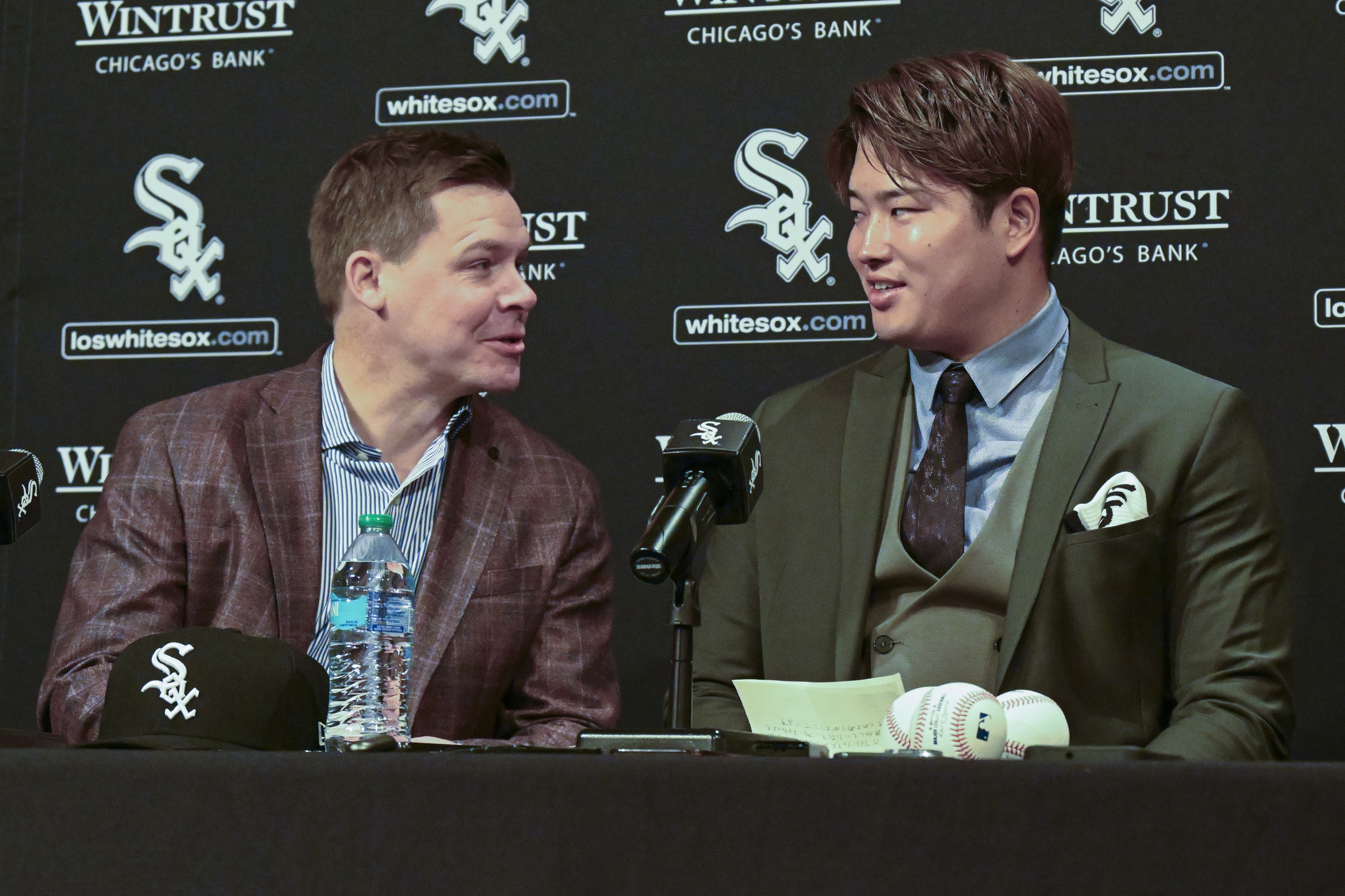
After getting caught flat-footed by the White Sox's signing of Munetaka Murakami, I feel obligated to post at least a passing reference to the rumor on Yahoo! Japan connecting the White Sox to Japanese righty Tatsuya Imai, whose deadline to sign with an MLB team is 4 p.m. CT on Friday.
Per Google Translate (emphasis mine):
Powerhouses like the Yankees and Phillies are considered leading contenders, but the White Sox , seeking to rebuild their team, have suddenly emerged as the obvious choice. Following the acquisition of infielder Munetaka Murakami (25), a major comeback from a "longshot" is becoming a reality. [...]
According to US baseball insiders, while other major teams are hesitant, the White Sox are taking a proactive stance. With no players who have reached the required number of innings pitched this season, the White Sox are strengthening their starting lineup, and they view Imai as an "ace." There are also reports that they are approaching Imai with a contract of around three years, rather than a long-term one of seven years.
MLB.com's Mark Feinsand says the White Sox are a longshot even while citing the report and James has heard similarly, and I think the last sentence in that block quote strikes me as a potentially factual item that can be interpreted the wrong way. There's no harm in the White Sox putting forth a make-good offer like the one Murakami accepted, but there's less reason to believe that Imai would have to settle for that short of a deal. FanGraphs' scouting report likened him to Zac Gallen or Michael King, and while King technically signed for three years and $75 million, King is three years older, and his deal includes opt-outs after every season.
That's before you get to the part about Scott Boras representing Imai, which makes it all the more difficult to picture one of his clients being funneled the White Sox's way. But if this winter wants to mock my skepticism for a second time in two weeks, by all means.
In news about other pitchers who aren't likely to suit up for the White Sox in 2026, we figured that Mark Buehrle's Hall of Fame case would get a boost from a net gain of open spots on big-Hall ballots and a higher concentration of comparable starting pitchers, and that's proving to be the case thus far.
The HOF tracker operated by Ryan Thibodaux and his crew reached 100 submissions on Tuesday, and Buehrle's name has been checked on roughly a quarter of the ballots. After setting a previous high with 11.4 percent in 2025, he's running at 24.6 percent through 102 ballots this year. He's gained six votes from returning voters, and is also propelled by a 7-for-15 showing on ballots from first-time voters.
This is undoubtedly good news for Buehrle's candidacy, although its impact is likely limited to the (very) long game. It's hard to imagine him coming close to gaining another 50 percent over the next five years, and while newer voters are more transparent and logically consistent about maintaining support for a candidate once it's given, he could once again be crowded out by the 10-player limit once first-ballot types return to the fray.
The other problem is that while voters are appreciating that starting pitchers are no longer approaching the traditional Hall of Fame benchmarks, they seem to be turning their attention to peak cases, rather than compilers.
| Player | 2025 | 2026* | IP | WAR | WAR7 | JAWS |
|---|---|---|---|---|---|---|
| Felix Hernández | 20.6 | 58.8 | 2729.2 | 49.8 | 38.5 | 44.1 |
| Andy Pettitte | 27.9 | 55.9 | 3316.0 | 60.2 | 34.1 | 47.2 |
| Cole Hamels | n/a | 31.4 | 2698.0 | 59.0 | 37.4 | 48.2 |
| Mark Buehrle | 11.4 | 24.5 | 3283.1 | 59.0 | 35.8 | 47.4 |
It's strange to see Hernández leading the pack when his traditional case is the squishiest. Mike Petriello voiced the peak case by noting that WAR called him the best pitcher in baseball over a 10-year period:
For example: Last year, one of my editors asked me if I would write up the case for and against Hernández as he debuted on the ballot, and I figured he would be an easy “nah,” having basically been toast by 30. I wrote the story anyway and was stunned to find that it turned my opinion around completely. That’s based on the fact that from 2005-’14, Hernández was the best pitcher in baseball, and going back to 1950, 16 of the previous 18 best-for-a-decade guys are in, will be in, or missed only due to off-field problems. I also learned that through age 29, he was basically identical to CC Sabathia, who sailed in on the first ballot, and Sabathia was only fine after that, basically average. Should we be keeping Hernández out because he didn’t throw more average, forgettable innings?
To that last question, my answer is "maybe?" because average, forgettable innings and seasons have value. Tim Raines was a great player during his Montreal heyday, but he probably doesn't get into the Hall without his sustained contributions as a role player in the 1990s. Peak-centric voters might argue that Raines' lesser work should have been largely immaterial to the conversation, but to me, successfully negotiating a decline phase can be taken as another sign of greatness.
At any rate, while the spread strikes me as weird, there probably isn't a point in arguing strenuously against Hernández's case, if only because when it comes to starting pitchers who are subject to debates about shifting contexts, a rising tide is likely to lift all boats. Buehrle's just happened to be anchored to a lower previous high-water mark.