Sean Burke has always been a terrific interview for James, and he delivered quite the platform statement before today's Game 2, in which he's expected to do most of the pitching for the White Sox.
“This is my life,” Burke told the Sun-Times. “I don’t have family, no girl, no kids. This is all I do.”
It's a great pregame quote because it can only be mildly weaponized against him. Should he stumble, perhaps people will comment on ways he could better spend his time, but nobody can accuse him of being distracted. On the other hand, should he outduel Hunter Brown and put the Sox on track for a Wild Card Series sweep, fans are going to fall in line behind him, if they haven't already.
But before we're thrown into another game with stakes we're not accustomed to, let's look back on some things that stood out in the White Sox's 6-3 victory over the Astros in Game 1 Tuesday evening.
Not a typical postseason atmosphere
Now here's a quote that can be easily turned against its source:
“The fans here are definitely spoiled with a lot of ALCS and World Series runs, and we have to earn that right to bring this team back to that position,” reliever Bennett Sousa said. “That being said, when this team was in their first (playoff) series 10 years ago, Minute Maid Park was probably packed. It makes a big difference. If we were in Chicago, it’d probably be loud as s—.”
Now Sousa isn't wrong. When I saw empty seats in the initial wide angles of Daikin Park, I figured there must be a bunch of late arrivals who were trying to navigate Houston traffic around 4 p.m. on a weekday.
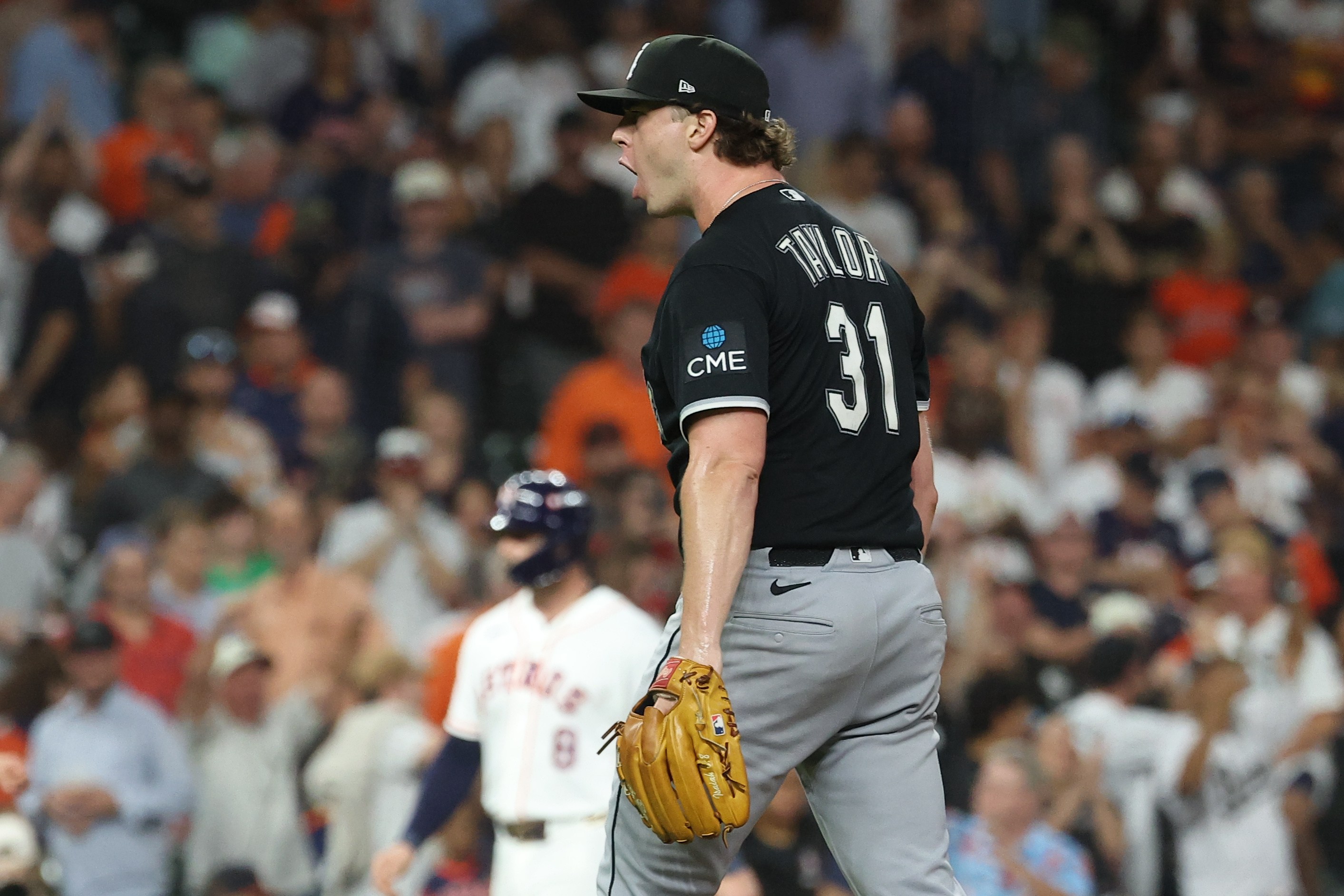
But a typical postseason crowd never materialized, falling nearly 7,000 fans short of capacity, and thanks to the White Sox controlling the game from the first inning onward, it only made something resembling postseason noise in their only sustained threat of the game against Grant Taylor in the eighth inning.
They were outnumbered by boos during a couple of longer-running disappointing innings from a Houston bullpen game. That's why players are irritated, but I'm just not sure what the payoff is for Sousa saying that, unless he really wants to go back to the team that originally drafted him.
Speaking of Taylor...
Bullpen flexibility pays off
Before the White Sox and Astros took the field, the Phillies blew a 3-2 lead in Game 1 of their Wild Card Series against the Atlanta Braves when Jhoan Duran gave up a homer to Austin Riley in the eighth inning, which was his second inning of work. Philadelphia lost with its best reliever on the mound, but Don Mattingly still inspired second-guessing because he brought his closer in the seventh inning, and might've asked him to go three.
Duran had never pitched in the seventh inning in 2026. In fact, only three of his 61 appearances started before the ninth, and in only one of those appearances did he pitch beyond one inning.
There have been enough instances of teams keeping their closers holstered while lesser pitchers lose leads that most writers understand that it's better to use the highest-leverage arms too soon than too late, but when a closer has no practice being extended, it lends an air of desperation to the proceedings.
Duran would have been super-extended even if managed to retire Riley, and the lack of precedent is what is driving most of the backlash. Here's Philadelphia Inquirer columnist Marcus Hayes, for example:
Mattingly asked Duran to get him six outs, which requires Duran to pitch, sit, and pitch — an up-down. Duran has done that once this year, on Aug. 29, against the Angels, the second-worst team in baseball. He did it on two days’ rest; he’d had just one day off before Tuesday. That also was 10 appearances ago.
Duran dominated the seventh.
He fell apart in the eighth.
Predictably.
You can say what you want about Will Venable's usage of Grant Taylor this season, but one thing it did was leave him prepared for the sort of demands Venable placed upon him in Game 1. Sure, Taylor hadn't thrown 54 pitches since his limited days in the Birmingham Barons rotation early last year, but he was otherwise prepared for the other elements.
Throwing two innings? Taylor had done that 17 times in 2026, including three games that involved seven-plus outs.
Entering in the seventh? Pfffffffft, Taylor had 12 of his appearances start in the sixth inning.
By using Taylor in a relief ace/fireman role versus a traditional closer, there isn't one case where you might see him enter a game and think that Venable is getting desperate. It might look desperate at the end of outings, but by that point, you're already on the roller coaster, and there's no getting out until it comes to a stop, whether that's on or off the rails.
Taylor contained the signs of wearing down to his fastball, which missed both velocity and location. The thing is, that might've actually worked in his favor. Kyle Teel said his fastball ended up being "more of a chase pitch," which led to Taylor throwing breaking balls when behind in the count to great success.
It worked against Teel's natural inclination, which reared its head in the White Sox's other problem inning.
More predictability problems with Sean Newcomb
You may remember from 10 days ago our discussion about Sean Newcomb's emerging dissatisfaction with Teel's pitch-calling. It stemmed from a quote about pitch calling after Detroit's Hao-Yu Lee hit a game-tying homer on the fifth high fastball over six pitches. When James followed up, Newcomb pointed the finger at himself.
Newcomb has struggled to land his slurve to get ahead in counts too, but feels this stretch resembles an earlier point of the season when he was getting beat on too many fastballs.
“The frustrating part is me not realizing it right away,” Newcomb said. “Pushing through it instead of taking a step back, looking at the big picture.”
Well, it happened again. The Astros were only able to get back in the game when Nelson Velázquez launched a two-run tank over the Crawford Boxes in the fifth inning on a third consecutive fastball, and a second consecutive high one.
Newcomb has allowed a .347/.458/.531 line over 59 batters faced with Teel behind the plate, as opposed to a .121/.243/.185 line with 144 batters' worth of Drew Romo. Alas, relievers aren't really in a position to opt for personal catchers to test this theory further.
An ideal game for Sam Antonacci
Not to be confused with perfect, as he did stumble out of the dugout during pregame introductions and make two outs at the plate. Otherwise, it had everything you want to see from his postseason debut.
He reached base three times, and in different ways. First, he led off with a walk, got hit by a throw while running to second and ultimately scored. Then he delivered a two-run single off a lefty, and an HBP made three.
But even one of his outs had the essence of Antagonacci, as what appeared to be a routine 4-3 was followed by Will Venable challenging Jose Altuve's positioning. The challenge was unsuccessful, but it seemed like the sort of edge Antonacci might seek were he the manager. He claimed to be unaware.
Even better, he only had one chance in the field, and a routine one at that in Isaac Paredes' fourth-inning flyout. Everything else was in the direction of Tristan Peters or Braden Montgomery, so Antonacci did not have to navigate the Crawford Boxes or the nooks and crannies of the left-center fence before being lifted for Brenton Doyle. You couldn't ask for anything more. Well, you could, but it'd be getting greedy.
Miguel Vargas' next conquest: Throwing
Speaking of getting greedy, it feels similar to wonder about further improvement from Miguel Vargas after all of his mind-expanding success this season, but his eighth-inning error on Altuve's two-out chopper made me look up how many of his errors involved throwing.
Including his mistake in Game 1, 13 of his 15 errors have been throwing errors. If that sounds like a lot, it is. He tied Junior Caminero for the most throwing errors in baseball during the regular season, but Caminero also tied for the league lead in overall errors with 20, so it was part of an overall limited defensive skill set that the Rays accepted in a trade-off for league-leading power.
Statcast isn't impressed with Vargas' range, but it seems like he gloves just about everything he's in position to stop. The question is whether throwing can be an addressable shortcoming since he's theoretically already done the hard part on a play.
A way to consider Colson Montgomery
Colson Montgomery arguably contributed the biggest swing of the game with his fourth-inning solo shot off Miguel Ullola.
For one, it technically stood as the game-winner, putting the Sox ahead 4-0 in a game they won 6-3.
But it also loomed large in a couple other ways. It reopened the scoring spigot after the Sox went 0-for-3 with the bases loaded in nobody out in the second, which felt like a huge missed opportunity. On a personal level, it snapped Montgomery's regular-season-ending 0-for-24 skid, during which he didn't even reach base once.
Now that Montgomery is batting ninth and making it no different than a Luisangel Acuña start in terms of expectations, it makes accounting for his contributions a whole lot easier. He grounded into a double play and struck out in his last two plate appearances, sure, but between the HBP in his first plate appearance, the homer in his second trip and mistake-free defense at short, when the score was settled, Montgomery provided more than he took away, and that's a huge win for a guy who needed one.