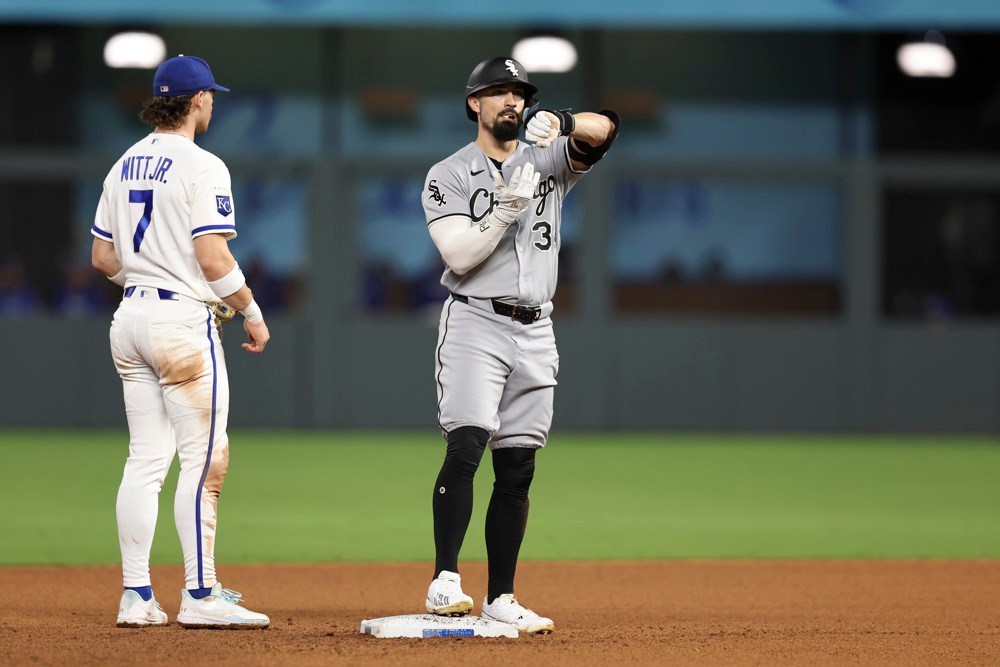
Not to say that Randal Grichuk has conditioned White Sox fans to expect great things when he's at the plate, but his 4-for-5 night against the Royals on Tuesday was somehow slightly diminished by knowing how close he came to hitting for the cycle.
He just needed his slicing drive in the seventh inning to elude Kyle Isbel's diving attempt in center field, but Isbel was able to knock it down and limit Grichuk to his second double of the night.
"I was just hoping it got down and saw him leaving his feet; figured he was either going to catch it or could've booted it a little bit," Grichuk told repoters after the game. "Unfortunately he trapped it, so I'll take a double."
After yet another monstrous night against a southpaw starter, Grichuk is hitting .306/.333/.608 over 97 games and 234 plate appearances, nearly two-thirds of which have come against lefties. The non-rate stats extrapolate to 45 doubles, 30 homers, 88 RBIs and 3.6 WAR over 502 plate appearances, the minimum needed to qualify for the batting title, but the world doesn't have nearly enough left-handed throwers to support that sort of usage.
Grichuk's overall stats have been able to stay that pristine because the White Sox are doing that thing that good teams do, where they largely put him in positions to succeed:
- vs. LHP: .331/.372/.650 over 172 PA
- vs. RHP: .226/.221/.441 over 95 PA
I'd been rolling around Grichuk's season in my head the last couple days before Greg posted a question in the recap discussion that helped me clarify it:
When was the last time the Sox had a bench/platoon OF as good as Grichuk has been? Lyle Mouton?
The headline gives it away, but to answer the question with a #HawkSuperlative, Grichuk could very well be the best strictly platoon-limited player the White Sox have ever deployed.
The 1990s White Sox outfielder who came to mind for me was Warren Newson, who thrice posted OBPs over .400 while only facing right-handed pitching. His rookie season was his fullest body of work in this role, as he hit .295/.419/.424 over 160 PA, with only eight of those plate appearances coming against lefties. But that was only good for a 137 OPS+, or an OPS 37 percent better than the league average. Grichuk is running a 155 OPS+, and over 70 more plate appearances and counting.
If you use Baseball-Reference.com's Stathead tool to look up White Sox players who have posted a 155 OPS+ over 234 plate appearances, it only turns up starters. Most played full seasons, others were shortened by injuries, but none were part-time players when healthy.
You have to dial back the plate appearances quite a bit to get production in Grichuk's neighborhood. Ron Hassey hit .353/.437/.500 (151 OPS+) over 174 plate appearances while backing up Carlton Fisk for the 1986 White Sox, with most of those starts coming against right-handed pitchers. To find somebody who actually outhit Grichuk, you have to go back to 1974, when Buddy Bradford hit .333/.414/.510 (162 OPS+), with all the damage coming against lefties. But that came over just 112 plate appearances, which isn't even halfway toward Grichuk's playing time.
If you make the OPS+ bar a little more forgiving, you get a couple more challengers. The nearest modern-day role player is Alejandro De Aza, who hit .329/.400/.520 (145 OPS+) over 171 plate appearances in 2011, with 150 coming against right-handed pitching. He comes up short on playing time, but you can blame the thoroughly unprofessional cold war between Ozzie Guillen and Kenny Williams for that, as De Aza could've taken the playing time of either Juan Pierre or Adam Dunn long before late July. Even with the delayed start, he outproduced Grichuk in terms of WAR (2.5) because he logged considerable playing time in center field.
But to find the closest comp to Grichuk in terms of playing time, production and defined reserve role, you have to go all the way back to 1958, when a 34-year-old Earl Torgeson hit .266/.415/.468 (145 OPS+) over 236 plate appearances and led those White Sox in slugging as the left-handed component of a first base platoon. Perhaps he could've done more if the designated hitter existed, which is among the reasons why direct comparisons are tricky to make that far back.
Either way, that's about it, and while Grichuk has set himself apart from the rest with his unlikely and immense production, it also reflects depth and discipline on the part of the White Sox. In previous years and administrations, any player who had the chance of providing concentrated bursts of production off the bench was automatically stretched beyond his utility in a starting role, and maybe not even in his natural position. This time around, Will Venable has been able to stick with Grichuk as a complement to Andrew Benintendi at DH and Sam Antonacci in left field. He showed up in May as a godsend on a $1.25 million contract after the Yankees let him go, and credit the White Sox for resisting any temptation to look a Grich horse in the mouth.
Grichuk could've grabbed more playing time, probably from Braden Montgomery, and his right-on-right game-winning homer off St. Louis' Riley O'Brien provided a proof of concept. But when looking at his career, it seems like his seasons see-saw between fans seeing too little of him, and seeing too much. He's played for six organizations over the last four years and hasn't delivered an outstanding experience twice in a row:
- 2023, COL: 122 OPS+
- 2023, LAA: 81 OPS+
- 2024, AZ: 139 OPS+
- 2025, AZ: 100 OPS+
- 2025, KC: 58 OPS+
- 2026, NYY: 48 OPS+
- 2026, SOX: 158 OPS+
My sense is that if it seems like Grichuk could be playing more, then he's playing just the right amount, at least in the regular season. Perhaps the calculus will shift in the postseason if the value of having the nine best hitters in the lineup outweighs the potential for a leverage situation that never arises, but that's a dilemma for October Venable to address. That "October Venable" is such a thing in 2026 is remarkable, and when considering all the things that have gone into making it possible, Grichuk's out-of-nowhere, strategically allocated excellence is toward the front of the line.