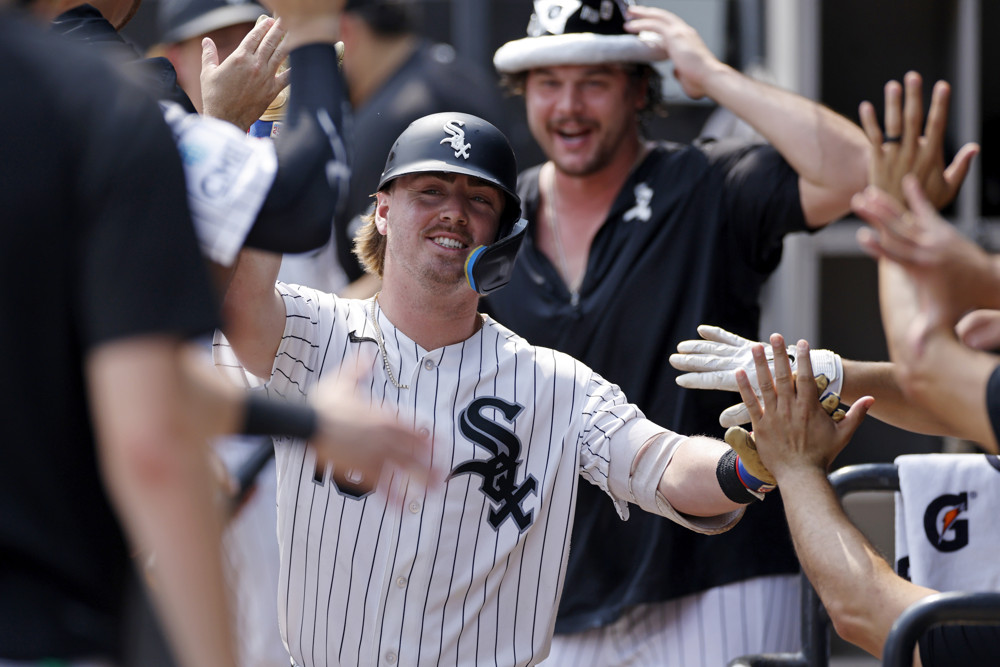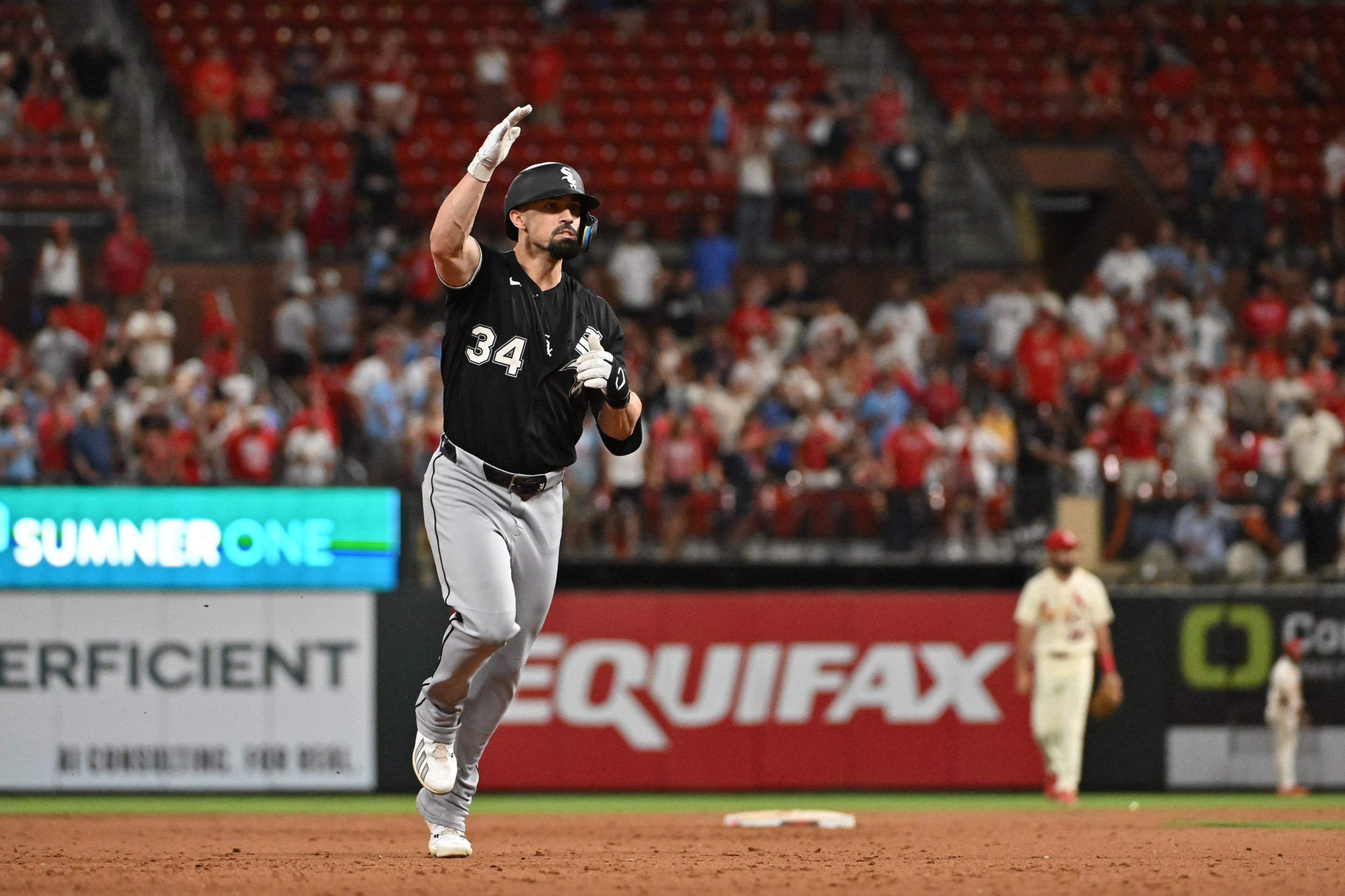
There's a chance that Randal Grichuk delivered his Joe Crede Moment for the White Sox in St. Louis on Saturday with his ninth-inning, two-out, two-strike go-ahead homer that provided a sorely needed bit of breathing room as they attempt to hold off the Cleveland Guardians in September.
There's also a chance that Grichuk delivered his Alex Rios Moment, in which he helped put the Sox ahead and provide a sorely needed bit of breathing room in September, except even that ends up not being nearly enough, and the play is largely forgotten about.
Let's go back to Sept. 17, 2012, when the White Sox were leading the Detroit Tigers by two games and had runners on second and third with nobody out in the fifth inning they trailed 4-3. Rios came to the plate and ... walked to load the bases. But that's not where Rios made the difference.
A.J. Pierzynski followed and lined to right, with a charging Brennan Boesch able to freeze Adam Dunn at third. Then Dayan Viciedo came up and hit a bouncer to short, threatening to scuttle the rally and keep the game tied. Jhonny Peralta made a clean feed to Omar Infante, but Infante appeared to assume he had more time to make the turn, and didn't anticipate Rios sliding in hard to his planted left leg in front of the bag. Rios upended Infante, who bounced the throw past Prince Fielder. Dunn and Paul Konerko both scored, the White Sox took a 5-4 lead, and that's where the score stayed the rest of the game.
Afterwards, some doofus tried to play Nostradamus, saying Rios' takeout slide "may go down as the most important play of the season." In my his defense, that could have held up, you know, had the White Sox lost 10 of their next 13 games to go from three up to three back before the final weekend of the season. In the end, Rios' slide delayed Detroit's surge, but it didn't deny it, and now it's a play only the true sickos remember.
That's the kind of accumulated scar tissue from 20 years of writing that limits my range of emotion and keeps me from stamping the significance of Grichuk's homer before the dust settles. For the time being, Grichuk's homer is a life preserver. The situation is far from resolved, but everybody can ease up on the thrashing for a bit.
Win Probability Added can't quite capture the enormity of Grichuk's homer because it wasn't a walk-off. Game-ending homers always have the advantage when it comes to WPA because by definition, there is no probability the other team can win afterward.
Looking at the Baseball-Reference.com box score, the White Sox had only an 11 percent chance of beating the Cardinals when Grichuk stepped to the plate with a runner on second and two outs of a game they trailed 5-4. Afterwards, they had an 82 percent chance of winning, so it was a boost of 71 percent.
Per WPA, that registers as merely the fourth biggest hit of the year behind three walk-offs:
- Miguel Vargas vs. Detroit on May 29, 0.858 WPA
- Braden Montgomery vs. Atlanta on June 9, 0.837 WPA
- Sam Antonacci vs. Cleveland on June 22, 0.756 WPA
- Randal Grichuk vs. St. Louis on Sept. 12, 0.709 WPA
But B-Ref does have such a thing as Championship WPA, which is the sort of leaderboard I've never had to explore. The feature is six years old, but this site concerns the White Sox, after all.
Anyway, cWPA does elevate the Grichuk homer to a place that feels right among 2026 hits:
- Grichuk vs. St. Louis, 1.57% cWPA
- Antonacci vs. Cleveland, 1.01% cWPA
- Montgomery vs. Atlanta, 0.73% cWPA
It also ranks up there when searching the White Sox's biggest cWPA plays this century, although this leaderboard reflects a flaw in the metric:
- Jim Thome vs. Minnesota, Sept. 30, 2008, 2.38% cWPA
- Ross Gload vs. Cleveland, Sept. 30, 2005, 1.85% cWPA
- Tadahito Iguchi vs. Cleveland, Oct. 1, 2005, 1.68% cWPA
- Grichuk vs. St. Louis, 1.57% cWPA
There are few hits that can knock the only run scored in a Game 163 off the top spot, so Thome should be fine there for a long, long time. But the Gload and Iguchi hits, while go-ahead hits against their direct divisional rival, came after the White Sox clinched, so they had no bearing on the postseason, even when it came to seeding.
That Crede walk-off homer against David Riske back on Sept. 20, 2005 carried a 0.48% cWPA, good for 66th this century, while Viciedo's 6-4-that-wasn't-a-6-4-3 charts 100 spots lower at 0.35, but neither number captures the size of the sigh of relief both plays generated. When it comes to estimating the biggest moments of a pennant chase, it's more art than science, especially when there are still 14 games on the schedule that will have a bigger say in how this moment is framed than anything else. We'll see if the 2026 White Sox end up making this an exercise worth revisiting.