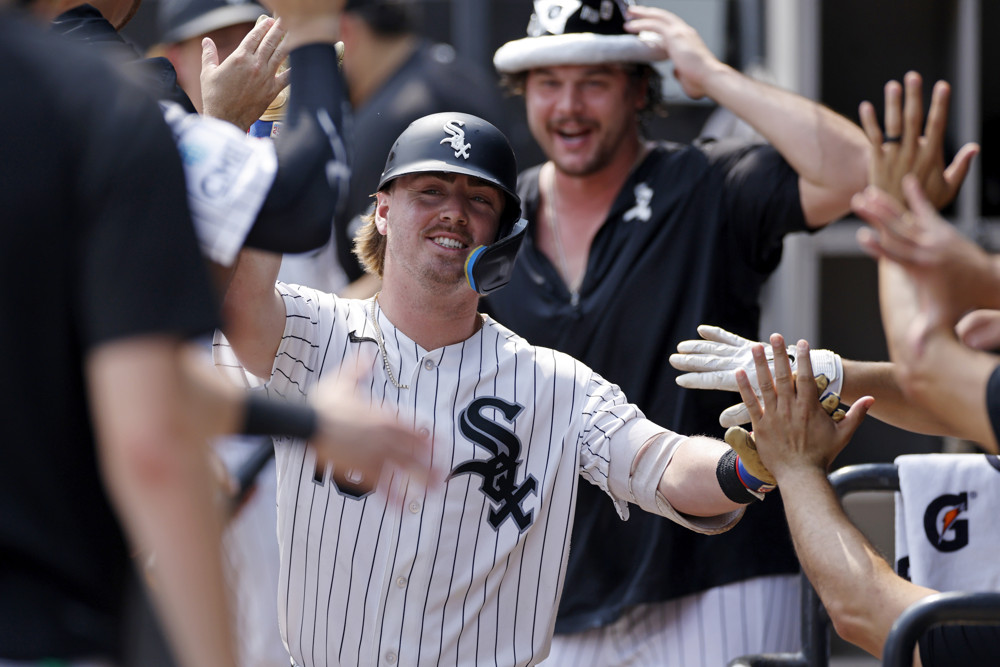
Approximately 49 babies were born in the United States during Tristan Peters' 18-pitch walk that truly set the White Sox's six-run sixth inning in motion en route to a crucial 7-3 victory over the Cleveland Guardians Monday night.
That's not the standard unit of measurement for determining the length of a sequence in a Major League Baseball game, but nothing about Peters' walk was standard -- the amount of pitches it consumed, the blooper that followed, nor the impact all of it had.
When Peters came to the plate, Cleveland starter Gavin Williams was at 95 pitches, but figured to have one more inning left in the tank in a scoreless game. Peters instead depleted the rest of his resources, and after he took his base, he took a throw off the helmet to break up what could have been a devastating double play, instead setting off the White Sox's most cathartic inning of the season.
Tristan Peters called getting conked in the head with a throw “one of the greatest feelings ever”
— James Fegan (@jrfegan.bsky.social) 2026-09-15T02:32:56.102Z
"It felt like I was up there for an hour," Peters told reporters after the game. "I was just exhausted. Honestly, after eight pitches, I'm like, 'OK, this is getting pretty long.'"
Peters saw 10 more pitches after that, which leads me to the first question I asked myself.
How much longer would Tristan Peters have been at the plate without a pitch clock?
Answer: At least a minute, but probably four more.
Peters was in the batter's box for seven minutes, give or take a few seconds. That averages out to one pitch every 23.3 seconds, which is four seconds slower than the average pace (19.2 seconds) due to the resetting required after each of the 12 foul balls.
In 2022, the last year before the pitch clock, the average pace between pitches was 23.1 seconds. Tack on four seconds to that average, and Peters' plate appearance would have taken 68 seconds longer.
However, merely adding a static number to the average undersells the variance in paces that no longer exists. Pedro Báez was considered the slowest worker in baseball at the time, averaging upwards of 30 seconds per pitch. He eventually whittled it down to 27 seconds towards the end of his career, but if you add four seconds to it, then you're talking a single plate appearance lasting nine or 10 minutes. And if he slowed down with every successive foul ball, the game might've broken local curfew statutes.
Accounts of Brandon Belt's record-setting 21-pitch plate appearance back in 2018 have it lasting 13 minutes. If you prorate that pace over 18 pitches, you get 11 minutes and 8 seconds, and that sounds about right.
Speaking of which...
How many plate appearances have run longer than Tristan Peters' 18-pitch walk?
Answer: At least four.
Pitch-by-pitch data has only been available since 1988, so per MLB.com, Belt's 21-pitch plate appearance against the Angels back in 2018 is the official record, followed by Ricky Gutierrez (20 pitches in 1998), Matt Wieters (19 pitches in 2020) and Kevin Bass (19 pitches in 1988).
Peters did set the record for longest official White Sox plate appearance, beating Frank Thomas' mark of 17 against Kansas City's Darrell May back on April 7, 2004. Like Peters, Thomas took a walk to bring it to a close. Unlike Peters, Thomas didn't command headlines for his walk. It was with two outs in the first inning, and Carlos Lee lined out to end the mild threat.
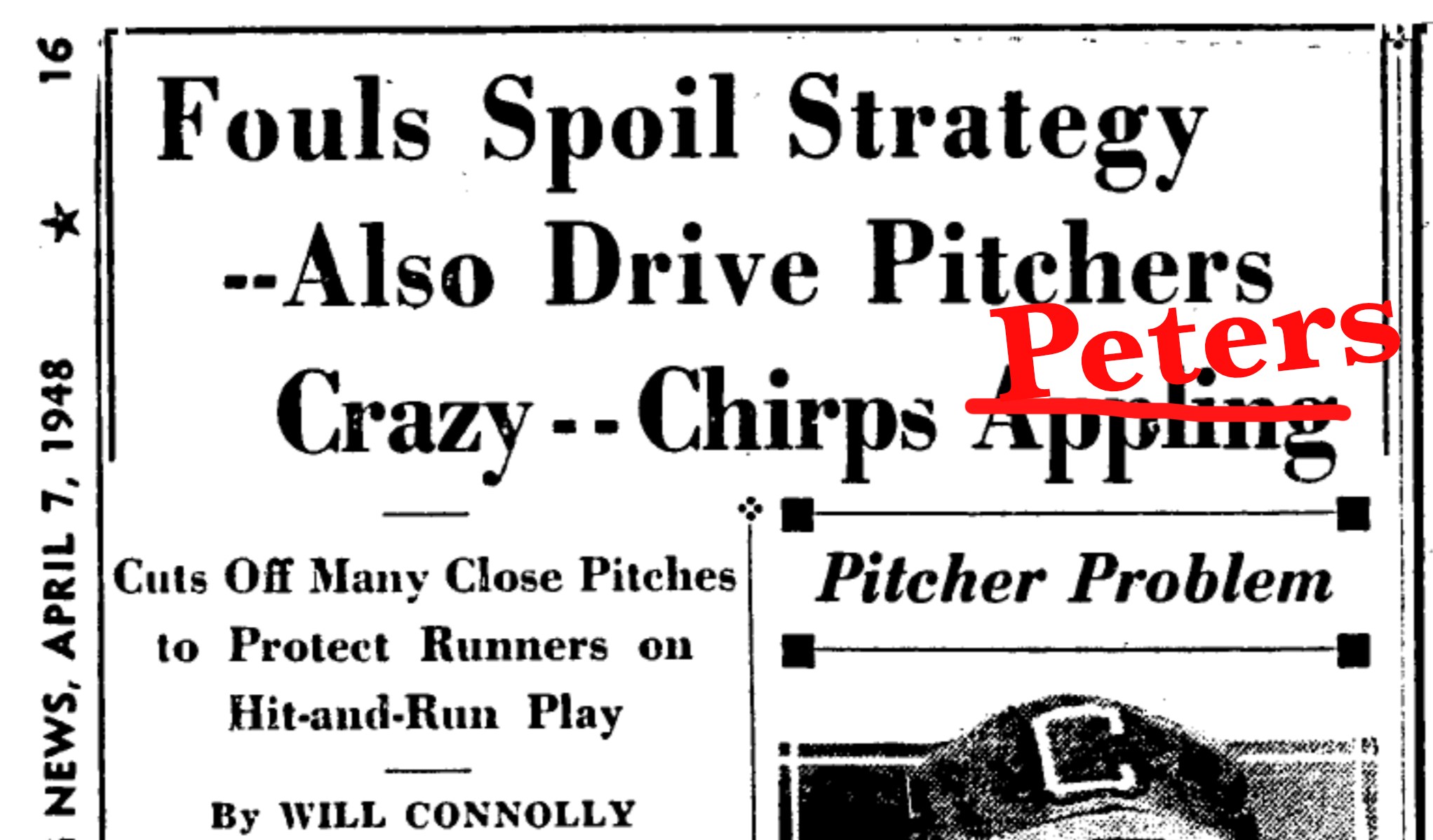
As for unofficial records, it feels like it's worth mentioning Luke Appling, who was said to have been the King of Foul Balls. The stories of him annoying pitchers are legion, and legend has him hitting upwards of 24 foul balls in a single plate appearance. Joe Posnanski looked into it and couldn't get that far -- he could maybe track 10 or 12 foul balls before myth-making took over, and Appling said in a 1948 The Sporting News article that his highest count was 14 consecutive fouls. The stories were likely exaggerated because foul balls were relatively costly to owners at the time and it made for good copy, whereas players voluntarily take balls out of play in 2026. But the larger point is that Appling fouled off pitches for fun and profit, and would have been proud of the display Peters put forth.
When did uniformed personnel start acknowledging the ridiculousness of it all?
Answer: Pitch 14.
Obviously we are limited to seeing what the broadcasts show us, but watching both the Chicago and Cleveland feeds, we see the first cracking of smiles on the Guardians broadcast when Peters fouls back the 14th pitch, a belt-high fastball. Stephen Vogt, who you may remember for his cameo as "normal control manager" in Pedro Grifol's controversial avant-garde performance Reacting to the Eclipse, is the first to break.
A pitch later, the CHSN broadcast starts tracking the movements of an increasingly delirious White Sox dugout, but it isn't until the penultimate pitch that the direct participants succumb to the absurdity. After Peters fouls off an inside fastball on Pitch No. 17, catcher Patrick Bailey lifts his mask and reveals a big ol' grin.
Perhaps he or home plate umpire Nic Lentz said something at that point, because that's the first time Peters breaks, too.
But at no point does Williams find this funny. He does mutter to himself, and on multiple occasions.
"Hitting fouls defeats the strategy of the team on the field and can drive a pitcher crazy," Appling said in that Sporting News article. "I'll admit fouls don't attract people into the park, yet in the book a foul is just as much a part of the game as a fair line drive, and is recognized as a wearing part of baseball."
Peters seemed to channel this energy as the plate appearance wore on.
"I saw he got close to 110 pitches, and I was like, "Maybe I'll try to get him to 110,'" he said as he described his mindset over the course of the battle.
Williams finished with 113.
How many pitchers threw fewer pitches in their White Sox career than Tristan Peters saw during his 18-pitch walk?
Answer: Officially, three.
Unofficially, there are probably a dozen pitchers who threw fewer than 18 pitches during their White Sox careers based on the number of batters they faced. In terms of the last 28 years during which pitches were officially counted, you get three pitchers, two of whom bring other things to mind.
One is Jeff Marquez, whom the White Sox received from the Yankees as the centerpiece in the second regrettable Nick Swisher trade. He allowed two runs in his only inning of work for the White Sox back in 2010, throwing just 16 pitches.
The other one that will generate a reaction is José Paniagua, who threw just 12 pitches in his only appearance for the White Sox on Sept. 9, 2003, flipped off the home plate umpire after giving up four runs over one-third of an inning, and was released afterward.
Vic Darensbourg rounds out the set, but he has no such baggage. In fact, he threw his 18 pitches over two scoreless outings back in June of 2004, both of which brought to a close the White Sox's pitching obligations in nondescript losses.
How did this ever become acceptable for a baseball broadcast?
Answer: Another victory for enshittification.
The other thing that struck me in closely rewatching Peters' 18-pitch walk is how much time the CHSN broadcast spent rendering Peters like an A-ha video due to the digital ad display behind home plate. When Peters isn't emanating a white glow from his gray White Sox road jersey, part of his helmet disappears into the black background. When Peters isn't losing a chunk of his head to the ether, his bat is turning into a blue pool noodle on the follow-through.
You'd think that in the era of 100-inch 8K TVs, leagues and networks would have baseline standards for making sure the center of the action on the most common broadcast angle doesn't look like utter crap, but that probably costs far more money than it makes.
Peters' plate appearance is already historic, and it could have its own legacy depending on how the remaining 14 games play out, but those who go back and watch it will be subjected to just the jankiest of productions. I always wish the White Sox won the World Series a few years later so the highlights wouldn't be in standard definition, but maybe it's a blessing. The picture might be softer and fuzzier, but at least no part of players' bodies flicker in and out of enormous ads for league partners.