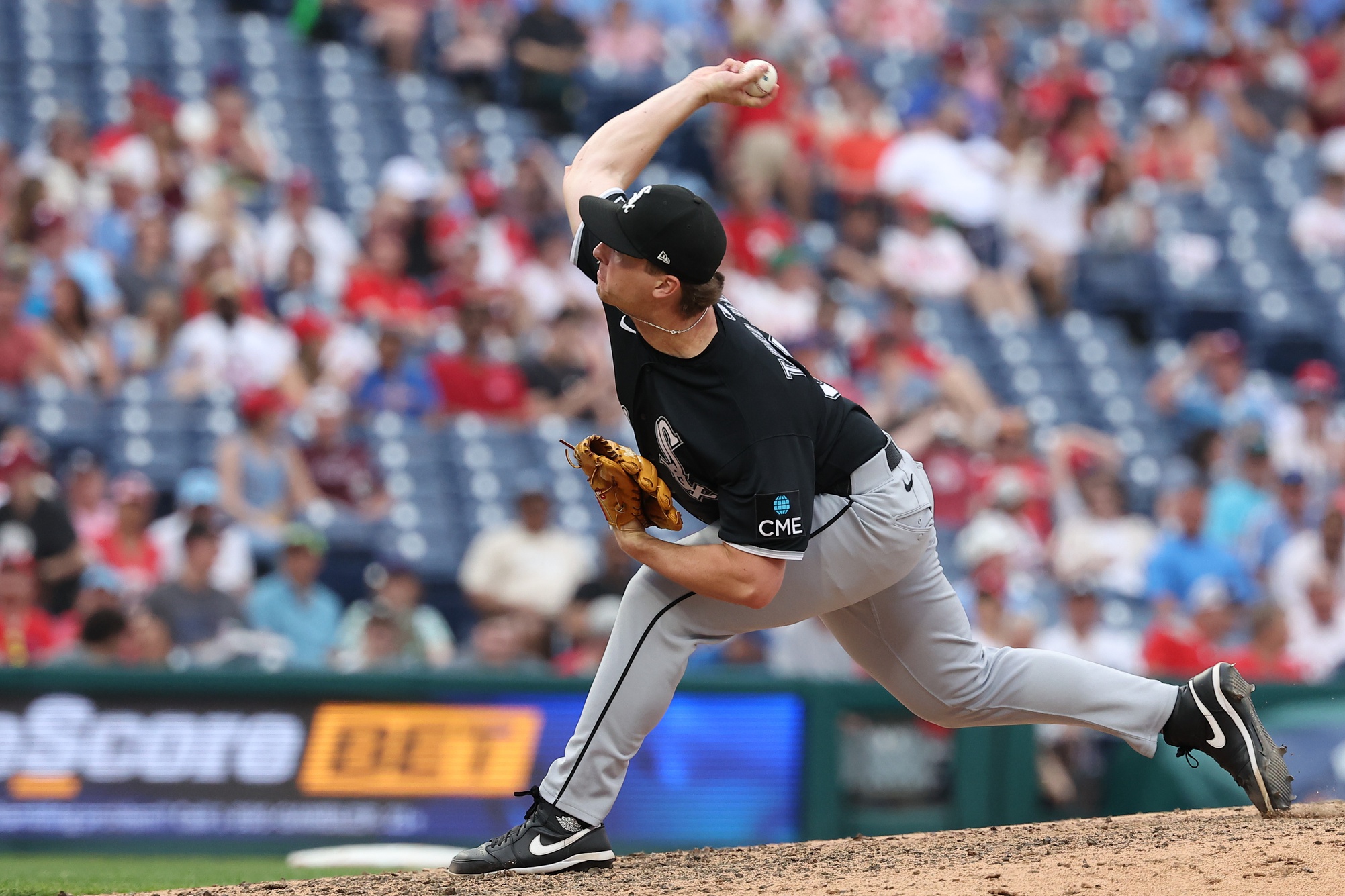
Based on run values per 100 pitches, or wOBA, Grant Taylor has either the third or fourth-most valuable curveball in the sport, at least among pitchers who have thrown over 200 of them.
"It’s a unicorn pitch," said pitching coach Zach Bove. "I would layer on the ability to throw it in the zone, too. He can dump that thing in and get it below for the strike. Guys have to honor that, plus 98-99 mph. You have to pick one and obviously a lot of guys are in between on him."
As a little leaguer, Taylor said he threw an old school palmball, and didn't throw with an actual curveball grip until he was 14 years old. That became his primary breaking pitch all throughout high school; a mid-70s bender with traditional 12-6 movement out of his high, over the top arm slot. Upon arrival at LSU, Taylor began to work on making the pitch harder, and trying to crack 80 mph with it.
Unfortunately, and/or ironically, Tommy John surgery gave Taylor's curve the biggest velocity boost. When he returned to throwing in 2024, his curve was in the 82-85 mph velocity band it sits in now, but with less movement.
"It was a lot smaller, it was -10 vert [inches of induced vertical break, IVB], versus now it's like -16, -17," Taylor said. "[Matt] Zaleski, our pitching coordinator, was in a bullpen with me and said 'Hey, try and spike your grip, see what happens.' And instantly it was the same velo, but seven more inches of vert difference. So, we've done that one ever since."
The movement change was instantaneous, but it would be at least a month before Taylor could land his new pitch for a strike at all, and if you wondered why he walked nearly a batter per inning and ran a 9.39 ERA in the Arizona Fall League in 2024, now you know what he was working on.
At present, there are 13 regular curveball users in MLB (100 or more pitches) who induce more drop than Taylor's curveball, but none of them throw theirs as hard as his 83.8 mph average. With Taylor's four-seamer averaging nearly 17 inches of IVB, that's a nearly three-foot spread between the perceived action on his fastball and his curveball, which leads to some fun decisions about where to set his target.
"It kind of depends on the day," Taylor said. "In the bullpen, I'll try and
figure out where my sights need to be to be able to throw it for a strike that day. Sometimes it might be, the bottom of the catcher's mask, sometimes it might be two inches above the catcher's mask. It changes every day."
⚙️⚙️⚙️
Will Venable said that Noah Schultz is being sent down to Triple-A to "work on the stuff," as a combination of a below-average strikeout rate (20.3 percent) and below-average groundball rate (34.6) won't suffice. Venable suggested there were mechanical elements behind Schultz's struggles, and as he is wont to do, centered the issues on a fastball that didn't dictate at-bats. Ultimately the White Sox feel he needs two viable versions.
"The [arm] slot got a little lower, a little scoopier, which then affects the four-seam [fastball]," said Bove. "Doesn’t have much ride. Getting the slot a little bit more upright, a little bit taller in the setup affects, adds [IVB] to the four-seam. It helps the whole arsenal play out in the east-west range."
Especially in the wake of his successful outing in Tampa, Schultz has asserted that he's an east-west pitcher and feels he's most effective when he's hammering right-handers inside with a sinker-cutter combo to open up the outer half of the plate for secondaries. Bove's answers notably affirm that structure, while still reiterating that the occasional four-seamers and vertically oriented breaking balls are necessary complements.
"Just allows him to get above and below the barrel," Bove said. "Obviously everything is [east-west] and we are definitely going to play into that. But having something that goes above the barrel with the four seam and below the barrel with the slider/curveball adds another element to the mix."
⚙️⚙️⚙️
Forced into action by a long rain delay, Hagen Smith's stuff played as advertised in his major league debut on Sunday, as he blew away Brayan Rocchio with a 96 mph high fastball en route to striking out the side in his first inning of work.
"The fastball is legit and the reason he's been kind of hyped up," said bullpen mate Sean Newcomb. "You can see the stuff, so I'm excited to see him get out there again."
And as the Sox needed length to survive Davis Martin getting washed out of the game after an inning, Smith's control also played as advertised, since he needed to retire Rocchio again after walking the bases loaded in his second inning of work.
It's rare to hear a general manager get into the weeds of pitch usage for a rookie hurler during a group media availability. But to Chris Getz's point, Smith's cutter was his best performing offering on Sunday (36 percent called strikes of whiffs), and his outing probably wouldn't have been scoreless -- despite four walks -- without it.
"Throwing his cutter is going to be really important for him against right-handed hitters," Getz said. "He’s starting to utilize that in his favor."
Prior to his debut, Smith affirmed that he's still focusing on maintaining a higher arm slot than the one he had in spring, with the hope that it will drive more consistent velocity, movement and command. Seemingly no one could throw strikes on Sunday (there were 17 walks combined), but with Smith’s velocity dipping into the 92-93 mph range as his control wavered in his second inning, the flashes of brilliant stuff are still spliced with stretches of instability.
⚙️⚙️⚙️
The White Sox PitchCom system has a couple of buttons that are used to indicate location, often for specific situations. One of them that is "sniper," which calls for dotting a fastball low and away, typically as a finishing pitch ahead in the count, when the opposing hitter is wary of a breaking ball thrown for a chase. You've probably seen it deployed with Sean Burke.
Because Burke has so much natural riding action on his four-seamer, it's actually an extremely difficult location for him to execute, and a couple of sniper calls have resulted in typical-looking high fastballs. But his gusto for breaking out of the high fastballs/low breaking balls dichotomy and work every quadrant of the strike zone is part of his breakout as a multi-faceted pitcher who is running a 1.64 ERA over his last nine outings.
"Maybe historically he has known himself in the league as a north-south guy, four-seam up and curveball," Bove said. "That’s still part of his identity, but being able to add the cutter to the mix now, the sinker down and away to lefties, the slider has been really good to lefties and righties. Again, it goes along with giving the offense multiple problems to solve. Throw to different locations -- it’s tough to cover all those as a hitter."