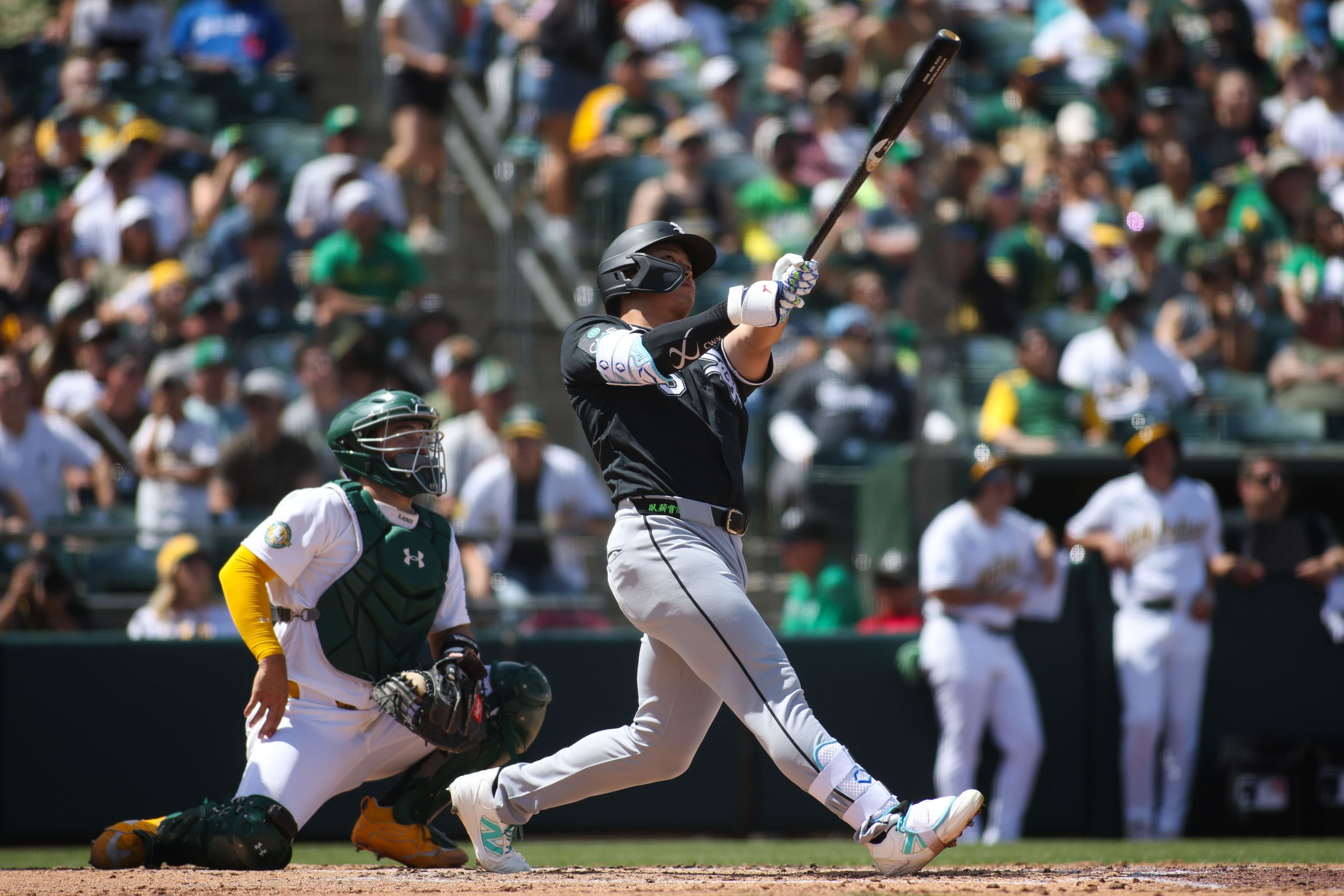
Seranthony Domínguez and Munetaka Murakami both spent large chunks of spring training preparing for and participating in the World Baseball Classic, and closers and first basemen tend not to have similar practice schedules. Maybe that's why, one month into the season, the novelty of Murakami's power remains fresh.
"Mune's hitting the ball really hard," Domínguez said. "It's surprised me, the power that he's got."
Closers often don't walk out to the bullpen until mid-game, but they don't hide under a rock until that moment. It quickly became clear that it wasn't necessarily the success of Murakami's 14 home runs through 37 games that was surprising, but a specific swing that was at the top of Domínguez mind.
"That was 415 feet and off the bat he looked like he was out of balance," Domínguez said. "You think, 'Man, he's got a lot of juice.'"
"Everybody in the dugout, all the starters were like, 'Miles [Mikolas] had to be like, 'Oh, I got him,'' and then it just kept going," said Davis Martin. "I just watched the replay of it and as soon as he hit I was like, 'Oh my god, he hit this out?'"
"I think he's had two of those where he's kind of beat, out front and he flips his hands at it and it's a homer," said Grant Taylor, who is correct.
"It's a weird kind of pitch, because you kind of won the timing, but he still got a good swing off," Taylor continued. "Not ideal to face, because he can just flick his hands and hit a homer off you."
Major league pitchers have to live with the concept that almost everyone they face has the power to take them deep, that almost all of them have made some sort of peace with their fallibility, and found the strength to keep going forward with their careers. That said, someone with true top-of-the-scale power like Murakami, and a 34.4 percent strikeout rate that suggests hunting for a whiff is possibly the most viable escape route, can be cause for briefly revisiting their calculus.
"There's always that little devil on your shoulder that's telling you, 'Don't throw here, don't throw there, don't miss your spot,'" said Bryan Hudson. "That's the name of the game, but there's a lot of really good hitters who get out a lot. So go to your strengths -- and sometimes in his case whenever he's swinging like that -- his weakness and just give it your best shot."
White Sox pitchers have t-shirts that read 'My strengths, their problem' that were passed out by Zach Bove, underscoring a team emphasis on gameplanning around their pitches and locations that play the best, rather than reacting to the opposition. So it's striking whenever there's a hitter who moves them off their basic tenets. It's not hard to get someone employed by the White Sox to say nice things about Murakami, but pitchers make an uncomfortable face whenever forced to accede to any approach outside the realm of "pound the strike zone."
"The first day we were in Milwaukee, I watched his BP for kind of the first time because I was shagging and he was hitting balls off the middle of the scoreboard in BP and I was like, 'Holy shit,'" said Sean Burke, who begin thinking through the problem of facing Murakami.
"When I think about it, I'd try to get ahead obviously. First pitch, I just try to box it, whatever pitch I'm throwing to him. Then from there, it's treating every pitch like it's 1-2. You're trying to be around the zone, but get your pitch on the black or a ball above the black and attack him like that.
"If you give those guys pitches on the fat part of the plate over and over again, those are the ones that get clipped. Mune can probably hit it, like, 70 percent and hit a homer."
"You just circle that kind of guy and say, 'This guy is not going to beat us today,' and I'm fine with either punching him out or walking him," said Davis Martin. "You got at him when there's two outs and no one's on base, because a solo is fine. If it's second and third, maybe two outs, let's not give him anything too juicy to hit."
There are counterexamples to the three true outcomes experience with Murakami...
"Just glad I didn’t have to face him any more times, since I faced him about 50 times in Japan," said Anthony Kay. "No [home runs], he hit like .400 though."
...but on the heels of Murakami drawing the golden sombrero Wednesday in Anaheim, Sox pitchers kind of hit upon how the early returns from the slugger help perpetuate his plate appearances ending in a walk, home run or strikeout 60.6 percent of the time.
"It's not that you're ever taking a pitch off, but I'm treating every pitch like it's 0-2, 1-2, I'm trying to blow you up or I'm trying to make this pitch a banger so it's around the edges," Burke reiterated. "That way if it does end up over the fat part of the plate, you gave everything you had to the pitch so it's going to be nastier or harder velo."
Taylor's modus operandi is generally to trust that his stuff can overwhelm anyone in the strike zone, and cautions that nibbling is playing into Murakami's hands, because his already selective approach will only narrow once he gets ahead in the count.
"Especially for someone like Mune because he walks so much and is so disciplined, you're going to put him on first if you don't throw him something down the middle," Taylor said. "I think it'd be more throwing two-strike pitch, but not necessarily locations. I wouldn't evacuate the zone, but it'd be more I'm going to throw a curveball here instead of a fastball. More swing-and-miss pitches than trying to get chases, trying to give myself the best odds for a whiff in the zone."
Whiffs are the emphasis, because more than the moonshots on middle-middle mistakes -- as impressive as they are -- it's the home run power on off balance swings, where an offspeed pitch has him out on the front foot, or he pops up a fastball but it just keeps carrying, that gets pitchers talking about how normal best practices don't apply to Murakami.
"His margin for error between a swing and miss and a home run is just so small," Martin said. "You get it to that spot, there's a good chance you'll get a swing and miss. But if you miss an inch up, it's going to get hit somewhere 115 mph.
"It's kind of like the Colson [Montgomery] thing where he comes up and all this juice, all this power, and the next thing you know is pitchers are throwing the kitchen sink at him, hoping to try to keep him off balance."
And now with Murakami in tow, Montgomery is on one of the quieter 39-homer paces in baseball.
"Lurking behind the shadows," Martin said. "I'm sure Colson likes it that way."